On 19 May 2026 when I received an invitation to participate in a two-week media training programme in China as part of the Global Development Initiative, I did not hesitate to inform Chen Hong at the Chinese Embassy in Abuja that I would be available to attend. My quick response was borne out of curiosity than excitement. I have interacted with a few Chinese people, but I have never had the chance to visit that Asian country. This invitation gave me the opportunity.
With that mindset, I quickly set out on the long 15-hour journey from Nnamdi Azikiwe International Airport on 6 July, arriving at Beijing International Airport after a transit stop in Addis Ababa at Bole International Airport, on 7 July.
In Beijing, I realised that the training was for over 20 media executives, senior journalists, and news anchors from about twenty countries of the global south, including Nigeria, Myanmar, Kenya, Ghana, Uruguay, Malawi, Tanzania, Liberia, Brazil, Uganda, the Maldives, Mongolia, Afghanistan, Laos, Egypt, and The Gambia.
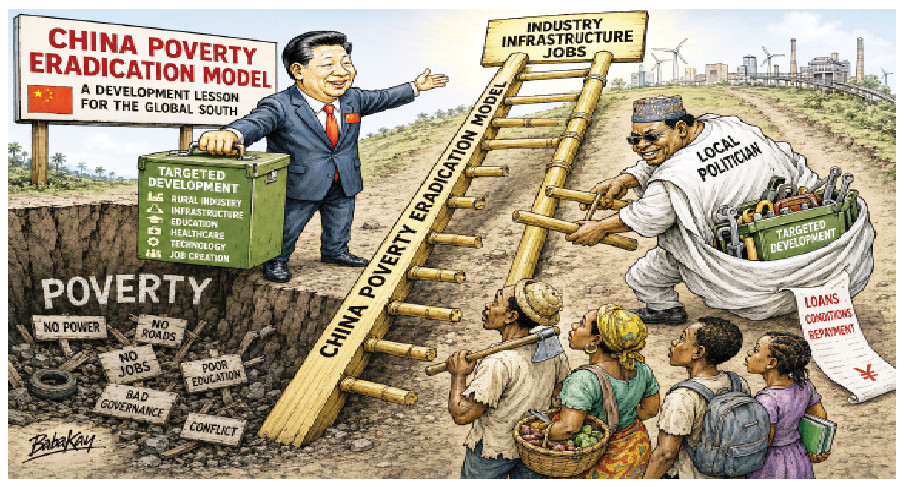
One particularly fascinating aspect of the training, in my own estimation, was the focus on China’s poverty eradication model. I strongly believe that the subject matter offers a practical approach for many impoverished countries worldwide, including Nigeria, where no fewer than one hundred and thirty-three million people—comprising 63% of its population—live in what the government itself described as multidimensional poverty.
Studying the China model for poverty eradication, indeed, provides vital comparative frameworks for other developing nations. The local research and policy reviews highlight how these strategies can inspire inclusive socioeconomic planning in third world countries.
From 770m poor to zero
During a two-hour lecture on ‘China’s Experience on Poverty Eradication’ LI Xin, Deputy Director General of the country’s International Poverty Reduction Centre (IPRC), offered a blow-by-blow account of how China navigated it’s way out of poverty.
In February 2021, President Xi Jinping declared that China had eradicated absolute poverty. He stated that by the end of 2020, China had lifted 98.99 million rural residents out of poverty over eight years, based on its national poverty line of 2,300 yuan per person per year at 2010 price levels.
All 832 designated impoverished counties and 128,000 impoverished villages were removed from the poverty list. Interestingly, China has established a five-year transition period to prevent people from falling back into poverty. By mid-2025, targeted assistance had been provided to over 6 million people at risk of relapse. The government also invested 850.5 billion yuan in infrastructure, education, and healthcare in formerly poor areas.
China, a heavily populated nation, experienced one of the darkest periods of poverty in modern history, enduring widespread hardship in rural areas. By 1978, over 770 million people were living in poverty, with a poverty rate exceeding 97.5%.
So, how was it possible for China to eradicate absolute poverty? “China’s achievement in poverty eradication is the result of a planned, organised, phased and sustainable effort”, Xin said.
Xin noted that in 1986, China initiated significant agricultural reforms, established a dedicated poverty alleviation agency, and identified impoverished areas and counties. Less than 10 years later, in 1994, China introduced the Priority Poverty Alleviation Programme, aiming to lift 80 million people out of poverty within 7 years.
Since 2000, China has implemented various poverty alleviation policies, including the full participation of individuals from 150,000 impoverished villages in poverty reduction efforts, promoting business development, and training and transferring rural labour.
Targeting infrastructure, industries
Among the practical measures taken by the Chinese government to eradicate poverty were prioritising infrastructure investment, fostering a supportive environment for new businesses and industries such as e-commerce, photovoltaic power generation, and rural tourism, and, most importantly, encouraging the consumption of products and services from the rural poor.
The Asian country invests significantly in infrastructure, particularly in road construction and social services. Roads link rural areas, boosting economic activity by facilitating the movement of goods and services. In China, at least 1.1 million kilometres of rural roads have been built or improved. Schools and health centres have been connected to the power grid to enhance access to electricity. Today, every village in China has electricity.
Through dedicated leadership rooted in patriotism, discipline, and thoroughness, the country adopted effective poverty alleviation strategies. These initiatives began with infrastructure development, improved financial services in rural areas, the construction of schools and health centres, and the establishment of a basic social security system. Building on this foundation, China implemented regional development strategies that helped it emerge from absolute poverty. It did not only built infrastructure but it also teach the poor skills that helped them be self-reliant through targeted poverty alleviation programmes.
Infrastructure deficit, health crisis and lack of education are part of the root causes of poverty. Conscious of this, the Chinese government mobilised three million dedicated party officials to live in the poorest villages and working with individual households to address them. The result? China has eradicated absolute poverty.
Countries in the global South can, without doubt, eradicate poverty if their governments prioritise providing access to electricity. Currently, about 655 million people, of whom a staggering 85% live in sub-Saharan Africa, lack access to electricity. China has set an example: to eradicate poverty, prioritise access to electricity.
Essentially, China classified poor households by income while accounting for key issues such as housing, education, and health. Are they educated? Do they have access to healthcare? What is the condition of their housing? Answers to these questions determine if a resident qualifies as being below the poverty line. The aim is to identify truly vulnerable individuals. While this process is quite straightforward, corruption often makes it appear complicated for most public officials in countries of the global south.
As Xin highlighted, China’s poverty alleviation strategy addresses five key questions: 1) How to identify the poor, 2) Who is responsible for providing support, 3) How to deliver support, 4) How to exit poverty, and 5) How to ensure people stay free from poverty.
None of these measures is difficult for countries in the global south, which are still battling endemic poverty, to implement. This is an undisputed fact. Why, then, has it been challenging for countries in the global south to tackle poverty directly? The answer lies in implementation issues and widespread endemic corruption across most of these nations. Despite possessing substantial resources, citizens often do not feel the benefits.
Besides developing practical strategies, China established institutional safeguards that helped achieve significant milestones in poverty eradication. These include an accountability system, social mobilisation, assessment, and multi-channel, all-year-round supervision.
Just adopt the Chinese model
Countries of the global south can adopt the Chinese model of poverty eradication and, most importantly, ensure they design and implement pro-poor policies with clearly defined strategies to assist the impoverished populations.
Nigeria’s experience includes establishing the National Poverty Eradication Programme (NAPEP) and now, the Ministry of Humanitarian and Poverty Alleviation, with the sole aim of ending poverty. Yet, after years of funding and rhetoric, the country still has about 133 million citizens, representing 63% of its population, living in multidimensional poverty.
In his The Wealth of Nations, Adam Smith said, “No society can surely be flourishing and happy, of which the far greater part of the members are poor and miserable”. The global south remains in constant distress because many are battling abject poverty despite having enormous resources. The world possesses enough resources that abject poverty anywhere cannot be justified.
China, through its steadfast commitment to shared prosperity, has demonstrated leadership by tackling poverty with a strong focus on infrastructure development, empowering the poor through people-centred policies, and establishing and adhering to a poverty reduction standard tailored to its specific circumstances.
One thing is clear: China’s poverty eradication approach provides a model. Other countries, especially in the developing world, should learn from China. The best time to have done so was years ago. The next best time is now.
New SSCE Fee
After the backlash, the Bola Tinubu government reversed its earlier directive to raise SSCE registration fees to ₦50,000 from N27, 000. At a time when lack of access to education and poverty have been linked to insecurity, violent extremism, and crime, rather than make education more accessible, the government took a step that, had it not been reversed, would have forced thousands of children, especially those from poor families, out of school.
A country with so many children out of school because parents cannot afford it; a country where 133 million people, or 63 percent of the population, live in multidimensional poverty, has no reason to increase SSCE fees. Nations serious about expanding education and supporting poor citizens would never do that. Even though the decision was reversed, it is shocking that the government considered it at all. Inconsiderate is an understatement!
We’ve got the edge. Get real-time reports, breaking scoops, and exclusive angles delivered straight to your phone. Don’t settle for stale news. Join LEADERSHIP NEWS on WhatsApp for 24/7 updates →
Join Our WhatsApp Channel