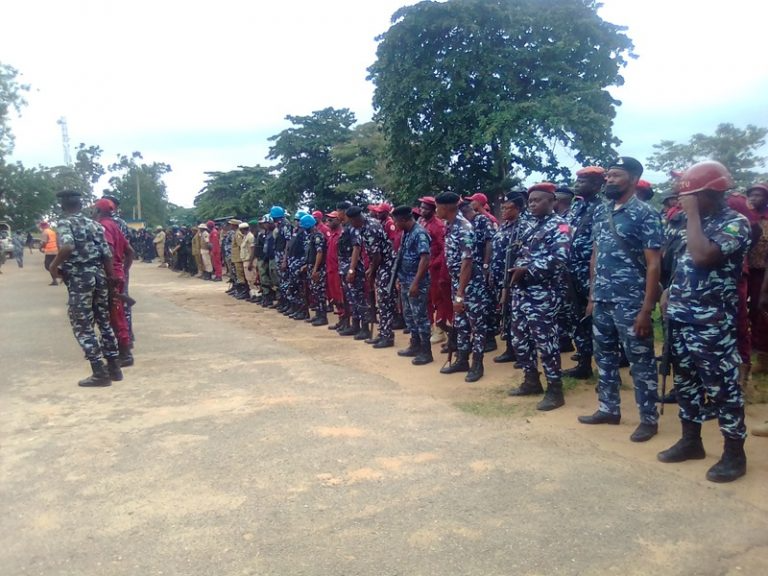
Nigeria’s security crisis is no longer an abstract concern – it is a ticking time bomb. The Chief of Army Staff (COAS), Lieutenant General Taoreed Lagbaja, recently exposed Nigeria’s lacklustre approach to its worrisome security challenges when he revealed that the country has a dismal total of two million security personnel for a population of 200 million.
Even though he reaffirmed the armed forces’ commitment to tackling the nation’s precarious security situation, he did not mince words in warning that it is “unrealistic to expect that size of security personnel to adequately protect a population exceeding 200 million.” Lagbaja made this assertion while delivering the 2024 Distinguished Personality Lecture in Ilorin, the Kwara State capital.
As a newspaper, we fully agree with the army chief that the figure is far too minimal to make any meaningful impact because the security challenges before all of us are too daunting.
In fact, it would not be out of place to declare that Nigeria is sitting on a keg of gunpowder, and the fuse is burning rapidly.
The country’s security situation has reached catastrophic levels, with banditry, terrorism, kidnapping, cattle rustling, and separatist movements threatening to tear the fabric of the country apart.
Yet, the staggering reality is that Nigeria’s two million security personnel are woefully inadequate to protect its 200 million citizens. The COAS should be applauded for speaking truth to power on this issue.
Although some downplay the continuous reliance on massive troop deployments in an age of technology, we assert that the physical presence of troops in every corner of the country builds public confidence and deters criminals.
The figures are grim. The United Nations recommends a minimum of one police officer for every 450 citizens. Nigeria’s ratio is a dismal 1:750, leaving millions vulnerable to the mercy of criminals. Compare this to developed countries such as the United States (1:240) and the United Kingdom (1:270). The disparity is not just troubling – it is perilous.
Even then, numbers alone do not tell the whole story. Nigeria’s security forces are plagued by corruption, nepotism, and incompetence.
The travails of Nigeria’s security system begin with the recruitment process, which, in our view, is compromised, with wealthy individuals and politicians hijacking the exercise to favour their cronies.
Merit is sacrificed on the altar of connections and cash. The result? Inefficient and ineffective security personnel who cannot safeguard citizens.
In the same vein, poor remuneration and lack of basic amenities have demoralised security personnel and made the armed forces unattractive to younger Nigerians.
The few who do join, do so not out of choice but because they have no other employment options. When given the opportunity, rather than serve, they turn security checkpoints into cash points.
It is shocking to note that soldiers in the Nigerian Army earn less than paramilitary personnel, while the families of fallen heroes are callously evicted from quarters. Young Nigerians, particularly from marginalised regions, are increasingly disillusioned with the prospect of joining the armed forces.
The consequences are dire. Insecurity has crippled economic growth, with investors fleeing and businesses shutting down; humanitarian crises have escalated, displacing millions and exacerbating poverty.
Additionally, social cohesion is fraying as ethnic and regional tensions simmer.
These issues must no longer be downplayed, particularly by the federal government, which controls the armed forces and the police.
We strongly suggest that the 64th Independence anniversary be used by our political leaders, especially President Bola Tinubu, to retool the security system.
Regardless of the reasons or explanations, two million security personnel are insufficient to adequately police the country given its landmass and the scale of insecurity in the nation. We need more boots on the ground.
We, therefore, challenge the Nigerian government to acknowledge the gravity of this crisis and take drastic measures, such as an immediate overhaul of the recruitment process to prioritise merit and transparency.
The government should also increase funding for security infrastructure, equipment, and training.
It should also implement competitive remuneration and benefits for security personnel. Soldiers and other security agents on the front lines should no longer be neglected by their superiors, who enjoy the luxury and comfort of their offices while those who speak out are court-martialled.
Furthermore, we call for the immediate establishment of state police to address regional security concerns. Similarly, the government should foster community engagement and intelligence gathering and address the socio-economic inequalities driving insecurity.
The clock is ticking on Nigeria’s security crisis, and the consequences of inaction are too dire to contemplate. Without immediate and comprehensive reforms, the country risks a catastrophic collapse of law and order.
We’ve got the edge. Get real-time reports, breaking scoops, and exclusive angles delivered straight to your phone. Don’t settle for stale news. Join LEADERSHIP NEWS on WhatsApp for 24/7 updates →
Join Our WhatsApp Channel