In many rural communities across Nigeria, women and girls cannot afford the luxury of sanitary pads. Without access to affordable menstrual products, clean water, or safe sanitation, they turn to rags, old newspapers, or even leaves to manage their periods. Each month, they risk infections, discomfort, and shame all for something as natural as menstruation. Behind their silent suffering lies a deeper story of neglect, inequality, and the high price of being a woman in poverty.
Every month, 17-year-old Amina Ahmed dreads the same week, not because of the cramps or discomfort that come with her menstrual cycle, but because she has to choose between buying food for her siblings or a pack of sanitary pads she can barely afford. In her small village in northern Nigeria, where a pack costs more than a day’s wage, Amina makes do with torn pieces of cloth washed in murky water and dried behind the house, away from prying eyes and judgment.
Across many rural communities in Nigeria, thousands of women and girls face the same painful choice. Poverty has turned a natural biological process into a health hazard. Behind every whispered conversation about menstruation lies a deeper story of inequality, silence, and the fight for dignity.
When we say sanitary pads have become a luxury for rural Nigerian women, we mean that something as fundamental as menstrual protection , a necessity tied to women’s health, dignity, and confidence , has slipped beyond the reach of many. What should be a basic aspect of healthcare has turned into a costly privilege, forcing women and girls in low-income or rural communities to resort to unhygienic alternatives. The rising cost of pads, coupled with poor access to clean water and proper sanitation, means that every menstrual cycle becomes a test of endurance and dignity.
A 2023 UNICEF report revealed that one in ten African girls misses school during menstruation due to a lack of sanitary materials or adequate facilities , a figure likely higher in Nigeria’s rural areas, where schools rarely have separate toilets or running water.
“I don’t blame them,” said Mrs. Grace Eze, a teacher at a government school in Bmuko, a rural community on the outskirts of Abuja. “Our toilets are filthy, and when a girl stains her uniform, others mock her. Many simply stay home during their periods.”
The result is a quiet but dangerous pattern , poor menstrual hygiene leading to infections, absenteeism, and widening gender inequality. Each monthly flow becomes a daily struggle, forcing girls to choose between education and embarrassment, and women between nourishment and dignity. What should be a basic necessity has tragically become a luxury item, reserved for those who can afford
it, while millions continue to bleed in silence, unseen and unheard.
In many rural markets, the rising cost of sanitary pads tells a silent story of exclusion. What was once a simple monthly purchase has now slipped beyond the reach of millions of women.
At the Kuje market in Abuja, a trader, Zainab Sani spreads different brands of sanitary pads across her wooden stall, ranging from ‘Always” Ladycare , etc The cheapest pack sells for N900 , a price that keeps many of her customers away. “Before, girls used to buy pads regularly, now, they come and ask for the price, shake their heads, and walk away. Some even ask if I sell tissue instead.”
For families earning less than N800 a day, a pack of pads competes with food, water, and transport. Faced with such hard choices, mothers often prioritise feeding their families over buying menstrual hygiene products.
At the Gwagwalada Market, 42-year-old mother of four, Mariam Abdullahi, sat behind a small table piled with second-hand clothes. Between attending to customers, she shared her own struggle. “Pads are too expensive,” she said. “Sometimes I use rags or cotton wool. If I wash them well, I can reuse them again next month. But if there’s no water, I just try to manage.”
For Mariam and many others, “managing” often means enduring discomfort and the constant fear of leakage in public. Some women with heavy flow double their clothing layers or stay indoors until their period ends. “When there’s no money, you can’t buy pad and still buy food. Hunger comes first,” she added quietly.
Another respondent in the Kabusa area of Abuja, Miss Ijeoma Paul, told LEADERSHIP Weekend that “health, they say, is wealth., but that does not apply in our case. I have pieces from a wrapper I condemned. I had to cut my wrapper into smaller pieces to complement the tissue I buy. You know, times are hard. Sometimes using only tissue isn’t enough, because there are moments when you laugh or take tea or even an orange, and you end up being embarrassed with period stains.
She said, “Just picture a scenario where someone whispers to your ear that your dress is messed up, especially when it’s a man. Sometimes, out of shame, we don’t even put these cloth pieces out in the sun to dry; we hide them indoors, which is dangerous to our health.”
In Masaka, a community in Nasarawa State, a teenager who gave her name only as Marnie told our correspondent that she uses newspapers to manage her monthly flow. Similarly, in Gurku, Jankawa, and Jeun communities in Nasarawa, some respondents who pleaded not to be named, said they resort to using pawpaw leaves, sack bags, and sponge leaves as makeshift pads because they simply cannot afford sanitary products.
Health experts say this trade-off between food and hygiene has far-reaching consequences. According to Nurse Okonkwo, who has worked in primary healthcare for over ten years, cases of vaginal infections and urinary tract infections (UTIs) are on the rise among rural women.
She said, “You’ll see women complaining of itching or discharge, and when you ask, they tell you what they use during menstruation. Some even use nylon or baby diapers. It’s risky, but they have no choice.”
Nurse Okonkwo said, “When sanitary pads become a luxury, it’s not just about blood , it’s about health and dignity. A woman’s ability to manage her period safely is a human right.”
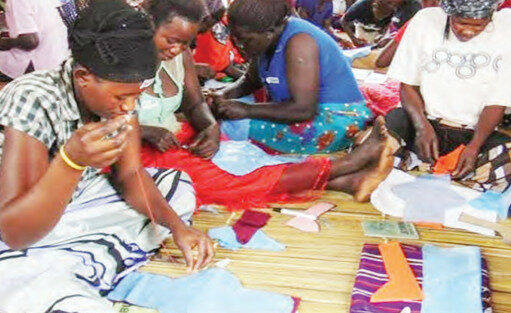
Some community-based organisations have tried to fill the gap by teaching women and girls to make reusable cloth pads. But these efforts are often small-scale and underfunded. In most villages, knowledge about safe menstrual practices remains limited, and deep-seated taboos around menstruation continue to persist.
In the face of these challenges, a few grassroots initiatives and concerned citizens are emerging to restore dignity and health to women and girls in rural communities through their Pad- Girl project.
One of them is , Ashley Lori, founder of Pad-Up Africa, has spent years tackling period poverty across the continent. Since 2018, her organization has reached over 13,000 women and girls in Nigeria, Niger, Ghana, Gambia, Rwanda, and Kenya through education, advocacy, and menstrual product distribution.
Beyond access, myths and stigma persist. This is because some brain washed young women believe that using pads causes infertility or that menstruating women are unclean. Poverty makes it worse. She revealed.
She said, “Our main focus is on menstrual hygiene management,” she says. “We teach good hygiene practices, provide sanitary products, and train communities to produce reusable pads so girls can stay in school.” But Lori says access and affordability remain major barriers in rural areas. “Many women can’t afford pads or even find them. Some use rags, old clothes, cow dung, or dig holes to sit in.
It’s not just unhygienic, it’s dangerous.”
Other experts also emphasise the need to normalise discussions about menstruation, in homes, schools, and workplaces to break the cycle of stigma and silence that keeps many women & young girls suffering.
On her part, Joyce Marcus, the founder of Pin up the Girl Child Initiative, believes there’s a mindset problem even among adults. ‘We need awareness everywhere not just for students’. Her frustrations, however, extend beyond the girls themselves. “Sometimes when I drop pads in schools for the girls, the teachers share them among themselves,” she said
Joyce, who has visited schools across Jaba, Zangon Kataf, and Kachia local government areas, began this work after her own experience in a public boarding school. She teaches girls about menstrual and personal hygiene,” she said. “After the sessions, I distribute free sanitary pads because many of them can’t afford to buy even one pack.”
Joyce’s visits have revealed how deeply stigma, ignorance, and poverty combine to harm girls’ health. “Many can’t talk to their parents when they have problems,” she said. “One girl told me she hadn’t seen her period for three years even though she wasn’t pregnant. It turned out she had a serious infection.
These beliefs isolate them,” Joyce explained. “They make something natural look like a curse.”
Joyce believes the Nigerian government should step in to make sanitary pads free or affordable for all women. “Sex is optional, but menstruation is not,” she said passionately. “Condoms are free in hospitals, yet women must pay for pads. Some girls need two or three packs every month because of heavy flow. How can poor families afford that?”
Girls and women, particularly those in the rural areas must understand the dangers of using unsafe alternatives during menstruation. Rags, newspapers, leaves, cow dung, and other makeshift materials may seem like temporary solutions, but they put the body at serious risk of infections, rashes, and long-term reproductive health issues. Where possible, if families can afford basic necessities such as Christmas and sallah food , farm produce , clean clothes, and access to water, they should prioritise menstrual hygiene as a critical part of health and dignity.
Protecting oneself during menstruation is not a luxury , it is essential.
At the same time, the government must rise to the challenge. Ensuring access to affordable sanitary products, clean water, and safe sanitation facilities is not just a public health issue; it is a national imperative. A healthy, educated, and empowered female population is key to building a fertile, productive, and representative nation. Failing to address period poverty threatens not only women’s health and education but the broader social and economic development of the country
We’ve got the edge. Get real-time reports, breaking scoops, and exclusive angles delivered straight to your phone. Don’t settle for stale news. Join LEADERSHIP NEWS on WhatsApp for 24/7 updates →
Join Our WhatsApp Channel