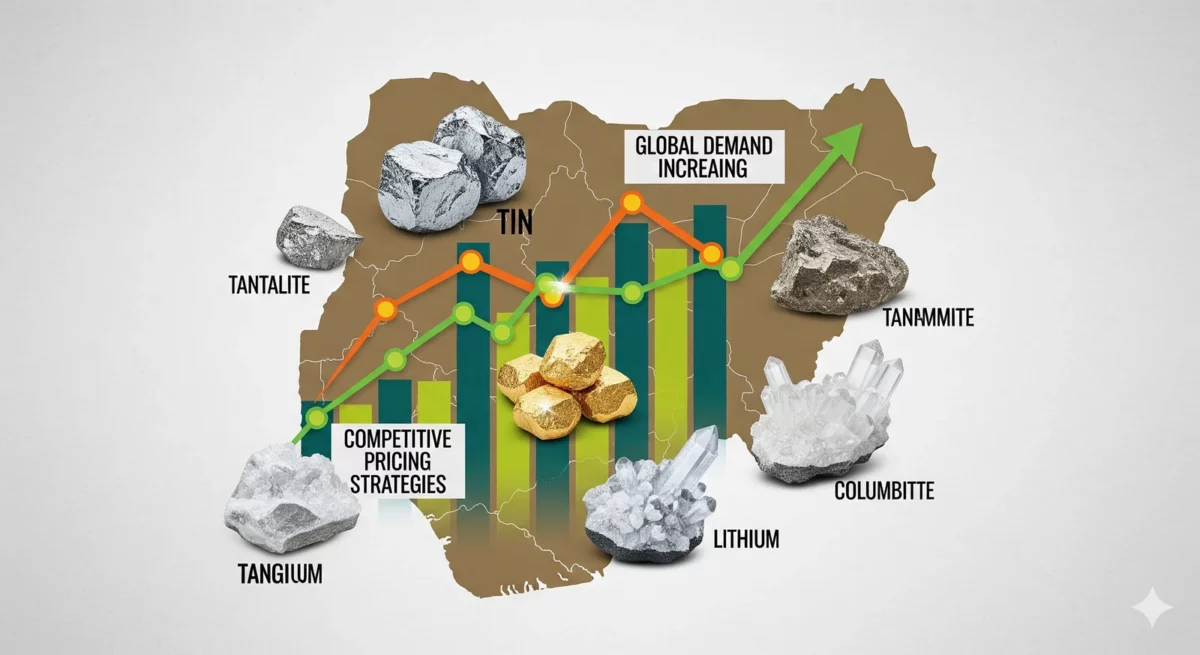
Global demand for raw materials, the essential inputs for manufacturing everything from electronics to energy technologies, underwent notable shifts in 2025, reshaping supply chains and testing the resilience of resource-dependent economies, particularly across Africa and in Nigeria.
Worldwide consumption patterns are shifting amid slowing growth in major economies, geopolitical realignment, and a rapid shift toward green and high-tech industries. China, long the world’s largest importer of commodities such as iron ore and industrial metals, is moderating demand as its economic model evolves and infrastructure spending cools. This transition has had knock-on effects on global commodity prices and the strategies of supplier nations.
According to a commodities economist based in Lagos, Dr Halima Yusuf, China’s recalibration is forcing exporters to rethink long-standing assumptions. “For years, African producers planned around China’s insatiable appetite for raw materials. That era is changing, and countries that fail to adapt will feel the pressure through lower prices and unstable revenues,” she said.
At the same time, demand for energy commodities and high-tech intermediate goods remains strong in advanced economies, where renewable energy technologies, electric vehicles and semiconductors are now central to industrial policy. Soft commodity markets, including sugar, coffee, cocoa and cotton, have become increasingly volatile, driven by climate disruptions, macroeconomic uncertainty and shifting consumer behaviour, leaving producers exposed to sharp price swings.
In the technology space, geopolitical tensions have intensified the push for supply-chain diversification. Analysts note that this is particularly evident in the race for rare earth minerals, which are critical for wind turbines, electric vehicle batteries, smartphones and advanced defence systems. Africa hosts significant deposits of rare earths, lithium and other strategic minerals, drawing increased attention from global manufacturers seeking alternatives to traditional suppliers.
“Africa is no longer just about oil and cocoa. Rare earths and green minerals are becoming the new frontier. Still, the risk is that we repeat the same old model, exporting raw ores and importing finished products at a premium,” said a resource governance analyst in Accra, Kwajo Mensah.
Africa sits at the centre of these dynamics, endowed with minerals and agricultural products vital to global manufacturing and the green energy transition. Minerals such as cobalt, copper and emerging rare earth deposits, alongside key agricultural commodities, have positioned the continent as an attractive partner in supply diversification. However, this advantage remains double-edged. Many African economies continue to rely heavily on the export of unprocessed raw materials, capturing only a small share of the value generated along global manufacturing chains.
Shifts in demand from major markets, particularly China and Europe, often lead to price volatility, complicating fiscal planning and export earnings across the continent. While emerging demand for green and rare earth minerals offers new strategic opportunities, experts warn that weak infrastructure, regulatory uncertainty and limited processing capacity could prevent African countries from fully benefiting.
Nigeria reflects these broader continental challenges. Despite its vast natural resource base, the country’s manufacturing sector remains heavily dependent on imported raw materials. In the first half of 2025 alone, Nigeria reportedly spent about ₦3.53 trillion on imported manufacturing inputs, nearly 20 per cent higher than the same period a year earlier, with close to 70 per cent of inputs sourced from abroad.
Manufacturers point to high energy costs, exchange-rate volatility and inadequate local processing capacity as major obstacles to domestic sourcing, despite government policies aimed at import substitution. “It is cheaper for many factories to import semi-processed inputs than to source locally. Until power supply, logistics and financing improve, local raw material utilisation will remain limited,” said a representative of a major manufacturing association, Seun Odulaja.
Economists also warn that Nigeria’s continued export of unprocessed agricultural produce and minerals, including emerging deposits of lithium and rare earth elements, limits broader economic gains.
“Value addition is where the real money and jobs are,” said the CEO of the Centre for the Promotion of Private Enterprise, Dr Muda Yusuf. “If Nigeria can process even a fraction of its minerals locally, the impact on employment, exports and foreign exchange would be significant,” he said.
Regional trade integration offers a possible pathway forward. Under the African Continental Free Trade Area, Nigeria could benefit from expanded regional markets for raw materials and manufactured goods, provided local industries scale up to meet demand and compete effectively across borders.
As global manufacturing recalibrates its appetite for raw materials, Africa and Nigeria face a defining choice. Rising demand for green technology inputs, rare earth minerals and diversified supply chains could unlock new opportunities, but only if long-standing structural constraints are addressed. For Nigeria, sustained investment in local processing, industrial infrastructure and regional trade linkages may determine whether its raw material wealth drives broad-based development or continues to serve primarily as fuel for factories elsewhere.
We’ve got the edge. Get real-time reports, breaking scoops, and exclusive angles delivered straight to your phone. Don’t settle for stale news. Join LEADERSHIP NEWS on WhatsApp for 24/7 updates →
Join Our WhatsApp Channel