While many traders in Anambra State avoid businesses on Mondays in solidarity with IPOB and its leader, Nnamdi Kanu, others stay away from markets out of fear that their businesses will be looted. OKECHUKWU OBETA reports.
Traders and their customers in virtually all the markets in Onitsha, the commercial hub of Anambra State, will not forget in a hurry the one-week closure of the Onitsha Main Market by the state governor, Prof Chukwuma Soludo.
Not only are the traders and customers in the Onitsha Main Market affected by the governor’s sledgehammer, but the action also impacts negatively on other business operators in the commercial town.
LEADERSHIP Weekend learnt that the closure of the market affected neighbouring markets, as many customers travel from far places like Kano, Maiduguri, Bayelsa, and even other West African countries to purchase goods from those markets, as the various markets sell distinct goods.
For instance, a commercial tricycle operator, Chinonso Ezekiel, who operates from Upper-Iweka through Oguta-New Market Road to Ose Market, told LEADERSHIP Weekend that they have been recording low passenger patronage since the Onitsha Main Market was closed.
“When you go round the whole of Onitsha, you will notice that people are not as many as they used to be because the Main Market is not open. Because the governor closed the Main Market, the traders and their customers are not coming.
“You know that some customers come from many places to the Main Market to buy something. Some come from Asaba, Enugu, Owerri; some come from Benue, Bayelsa, Kano, Maiduguri. But they are not coming because they heard that the government has closed down the Main Market for one week,” he stated.
Asked if he knew the reason the governor shut down the Main Market, he said, Yes. He, however, blamed the governor for taking the action.

“The governor came to the Main Market and said that he is closing down the market because the traders are not opening on Mondays because they are obeying IPOB’s ‘sit-at-home’ order.
“So, why is the governor forcing people to do their business?
“They said that they are doing sit-at-home because of Nnamdi Kanu, who is in prison. Everybody knows that what the government is doing to Nnamdi Kanu is not good. Nnamdi Kanu is fighting for the Igbos. Why can’t the government release him?,” he queried.
LEADERSHIP Weekend observed that there were low business and social activities in Onitsha, including other markets that were not closed down by the governor.
The markets included the nearby Ose Market, Ochanja Market, Ogbogu Head Bridge Market and Relief Markets. Street market operators also witnessed low patronage.
Most popular discussions among people in the commercial town centred on the Main Market closure, particularly the governor’s threat to revoke the rights of all shop owners and recover the market for reconstruction if the traders continued to lock up their shops to observe sit-at-home on Mondays.
Some traders in the Main Market have bemoaned that the market closure has resulted in huge losses for their businesses and also affected their domestic responsibilities.
A dealer in safety wear, Mr Chukwugozie Chima, said he has lost about N2 million in business due to the market closure. He lamented that some of his customers had contacted him to say they would purchase safety wear by the end of this month, but that, because of the market closure, they would go elsewhere to buy it.
“I sell safety wear to companies. And some of my customers said that they will come at the end of January to buy some wears. And see now, the governor came on Monday and closed down the Main Market, saying it won’t open for at least a week. What it means now is that I will miss my customers, as they will not wait for me until the market opens after one week. They will go to another place to buy,” he lamented.
His greatest pain, according to him, is that he had planned to pay his shop and house rent from the gains he anticipated making from the sales.
Some other traders who decried the market closure included one young man who gave his name as Ije-Uwa, a dealer in Chinos and T-shirts; Emeka Okonkwo, a dealer in baby wear; Mrs Ijeoma Okeke, a petty trader in the Main Market who said she relocated from Kano in Kano State in 2012, where she was selling clothes due to incessant riots.
Another trader who also complained of huge losses due to the closure was Mrs Nneka Anyakora, who said she deals in baby wear. She lamented that the market closure came just as she was expecting to recover from the Christmas and New Year celebration expenses.
Anyakora also lamented that the loss of business patronage during the one-week closure would have an adverse effect on her business, as her trading capital would deplete.
Both Ije-Uwa and Okonkwo accused the governor of high-handedness for suddenly shutting down the market. While Ije-Uwa said he was already perfecting plans to relocate to America, Okonkwo said he would relocate to Canada with his family.
He said that he has a wife and two children: a boy and a girl.
“Why should Soludo force any trader to open his shop? Is he the one who set up the business for the person? If hoodlums come and loot our wares or destroy them, will he pay for them? He boasted that he would revoke any trader’s license for refusing to open on Monday. This is intimidation.
“I have started making plans to relocate to Canada with my wife and my children.
“I will hand over any property I have here to my lawyer to manage for me,” Okonkwo said.
Meanwhile, the traders have expressed mixed reactions to the vexed issue of having to close their shops every Monday to observe a sit-at-home, contrary to the directives of the state government.
While a few of those who spoke with LEADERSHIP Weekend said the action was a mark of solidarity to the agitation of the separatist group, Indigenous People of Biafra (IPOB) and for the release of the group’s leader, Mazi Nnamdi Kanu who is currently serving a life jail having been convicted of acts related to terrorism, most said that their staying away from the markets was to avoid being attacked and their goods destroyed by IPOB members.
But the state governor had during a press conference at the Government House, christened “Light House” on Wednesday, three days after shutting down the Onitsha Main Market, insisted that the Monday sit-at-home being observed by traders in the market and in the other major markets across the state was deliberately orchestrated to sabotage the economy of the state.
Soludo particularly insisted that some political opponents were behind the sit-at-home and even vowed to make public the names of such unscrupulous politicians whenever he deemed it necessary.
He argued that the sit-at-home order has nothing to do with showing sympathy for IPOB or the travails of its leader, Nnamdi Kanu.
The governor said that when he visited Nnamdi Kanu at Kuje Prisons shortly after IPOB ordered the Monday sit-at-home, Kanu personally agreed that the action would have an adverse effect on the economy of the South East zone and would unleash severe hardship on the people, especially the poor. So, he (Kanu) ordered that the sit-at-home should not be halted.
“So, sit-at-home ended about three years ago after I personally visited Nnamdi Kanu at the Kuje Prisons. He ordered that the sit-at-home should not be observed. He said that such action would sabotage the economy of the South East Zone and impoverish the people,” Soludo said.
The governor said that he thereafter established a Peace and Conflict Resolution Committee and later declared amnesty for criminal elements.
He also said that his administration later initiated a youth employment programme tagged “One Youth, Two Skills”, deliberately designed to empower and create jobs for the youth. He said that over 15,000 youths have benefited from the programme.
Soludo also dismissed fears of insecurity as the reason for traders abandoning their shops every Monday to observe sit-at-home, arguing that the state is the most secure nationwide. He added that about 150 internal security operatives were stationed at the Onitsha Main Market.
“So, I want to know if it is the security operatives in the Main Market that are the problem of insecurity in the market,” Soludo stated.
He further argued that the reason for the traders closing their shops every Monday could not be associated with any fear of insecurity, citing an instance that during the preparations for the last Christmas and the New Year celebrations, traders in Onitsha, including the Main Market, operated their businesses every Monday, Saturday and even on Sundays with no security breach recorded.
He, therefore, expressed the belief that there were deliberate plots to undermine the economy of the state and, indeed, the South East region at large.
He therefore warned traders in the markets in Onitsha to be ready to open their shops on Mondays or risk losing them through government revocations.
“If push comes to shove, I will revoke the rights of owners of the shops in the Onitsha Main Market, reconstruct it and transform it into an Agunechemba (state government vigilante) office annexe,” he said.
He dismissed threats of possible legal action against the state government by traders over his shutting down of the market, stating that the state government owns the market and therefore, has the right to revoke the rights of the shop owners, pay them whatever compensation and acquire the area to “overriding public interests.”
Most traders, however, insisted that, contrary to the governor’s claims of tight security in the state and markets, the main market is highly vulnerable to attacks by hoodlums.
For instance, Mrs Anyakora said that the Onitsha Main Market has no central entrance gate but multiple entrances.
“Criminals can easily plan their attack, penetrate the market, strike, and run away freely through any of the entrances. The Main Market is porous.
“The security we have in the market cannot even stop the criminals when they come. What do they have that they can use to fight them? What the security operatives in the market are doing is working for the government and market leaders. They are helping them to collect revenue and not to protect traders against any attack,” Anyakora said, corroborating the views of other traders.
Virtually all the traders who spoke with our correspondent complained that the fear of a possible sudden attack by hoodlums enforcing sit-at-home was the major reason traders observe sit-at-home, citing the abduction and killing of the chairman of Old Motor Spare-parts Ngbuka-Amazu, Chief Francis Enibe, in 2023. They said the sad incident occurred when Soludo first ordered traders to open their shops in defiance of the IPOB sit-at-home order.
They said that Enibe, as the market chairman, had ordered all the traders to open their shops in accordance with Soludo’s directive. They said that at about 9.30 am on that fateful Monday, 2023, a group of hoodlums enforcing sit-at-home stormed the Old Motor Spare-parts market in Ngbuka-Amazu, abducted Chief Enibe and later killed him.
Chairman of Reliefs Market Ogbaru, Chief Ndubuisi Ochogu, who confirmed the incident in an interview with LEADERSHIP Weekend in his shop at the market on Thursday said that the most painful thing about the Enibe’s death was that the state government had not done anything to make sure that his killers were arrested to face the wrath of the law for their evil action or even asked about his family members.
“We were in this market conducting prayers that very day the incident happened. Before those criminals came, we got information that they were planning to come and attack us because the governor said that we should start opening the market on Mondays.
“When we heard that they were planning to come, we went and reported to the Area Commander. So, the Area Commander responded immediately and sent his men to us. We also made our own arrangement here.
“So, because they (hoodlums) saw that we were ready for them, they diverted to Old Motor Spare-parts Ngbuka-Amazu, where Chief Enibe was mobilising his traders to open their shops. They took him by surprise and abducted him, and since then, we have not seen him. Since that incident, many traders have been staying away from the markets, even though we open the market here every Monday.
“What I normally do is buy drinks and chips for those who are able to come every Monday.
“But many traders do not come to open their shops because they are afraid,” Ochogu added.
He, however, assured that traders will heed the latest warning by the state governor and start coming to the Market on Mondays.
He told LEADERSHIP Weekend that during a meeting of chairmen of all major markets in the state with the governor, which he attended at the International Conference Centre (ICC) on Thursday, the governor briefed them on the government policies in the markets and directed them to go and make sure that traders in their respective markets complied with the directive.
Ochogu stated that one of the directives is that every shop owner must open their shop every Monday; otherwise, such a trader risks losing the shop through revocation by the government.
In his reaction, Okonkwo said that although they have not recorded any attack by the enforcers of the Monday sit-at-home in the Onitsha Main Market so far, the majority of traders have decided to stay away from markets on Mondays to avoid being attacked or having their goods destroyed.
He also said that they have become accustomed to not going to market on Mondays because, over time, they have found Monday to be the day that offers them the opportunity to have true rest.
“Before we go to market from Monday to Saturday. And we have only Sunday to rest. But we have discovered that even on Sundays, we don’t rest, because after going to church, that is the day you attend meetings again. So, we don’t rest on Sundays.
“But since we started the sit-at-home on Mondays, we found out that we are really having a good time resting.
“Before we started Monday sit-at-home, people were always slumping in the Main Market. But since the Monday sit-at-home began, we have not heard of anyone slumping in the Main Market. This is because people are using Mondays to get a good rest.
“So, let the governor allow the Monday sit-at-home to continue”, Okonkwo pleaded.
Also reacting to the governor’s order for traders to compulsorily open shops on Mondays, a chainsaw dealer at the Bridge Head Market, Chief Peter Okala, blamed insecurity in the market on poor leadership.
He said that the use of caretaker committees to manage markets led to arrangements in which leaders do not protect traders’ interests but rather their own and the government’s.
He suggested that major market stakeholders should be given critical roles in managing markets.
Okala stated that the fear of possible attacks by hoodlums enforcing sit-at-home is no longer necessary because, according to him, the current administration of Soludo has decimated the criminals.
LEADERSHIP Weekend observed on Thursday that operatives of Udo Ga-chi, a combined security team including the Police, Civil Defence, and Agunechemba, heavily armed to the teeth, have taken over the markets in Onitsha and barricaded every entrance leading into the various lines in the market.
Though they allowed people to pass through the market streets, they didn’t allow anyone to approach any shop or attempt to open one.
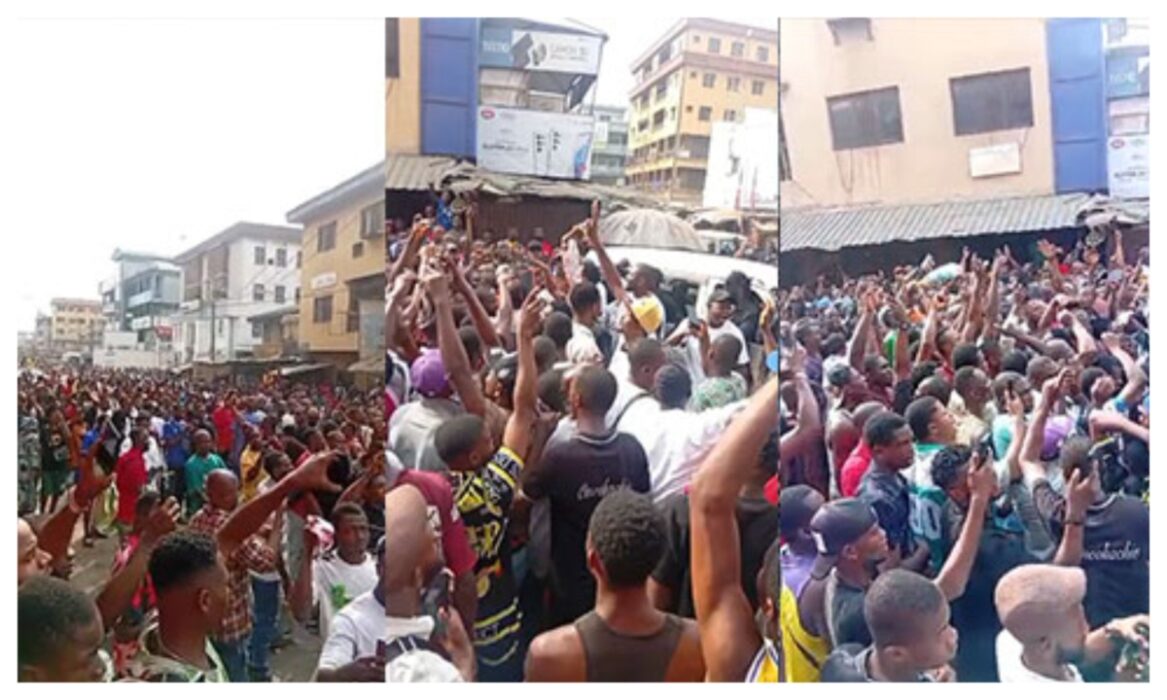
No casualties were reported, though traders protested on Tuesday against the market closure.
Some traders even threatened that at the expiration of the one-week closure on Monday, they would not open shops.
“Just wait and see what will happen on Monday. We are mobilising our people. No amount of security personnel can force any trader to open shop in the Main Market on Monday,” one of the traders threatened. Many other traders also issued a similar threat.
We’ve got the edge. Get real-time reports, breaking scoops, and exclusive angles delivered straight to your phone. Don’t settle for stale news. Join LEADERSHIP NEWS on WhatsApp for 24/7 updates →
Join Our WhatsApp Channel