Whether you are a typical Lagosian or a visitor to Nigeria’s bustling commercial hub, the sight of these men and boys can haunt you both day and night, given their notorious ability to unleash chaos across the city. In this report, SAMUEL ABULUDE and ABIODUN SIVOWAKU delve into the harsh living conditions of the homeless youths in Oshodi, the sprawling illicit drug trade, and the dangers that have turned this once-thriving barracks into a hotspot of crime.
Oshodi is a bustling transportation hub and commercial district on the mainland of Lagos, Nigeria. The area serves as a vital link connecting key parts of the city, including Ikeja, Mushin, and Mile 2. Home to numerous markets and businesses, Oshodi sees millions of people pass through daily , whether commuting for work, running errands, or pursuing other tasks essential to their livelihoods.
With thousands of people moving on foot through Oshodi daily, the area is considered one of Lagos’ highest-risk zones, ranking among the state’s top crime hotspots. It is particularly notorious for petty theft, pickpocketing, one-chance robberies, and gang-related violence. While the Oshodi Transport Interchange has brought some improvements in safety, the district remains a haven for extortion by local area boys and other opportunistic crimes especially after dark.
Railway Showdown: Crossing Paths With Oshodi’s Notorious Area Boys
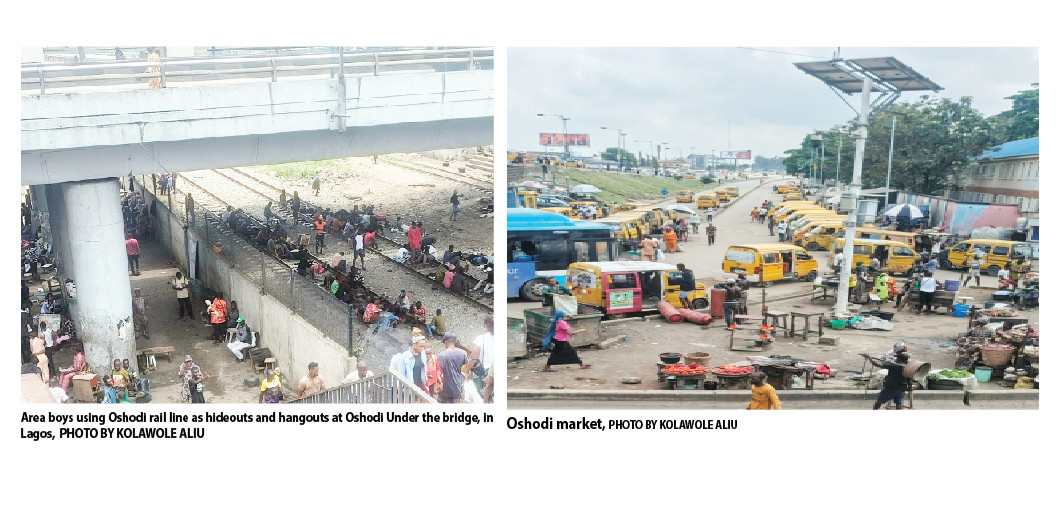
The Oshodi market area is a vibrant, and chaotic, a mix of activity, almost like a living theatre. Legitimate traders ply their goods, while groups of men sell illicit drugs at strategic corners. Pedestrians carefully navigate the crowd, wary of pickpockets, while transporters and agberos hustle to make a living. Adding to the scene, traffic officials try to maintain order, and mobile police vans are stationed at major hubs, ready to respond in case of a crisis or outbreak of violence.
Amid the chaos of Oshodi, the railway tracks tell a different, darker story. Here, the area boys operate with near-total impunity, preying on anyone who dares to pass through. On a recent visit, the tension was palpable, shouts, jeers, and the sharp movements of men on the lookout created a sense of constant threat. Pedestrians hurried along the tracks, glancing nervously over their shoulders, knowing that a single wrong step could invite confrontation with these notorious youths.
LEADERSHIP Sunday correspondents met with area boys who practically live along the railway tracks, having claimed a section of the underground and sealed it off with barbed wires as their makeshift shelter. This hidden enclave has become a stronghold, giving them a sense of control and security while operating openly in the heart of Oshodi.
Inside their barbed-wire enclave, life is harsh and cramped. Makeshift shelters of corrugated iron sheets and tattered fabrics serve as bedrooms, while the smell of smoke and refuse hangs in the air. By day, some scavenge or hawk small items, but most are entrenched in drug use and petty crime, maintaining a constant lookout for intruders or law enforcement. Nights are even more perilous, as disputes flare, and the tracks become a stage for confrontations that can escalate in seconds. For these youths, survival is a daily battle, shaped by desperation, neglect, and the absence of opportunities.
Investigations revealed that these boys, along with a few young women aged between 14 and 40, have long made the railway section their permanent abode, turning the tracks into a semi-permanent community hidden in plain sight.
By day, the youths engage in a mix of petty hustles like hawking small goods, collecting scrap, or begging from passersby, but the backbone of their survival is the illicit drug trade. Many are both users and sellers, creating a self-sustaining but destructive cycle. The young women, some barely in their teens, are often drawn into these activities, either as companions of the boys or to earn a living amid the harsh conditions.
Life here is dictated by the tracks: scarce food, constant vigilance against rivals or police, and the unrelenting pressure to survive in an environment that offers little hope for the future.
Looking ruffled and unhealthy, the so-called ‘railway home boys’ appeared as a mix of the homeless and the desperate, with no visible means of livelihood. As we cautiously moved along the railway tracks, we summoned the courage to approach them, aware that any misstep could provoke hostility in this unpredictable enclave.
We tracked down their leader popularly referred to as the “King of Boys” in a viral video interview, but it proved to be a herculean task. The name was either unfamiliar to most in the area, or deliberately concealed out of fear of arrest, making our pursuit as risky as it was uncertain.
Our correspondents gathered that after a five-minute video interview which shed light on the survival struggles of the area boys went viral, the railway enclave was raided twice by the task force, and several members were arrested. The remaining boys we met were wary and cautious, keen to avoid arrest. Their leaders, aware of our presence, were curious about what assistance we could offer, as homelessness and unemployment remained their most pressing challenges.
One of the ring leaders said, “We don’t want people to come here and take pictures of us or ask questions. That was what the video guy promised but the government who saw the video came here to raid. They destroyed our tables and arrested many here. I am a painter and I stayed here with my wife. We don’t have anywhere to live. My wife cooks here on the railway to sell indomie to people but the government sent a task force here after they saw the video and destroyed many of our things and even burnt our clothes.”
Looking helpless, one of their leaders, named Segun, said, “What we want the government to do for us here is that they should provide for us shelter. Also they should try and provide for us jobs that we can do because we know staying on the rail is not ideal for us. We for sure know it is not everyone who likes living this kind of life.”
“We know some of us who use the railway as shelter have families. Bad behaviour makes some run away from their parent’s houses to be living here. We know some whose family can take care of them but because of their stubbornness make them end up staying here.”
”I am appealing to the public, you are the only one who can help us and take our plea to the government to come to our rescue. I learnt how to do vulcanising about four years ago, and because I don’t have tools to start with. I never practiced it. If now, I can see people who can help me, so that I can start living a good life, I will appreciate it. So we don’t have somewhere else to sleep. Come sun or rain, this is where we live. If we need to take our bath, we go to the public toilet and pay N100. These are our stores and we are crying for help. We are not happy being here. It’s just circumstances that brought us here”.
Another, respondant, called Wasiu, narrating his story, said, “I learnt panel beating work but I left it many years ago. And if I can get a job that I can do and can survive on, I will leave this railway, I am ready to do that.”
“Some of us survive by doing conductor work for some commercial drivers who don’t have conduct. Some of us are engaged as agbero who call passengers into the bus, some carry loads for people, while some pick pet bottles and from there, whatever we get we use it to survive daily. We can only call on the government to help us. We also have ladies who sleep here. Some have gone to sell in the market”.
One of the homeless girls we encountered, named Rachel, in her twenties and looking unhealthy from drug use, affirmed that she sleeps in the bunker under the railway, where most of the youths have made their shelter at night.
“This is where I manage. I sleep under the railway. I don’t have a shelter,” she said.
“This is where I lay my head. I came out to get some medicine because I’m not feeling well. I hawk pure water for living and that can’t even afford me to get a house. So I sleep under the railway stand at Oshodi,”says Rachel.
When asked where she came from, she said, “I came from Ondo State to Lagos to come and work and I don’t have any family here in Lagos. So if I hawk, the money I realise I will use it to take care of myself,” says Rachel .
But the stories and challenges of these homeless boys and girls in Oshodi are replicated at Obalende under bridge, Berger pedestrian bridge, Iyana Ipaja, Mushin, Ajah and other areas in Lagos as the population of Lagos has skyrocketed.
The Many Faces Of Lagos: A City Battling Its Own Complexities
Indeed, youth involvement and drug prevalence in Lagos are alarming, yet there appears to be no comprehensive strategy to curb it or address the root causes effectively
Homelessness in Lagos has become a critical and growing crisis. According to reports, an estimated half a million people live under bridges, in slums, or in abandoned buildings. Driven by rapid urbanisation, extreme poverty, and a massive housing deficit, this vulnerable population, largely women, children, and youths, faces daily struggles to survive, often compounded by forced evictions carried out by state authorities.
Indeed, tackling the menace of homeless boys and drug abuse in Lagos, who pose serious security threats is no easy task. On the issue, Lagos State Commissioner for Information and Strategy, Gbenga Omotoso, said, “This is a complex issue that yet needs to be confronted.
People are getting into drugs, and we see the effects all over the place.
People are wondering how it is so. People are wondering how the drug is so available, and people have easy access to it, so people are just going down the gutter, especially our young people. In a recent video, we saw people sleeping during the day on railway lines and wondered if such people want to commit suicide.”
”The Lagos State government has been doing a lot about this issue to take our young people off drugs with a lot of programs it is embarking on. But with the recent video, you will ask yourself again if the government is really doing something at all. The government is doing many things, such as Youth Kick Against Drug Abuse. It also visits schools and streets on this drug issue, and yet the issue persists.”
Also speaking on the issue, the Lagos State commissioner for Youth and Social development, Mobolaji Ogunlende “Drug abuse is a pandemic, and it is as bad as COVID-19 or even worse. At the national level, it must be declared an emergency. Once it is treated as such, every state can take responsibility, making it easier to safeguard Lagos.
“We already have blueprints from past administrations, but today’s context is different. Migration has increased, and the social media era amplifies issues sometimes turning them into tribal concerns. Implementation is therefore more complex, but we continue to work on the blueprint. In the past, drug use was hidden. Now it happens openly on the streets, sometimes even with security escorts. This makes enforcement more difficult. Lagos cannot fight this alone; porous borders mean substances flow in from neighbouring states and countries. A holistic national approach is required, involving all security agencies, NGOs, and governors across the 36 states.”
Lagos State Deputy Governor, Dr. Obafemi Hamzat had in November 2024, pointed out that over 6,000 people enter Lagos daily, with approximately 3,000 of them staying permanently. This high rate of inward migration contributes to an estimated population of 27 million, significantly straining the state’s infrastructure and resources.
It is said that roughly 3,000 people stay daily in Lagos with no known address. The population growth creates immense pressure on housing, with many arriving in a city where over 70% live in substandard conditions.
Lagos State is facing millions of homeless people who have come from other states for greener pastures. With these challenges come other issues like high rents in major areas that even those working with a form of livelihood cannot cope with the present exorbitant rent compared to their salaries. The minimum wage of civil servants cannot suffice.
A public analyst, Mr. Femi Ogundeyi said that the Lagos State government should rise up to the occasion and tackle the housing problem and other issues in Lagos. “We have not seen a major housing policy for the masses in Lagos. Are they saying it cannot be done? We will continue to have these problems if buildings like those built by former Governor Jakande cannot be replicated with the opportunity for innovation that we have. Also other states should take care of their economic climate and care for their youths as this will reduce the migration to Lagos,” he said.
LEADERSHIP Sunday writes that beneath the chaos and crime, the plight of these area boys reflects deeper social failings. Most are driven to the railway tracks by homelessness, poverty, and the absence of stable jobs, leaving them with few options for survival. With little government intervention or community support, many have been forced to carve out their own dangerous ecosystem, selling drugs, engaging in petty crime, or depending on scavenging, simply to endure day by day. For them, the tracks are both a shelter and a trap, offering a precarious existence with no clear path to a safer, more productive life.
We’ve got the edge. Get real-time reports, breaking scoops, and exclusive angles delivered straight to your phone. Don’t settle for stale news. Join LEADERSHIP NEWS on WhatsApp for 24/7 updates →
Join Our WhatsApp Channel