
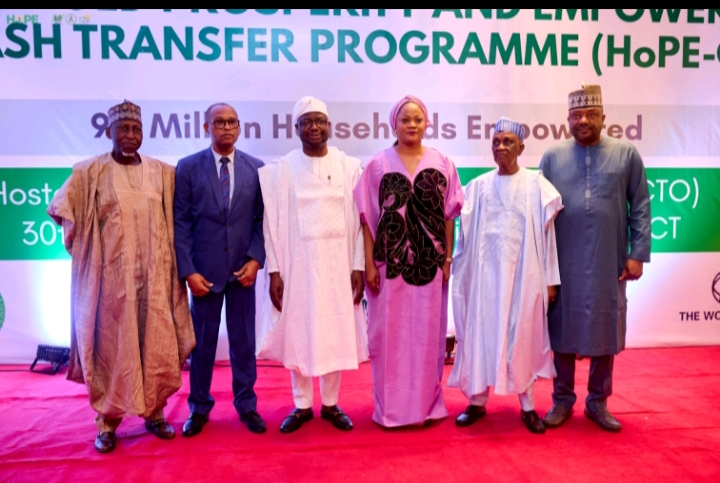
The federal government has announced that a total of 9,178,837 households have so far benefited from the Household Prosperity and Empowerment Cash Transfer (HoPE-CT) Programme, with over ₦229 billion disbursed to vulnerable Nigerians since its inception in November 2023.
This disclosure was made on Monday at a Ministerial Press Conference in Abuja, where top government officials provided a comprehensive scorecard of the National Social Safety Nets Project – Scale-Up (NASSP-SU), a key social intervention under President Bola Tinubu’s Renewed Hope Agenda.
The event brought together ministers from key ministries, development partners, and the media.
The National Programme Manager of the National Cash Transfer Office (NCTO), Abdullahi Alhassan Imam, who welcomed stakeholders, emphasised that the initiative was about more than just statistics.
“At its core, the National Cash Transfer Programme is about people. It is about families who need support to stay afloat in difficult times, and about giving them a fair chance to build better lives,” Imam stated.
He disclosed that the programme, funded by an $800 million loan from the International Development Association (IDA) of the World Bank, aims to reach 10.4 million households, a target the government has already increased to 15 million.
Providing a detailed breakdown, the minister of Humanitarian Affairs and Poverty Reduction, Dr. Bernard M. Doro, outlined the scale of the intervention.
“As of today, 9,178,837 beneficiaries have received the first tranche, 7,203,579 beneficiaries have received the second tranche, and 6,497,089 beneficiaries have received the third tranche,” Doro said.
He explained that each eligible household receives a total of ₦75,000 over three months to meet essential needs for food, healthcare, and education.
“These are not just numbers. They represent millions of Nigerian households whose dignity is being restored, whose resilience is being strengthened, and whose hope is being renewed,” he added.
Doro emphasised that the programme is built on a foundation of transparency and accountability, with all beneficiaries captured in the National Social Register and verified using their NIN or BVN.
He noted a significant gender focus, with 58.7 percent of beneficiaries being women.
“When you empower a woman, you strengthen a household. When you strengthen a household, you stabilize a community. And when communities are stable, nations prosper.
“Let me be unequivocal: this programme is completely free. No Nigerian should pay any money to be registered, enrolled, or benefit. Any individual demanding payment is engaging in criminal activity, and we are working closely with security agencies to investigate and prosecute such cases,” the minister said.
Doro further outlined the government’s long-term vision to institutionalise the National Social Register as the single, authoritative platform for all social interventions, transforming the NCTO into a robust national delivery system aimed not just at managing poverty, but at ending it.
Representing the minister of Information and National Orientation, Mohammed Idris, the director of Protocol, Dr Haruna Suleiman, lauded the achievement while urging the media to focus on the human impact of the programme.
“As the primary focus of this engagement, 9.2 million beneficiaries is a significant achievement, but we must look beyond the statistics to isolate individual beneficiaries and tell their before-and-after stories,” he said.
He charged journalists to be dispassionate and avoid partisanship, adding, “As storytellers, we must amplify this human angle; we must tell these stories in such a way that they rekindle hope in our people and trust in our government. Renewing hope is President Bola Ahmed Tinubu’s primary agenda.”
In her opening remarks, the minister of State for Humanitarian Affairs acknowledged the collaborative effort behind the programme, highlighting the presence of the minister of Finance, the minister of Women Affairs, and the minister of Budget and Economic Planning, calling it a true whole-of-government approach.
The permanent secretary of the ministry delivered the vote of thanks, specifically acknowledging the National Identity Management Commission (NIMC) for integrating the National Identification Number into the National Social Register, an effort he said has “significantly enhanced the accuracy, transparency, and integrity of beneficiary targeting.”
We’ve got the edge. Get real-time reports, breaking scoops, and exclusive angles delivered straight to your phone. Don’t settle for stale news. Join LEADERSHIP NEWS on WhatsApp for 24/7 updates →
Join Our WhatsApp Channel