
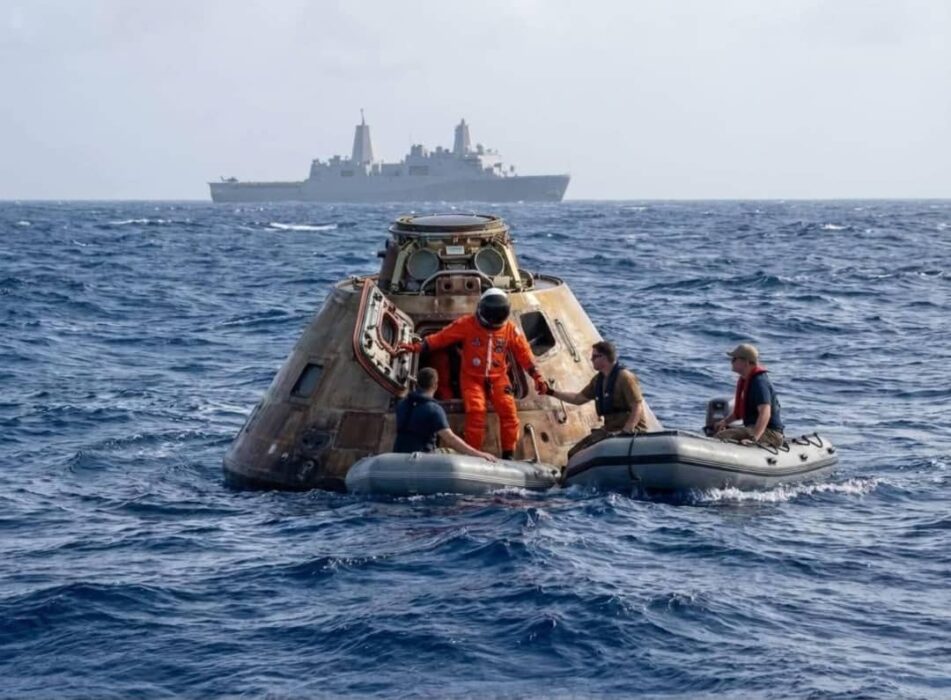
Astronauts aboard Artemis II have safely returned to Earth after re-entering the atmosphere at speeds of about 25,000mph (40,000km/h), splashing down off the coast of California.
The crew — Reid Wiseman, Christina Koch, Victor Glover, and Jeremy Hansen — travelled deeper into space than any humans in history, surpassing the previous record set during Apollo 13 by more than 4,000 miles.
Despite the physical and mental strain associated with space travel, astronauts often described the experience as life-changing and deeply fulfilling.
Speaking before landing, Koch acknowledged the challenges of life in space, noting that the discomforts were worthwhile.
“The inconveniences, such as freeze-dried food or a toilet without much privacy, were worth it,” she said.
Upon splashdown, the astronauts were immediately examined by medical teams aboard a US Navy recovery ship before being airlifted ashore by helicopter. They were expected to be flown to Johnson Space Center in Houston for further evaluation and rehabilitation.
Experts said time spent in microgravity can significantly impact the human body, leading to muscle and bone density loss.
The muscles most affected include those in the back, neck and calves, which are essential for posture on Earth.
Although astronauts adhere to strict exercise routines while in space, some muscle loss is unavoidable. Studies show that muscle mass can decrease by up to 20 per cent in just two weeks.
However, analysts noted that the Artemis II mission duration was relatively short compared to extended stays aboard the International Space Station, where astronauts typically spend five to six months. As a result, the long-term health effects on the crew are expected to be minimal.
Astronauts are trained to maintain emotional resilience, and there are unlikely to be significant psychological challenges following their return.
Koch said she would miss the shared sense of purpose experienced during the mission.
She noted that viewing Earth from space reinforced a sense of global unity.
“Seeing our planet surrounded by the blackness of space truly emphasised how alike we are, how the same thing keeps every single person on planet Earth alive,” she said.
Many astronauts, including Helen Sharman, have previously expressed reluctance to return to Earth due to the excitement of working in space.
The crew is expected to reunite with their families following medical clearance.
Commander Wiseman, who has been raising his two daughters since the death of his wife in 2020, had prepared his family for the risks of the mission before departure.
The splashdown phase is widely regarded as one of the most dangerous stages of space travel, heightening relief among family members upon the crew’s safe return.
Catherine Hansen, wife of Jeremy Hansen, said their children were eager to reunite with their father.
“We certainly will have a celebration… When Jeremy is back safely, we will absolutely come together. First just the five of us in a quiet environment to hear some of those private stories, and then we will absolutely celebrate with the world,” she said.
NASA has not disclosed specific post-mission plans for the astronauts. However, all four remain eligible for future missions under the Artemis programme, including Artemis III in 2027 and Artemis IV in 2028, which aim to return humans to the Moon.
Meanwhile, Donald Trump, who initiated the Artemis programme during his presidency in 2017, has invited the crew to the White House for an Oval Office reception.
“I’ll ask for your autograph, because I don’t really ask for autographs much, but you deserve that,” he told them.
He also promised to give the astronauts “a big salute on behalf of the American people and beyond that.”
Following extensive global media coverage and viral social media attention, the Artemis II astronauts are expected to return to significantly heightened public recognition.
Observers say adjusting to newfound fame may be one of the more unexpected challenges awaiting the crew after their historic journey beyond Earth.
We’ve got the edge. Get real-time reports, breaking scoops, and exclusive angles delivered straight to your phone. Don’t settle for stale news. Join LEADERSHIP NEWS on WhatsApp for 24/7 updates →
Join Our WhatsApp Channel