There was a quiet sense of arrival in the air as dignitaries, policymakers, and industry leaders gathered in Abuja for the commissioning of the new headquarters of the Nigeria Revenue Service. It was not just another government event. It felt like a turning point—subtle, but significant.
The expansive auditorium of the new complex told its own story even before the speeches began. Soft lighting reflected off polished surfaces.
Rows of neatly arranged seats stretched across the hall, filled with a cross-section of Nigeria’s economic leadership—ministers, governors, private sector executives, and development partners.
Conversations were measured, almost reflective, as if those present understood they were witnessing something more than a ceremonial ribbon-cutting.
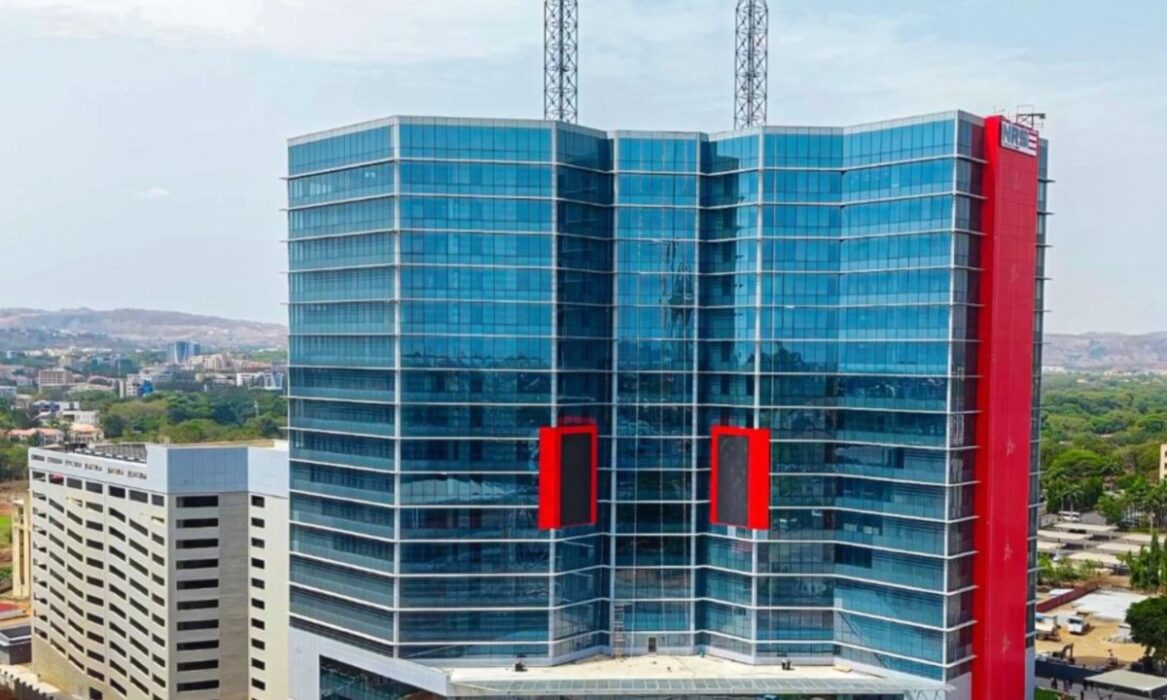
At the centre of it all stood a structure that has already begun to redefine the visual identity of Nigeria’s fiscal institutions. Rising in three distinct towers, with 16 floors and capacity for over 3,000 personnel, the new NRS headquarters is both imposing and elegant.
Its glass façade catches the Abuja sun with a quiet confidence, while its clean architectural lines suggest order, discipline, and intent.
Inside, the design leans toward functionality without sacrificing aesthetics. Wide corridors, modern workspaces, integrated digital systems, and a layout built for collaboration all signal a deliberate shift from the bureaucratic congestion that has long defined public sector offices.
There is a sense that this building was not just designed to house workers—but to improve how they work.
That, perhaps, is the central message of the entire project.
Speaking at the commissioning, President Bola Ahmed Tinubu framed the moment as part of a broader national journey—one anchored on reform, discipline, and institutional renewal.
His remarks were less about bricks and mortar, and more about what they represent. “We are not gathered here merely to commission a building,” he said. “We are here to mark a milestone in strengthening our fiscal foundation and rebuilding confidence in public institutions.”
It is a point that resonates strongly in Nigeria’s current economic context. For years, the country’s revenue challenges have been well documented—low tax-to-GDP ratio, fragmented systems, weak compliance, and limited trust between the state and taxpayers.
Addressing these issues has required not just policy changes, but a rethinking of the institutions responsible for revenue collection.
The emergence of the NRS, and now its headquarters, appears to be part of that rethinking.
In his address, Executive Chairman Zacch Adedeji described the building as the physical manifestation of a renewed fiscal vision—one built on structure, credibility, and long-term sustainability. His words captured the deeper narrative behind the project: that reform must be seen, felt, and institutionalised.
Indeed, the headquarters stands as a symbol of a broader transformation already underway within Nigeria’s fiscal space.
Over the past year, the Tinubu administration has embarked on sweeping reforms—unifying foreign exchange markets, streamlining over 60 tax laws, tightening public financial controls, and modernising trade systems through initiatives such as the National Single Window. These measures, while sometimes difficult, have begun to reshape Nigeria’s economic outlook.
The early signs, as both the President and Adedeji noted, are encouraging. Improved fiscal stability, rising foreign reserves, and renewed investor confidence are gradually replacing the uncertainty that once defined the macroeconomic environment.
But beyond the macro numbers lies a more fundamental shift: the attempt to build institutions that can sustain these gains.
This is where the NRS headquarters becomes more than an architectural statement.
A centralised, technologically equipped facility has the potential to significantly improve coordination across departments, reduce inefficiencies, and enhance data integration—critical elements in modern revenue administration.
With over 3,000 staff working within a unified system, the opportunities for faster decision-making, better compliance monitoring, and more effective enforcement increase considerably.
In practical terms, this could translate into higher revenue mobilisation without necessarily increasing tax rates—an approach the administration has repeatedly emphasised.
Equally important is the role such a facility can play in changing public perception.
For many Nigerians, tax administration has historically been associated with opacity, inefficiency, and frustration.
A modern headquarters—backed by digital systems, transparent processes, and improved service delivery—offers an opportunity to reset that narrative.
President Tinubu touched on this directly, noting that no government can demand trust when taxation is perceived as unfair or inefficient. The new NRS, he insisted, must go beyond collection to embody fairness, accountability, and responsiveness.
That expectation places a significant responsibility on the institution.
But it also highlights the strategic importance of the headquarters itself. By providing an environment that supports professionalism and efficiency, the building becomes an enabler of behavioural change within the organisation.
There is also a broader economic dimension to consider.
Efficient revenue collection is the backbone of any functioning state. It determines the government’s ability to invest in infrastructure, fund social services, and respond to economic shocks. In Nigeria’s case, improving domestic revenue mobilisation is particularly critical given the volatility of oil revenues and the country’s growing development needs.
A stronger NRS, supported by modern infrastructure, could therefore play a pivotal role in driving sustainable economic growth. It could also enhance Nigeria’s attractiveness to investors.
Clarity and predictability in tax administration are key factors in investment decisions. By streamlining processes and improving transparency, the NRS can help create a more business-friendly environment—one where companies can plan with greater certainty and confidence.
This aligns with the administration’s broader goal of building an economy that rewards enterprise and supports growth.
Yet, as several speakers at the event acknowledged, infrastructure alone is not enough.
The real test will lie in how effectively the NRS leverages this new facility to deliver results. Efficiency, transparency, and trust cannot be designed into a building—they must be practiced daily.
Adedeji himself emphasised this point, describing the headquarters not as an endpoint, but as a foundation. Its true value, he noted, will be measured by the quality of service it enables and the level of trust it builds between the government and the people.
That sentiment was echoed in the atmosphere of the event itself.
As guests moved through the building after the formal ceremony—taking in its scale, its design, and its quiet sense of order—there was a shared recognition that this was a statement of intent. A declaration that Nigeria is serious about fixing one of the most critical aspects of its economy.
It is, in many ways, a bold statement.
For a country long challenged by revenue constraints, the decision to invest in a facility of this scale reflects a belief that institutions matter—that how government works is just as important as what it does.
It also reflects a growing understanding that economic reform is not just about policies, but about systems and structures that can sustain those policies over time.
As the sun set over Abuja on the day of the commissioning, the glass towers of the NRS headquarters stood illuminated—calm, steady, and purposeful.
They are, ultimately, more than just buildings. They are a test.
A test of whether Nigeria can translate ambition into execution. Whether reforms can move from paper to practice. Whether institutions can rise to meet the expectations of a nation seeking progress.
For now, the signs are promising.
And if the vision articulated at the commissioning is realised, the NRS headquarters may well come to be seen not just as a landmark in Abuja—but as a cornerstone of Nigeria’s economic renewal.
We’ve got the edge. Get real-time reports, breaking scoops, and exclusive angles delivered straight to your phone. Don’t settle for stale news. Join LEADERSHIP NEWS on WhatsApp for 24/7 updates →
Join Our WhatsApp Channel