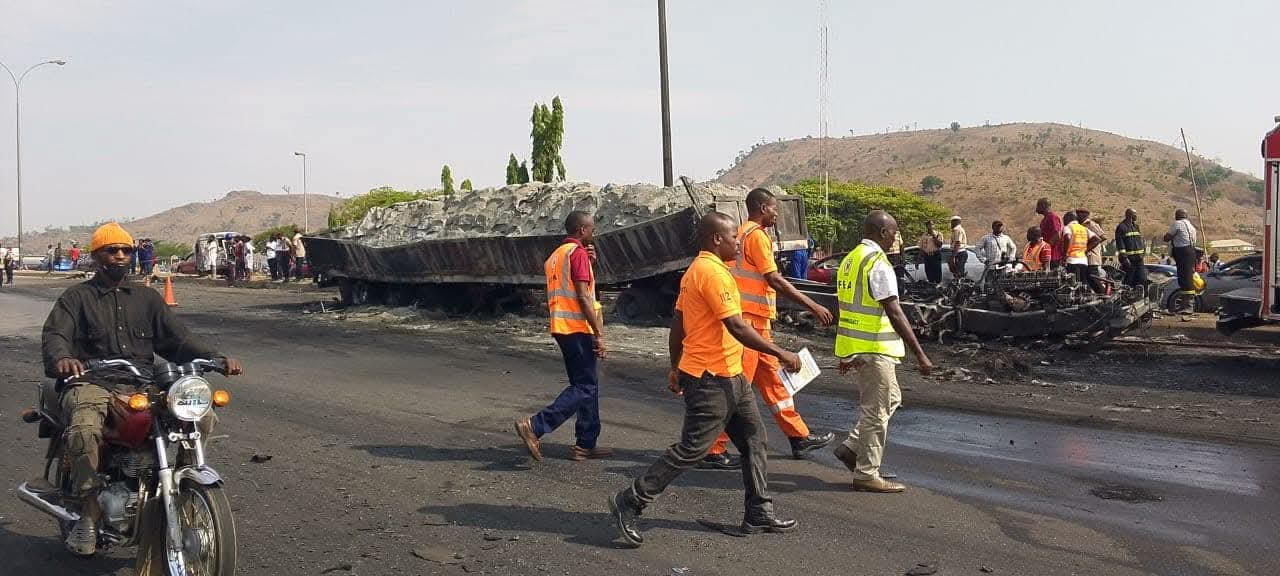
When the National Bureau of Statistics (NBS) released its road traffic data for the first quarter of 2026, the numbers should have triggered a near-nationwide emergency. They did not. Between January and March of this year, 1,347 Nigerians died on the country’s roads. Another 8,575 were injured, many of them maimed for life. A total of 2,720 crashes were recorded across all six geopolitical zones, a 2.64 per cent rise from the corresponding period in 2025.
These are not statistics. They are people ,breadwinners, students, mothers, children swallowed by roads that should have been safe enough to travel on.What makes these figures particularly chilling is the company they keep. At a time when Nigerians are dying in their hundreds from bandit attacks, terrorist raids, and communal violence, road crashes have become a parallel catastrophe running neck and neck with insecurity for the grim title of Nigeria’s leading killer.
The NBS data shows the North-West zone recorded 2,675 casualties in the quarter, the highest in the country. The North-Central was not far behind with 2,544. These are the same zones ravaged by banditry and farmer-herder violence. The roads are not sparing lives that insurgency is missing. That convergence of mass death demands a response that matches the gravity of the situation.
The gender dimension of these figures is also worth pausing on. Of the 1,347 killed, 1,076 were male ,nearly 80 per cent of total fatalities. Men dominate the injured count too, at 76.35 per cent of 8,575 persons hurt. The road, in Nigeria, is disproportionately a male killing ground, likely because men constitute the majority of commercial and long-distance drivers. That observation is not incidental; it should direct enforcement attention. Who is driving these vehicles? What conditions are they under? How long have they been on the road without rest? These are questions the authorities have never seriously answered.
The usual catalogue of causes ,overspeeding, overloading, poor road conditions, drunk driving gets recited after every report like a ritual. But there is a newer menace climbing fast up that list, and it is one the Federal Road Safety Corps has been extraordinarily slow to confront with the force it deserves. Nigerians are making and receiving calls while driving, and not just on local roads.
Yet the FRSC, which was established specifically to deal with road safety, has somehow drifted into becoming a revenue-generating agency, more interested in collecting fees, renewing licences, and issuing certificates than in the unglamorous, daily work of keeping drivers disciplined on the road. That drift has cost lives. The Corps must return to its core mandate, and the supervising ministry must ensure it does.
There is a more structural failure here, though one that goes beyond the FRSC. Nigeria has no serious accident investigation system. When a plane crashes in this country, investigators descend, wreckage is analysed, black boxes are retrieved, reports are written, and whatever one thinks of the follow-through ,there is at least a formal process of asking why. When 1,347 people die on the roads in three months, the dead are buried, the families mourn, and life moves on. No investigation desk. No root-cause analysis. No published findings. No corrective action directed at specific failure points.
In our view , this is not how a country that is serious about road safety behaves. Every fatal crash should have a formal investigation. The data exist ,the NBS report itself shows that serious crashes numbered 1,761 in the quarter, with fatal crashes at 714. That is a substantial pool of incidents from which patterns can be drawn, dangerous corridors identified, and policy interventions targeted. The absence of that process is a policy choice, and it is the wrong one.
Closely tied to this is the question of accountability. What happens to the driver who runs a red light and kills a family of four? In too many cases, very little. If the vehicle belongs to a powerful individual or a well-connected fleet operator, even less.
This newspaper has previously argued for manslaughter charges in cases where reckless driving results in death, and we make no apology for repeating that position. The law must communicate, loudly and unmistakably, that killing someone with a vehicle through reckless conduct is a crime with consequences not a misfortune to be settled with insurance adjusters and condolence visits. Where the evidence supports it, prosecutions must follow. Where convictions are secured, custodial sentences should not be an exception. When drivers know genuinely know that causing a fatal crash through negligence could put them in prison, the calculus around speeding, phone use, and overloading changes.
The NBS data further shows that 4,078 vehicles were involved in crashes in the first quarter, slightly up from 4,059 in the previous quarter. That incremental rise matters because it suggests the problem is not plateauing. Without deliberate intervention, the curve will keep climbing. And while the South-South recorded the least crashes at 137, that is cold comfort when the national aggregate keeps worsening.
It is past time to treat road deaths as what they are: a preventable public health crisis. The government must establish formal accident investigation structures. The FRSC must abandon its revenue fixation and enforce road rules with the consistency and seriousness the situation demands. Lawmakers must strengthen the legal framework around fatal negligence on the roads. And phone use while driving must be treated as the deadly behaviour it is not a minor traffic offence to be waved through or fined lightly.
Nigeria cannot absorb 1,347 road deaths every quarter and maintain any credible claim to responsible governance. The roads are killing Nigerians at scale, every single quarter, without pause. That is a policy failure, and those responsible for road safety policy owe Nigerians a serious, credible plan.
We’ve got the edge. Get real-time reports, breaking scoops, and exclusive angles delivered straight to your phone. Don’t settle for stale news. Join LEADERSHIP NEWS on WhatsApp for 24/7 updates →
Join Our WhatsApp Channel