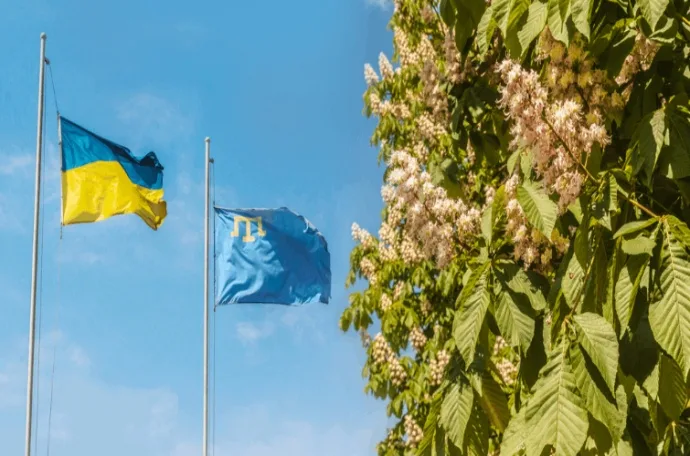
Ukraine has called on the international community to remember the suffering of the Crimean Tatar people and to stand against colonialism, even as it condemned historical persecution perpetrated by the former Soviet Union and current Russian occupation.
The Ambassador of Ukraine to Nigeria, Ivan Kholostenko, made this call as Ukraine commemorates the Day of the Crimean Tatar Flag, stressing that the global community must rise against forced displacement and the suppression of indigenous peoples,
In a statement marking the annual observance on June 26, the ambassador described the light blue Crimean Tatar flag bearing the golden tamga as a powerful symbol of memory, freedom and resilience, representing a people who endured centuries of persecution, deportation and attempts to erase their identity but refused to surrender their culture or dignity.
Kholostenko said the observance highlights Ukraine’s commitment to protecting the rights of all its people and preserving the country’s rich cultural and religious diversity.
He noted that although Ukraine is predominantly a Christian nation, it has for centuries been home to diverse ethnic and religious communities, including the indigenous Crimean Tatars, who are predominantly Muslims and remain an integral part of Ukraine’s history and national identity.
“The Crimean Tatars are a vivid example that modern Ukraine is built as a state that respects diversity, protects the rights of all its citizens, and regards cultural and religious pluralism as a source of strength rather than division,” he said.
The ambassador traced the origins of the Crimean Tatars to the Crimean Peninsula between the 13th and 15th centuries, noting that they established the Crimean Khanate in 1441, which was dismantled following the Russian Empire’s annexation of Crimea in 1783.
He said that before the annexation, Crimean Tatars constituted more than 92 per cent of Crimea’s population, but imperial policies gradually stripped them of their lands, religious freedoms and political rights while encouraging the settlement of other populations in the peninsula.
According to Kholostenko, those policies culminated in one of the darkest chapters in Crimean Tatar history on May 18, 1944, when the Soviet regime ordered the mass deportation of the entire indigenous population from Crimea.
He recalled that tens of thousands of Soviet security personnel carried out the operation, giving families only 15 to 20 minutes to gather their belongings before being forced onto trains bound for remote regions of the Soviet Union.
Most of those deported, he said, were women, children and elderly people because many Crimean Tatar men were fighting on the front lines during the Second World War.
“In total, 47,885 families—193,865 people, including more than 92,000 children under the age of 16—were deported, while the overall number of Crimean Tatars removed from their homeland exceeded 207,000,” he stated.
The ambassador said the deportees endured journeys lasting up to three weeks in overcrowded cattle wagons without sufficient food, clean water or medical care, resulting in thousands of deaths before they even reached exile.
According to official figures, nearly 30,000 Crimean Tatars died within the first 18 months after deportation, while estimates by the Crimean Tatar National Movement suggest that almost half of the deported population—46.2 per cent—perished during the first years of exile.
Beyond the physical deportation, Kholostenko accused the Soviet authorities of attempting to erase the Crimean Tatars from history.
He said 112 private libraries, 640 primary school libraries, 221 secondary school libraries and 861 Crimean Tatar schools were destroyed. Dozens of museums, theatres, newspapers and cultural institutions disappeared, while approximately 2,400 cemeteries were demolished and hundreds of Crimean Tatar place names were replaced.
The ambassador added that about 80,000 houses and 34,000 household plots belonging to Crimean Tatars were confiscated and have never been returned.
“The Soviet regime sought not only to deport the people but also to erase every trace of their existence by promoting the false narrative of an ‘eternally Russian’ Crimea and portraying the Crimean Tatars as a ‘traitor nation’,” he said.
Despite decades of forced exile, however, Kholostenko said the Crimean Tatars preserved their language, traditions and national identity, while building one of the Soviet Union’s most resilient human rights and national movements.
Following Ukraine’s independence, many Crimean Tatars returned to their ancestral homeland and began rebuilding their communities.
The ambassador, however, expressed concern that history has begun repeating itself since Russia’s occupation of Crimea in 2014.
He alleged that Crimean Tatars have once again faced political persecution, repression and attempts to alter the peninsula’s historical and cultural identity.
According to him, the significance of Crimean Tatar Flag Day extends far beyond Ukraine.
“It is a reminder to the entire world of the dangers of colonialism, forced displacement and attempts to destroy entire peoples by erasing their culture, historical memory and right to exist,” he said.
Kholostenko concluded that the light blue flag with its golden tamga now stands as a universal symbol of freedom, dignity and resilience.
“It honours those who died in exile, expresses solidarity with those who continue to defend their rights, and reminds us that a people who preserve their memory and dignity can never be erased,” he added.
We’ve got the edge. Get real-time reports, breaking scoops, and exclusive angles delivered straight to your phone. Don’t settle for stale news. Join LEADERSHIP NEWS on WhatsApp for 24/7 updates →
Join Our WhatsApp Channel