
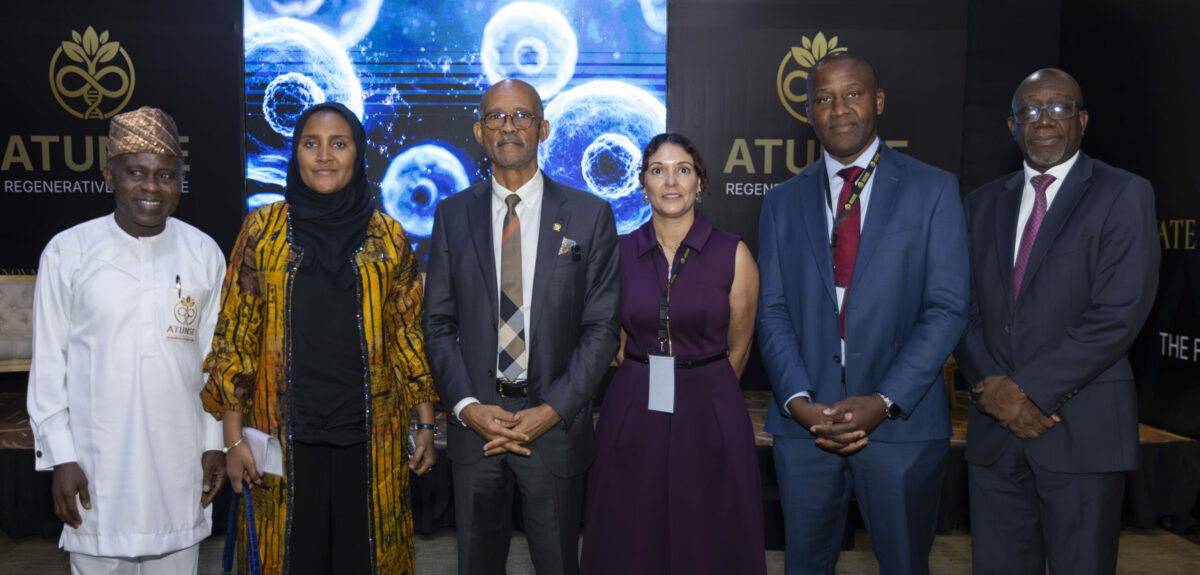
A new US-Nigeria healthcare partnership, Atunse Healthcare Limited, has launched operations with a focus on regenerative medicine and advanced treatment, as part of efforts to reduce Nigeria’s heavy dependence on overseas medical care and imported healthcare products.
The company, which is a partnership between KweHealth, LLC of the United States and Tri-State Healthcare System of Nigeria, said it would seek to develop local capacity in advanced healthcare and help retain some of the funds Nigerians spend on medical treatment abroad.
The initiative comes amid growing concerns over Nigeria’s medical tourism bill, with the country losing an estimated $2.39 billion in 2024 to citizens seeking healthcare services overseas.
Speaking at the launch of Atunse Healthcare in Lagos yesterday, the president and chairman of the company, Prof. Kamar Adeleke, said the partnership was designed to bring international scientific and manufacturing capabilities into Nigeria while building local clinical capacity.
According to him, KweHealth, LLC provides an established scientific and manufacturing platform, while Tri-State Healthcare System contributes clinical delivery and institutional expertise.
He stressed that Atunse Healthcare is Nigerian-domiciled and Nigerian-based, adding that its focus on regenerative therapies and advanced treatment would contribute to the development of Nigeria’s healthcare ecosystem.
Adeleke said the cost of Nigeria’s dependence on imported healthcare products and overseas treatment extends beyond the foreign exchange spent on medical tourism.
He noted that Africa imports approximately 99 per cent of its vaccines and more than 95 per cent of its medicines, while producing less than one per cent of its vaccine supply.
“While $2.39 billion left Nigeria in 2024 for medical tourism, the greater cost is borne by those who cannot travel and for whom advanced treatment has not been an option,” he said.
Also speaking at the event, the Group Executive Director, Commercial Operations, Oil & Gas, Dangote Industries, Fatima Aliko Dangote, who represented the Group President/CEO of Dangote Group, Alhaji Aliko Dangote, said strengthening local healthcare capacity was critical to Nigeria’s economic development.
She said building the capacity to prevent, detect and treat health challenges should be regarded as a strategic national priority rather than solely a healthcare objective.
“A nation that can protect the health of its people is better positioned to grow its economy, strengthen its workforce, retain talent, attract investment and respond effectively in moments of crisis,” she said.
Dangote, who referenced the COVID-19 pandemic and the work of CACOVID through the Aliko Dangote Foundation, said the health crisis demonstrated the importance of countries having the capacity to respond to emergencies without excessive dependence on external sources.
She said Nigeria must therefore strengthen its healthcare infrastructure, local manufacturing capabilities and human capital to reduce vulnerabilities exposed during global health crises.
The Lagos State Commissioner for Health, Prof. Akin Abayomi, who represented the Lagos State Governor, Babajide Sanwo-Olu, said regenerative medicine represented an important emerging frontier in healthcare.
He said the priority for Lagos was to ensure that the required scientific expertise, human capital and institutions were developed to take advantage of opportunities in the sector.
“Regenerative medicine is one of the exciting frontiers in healthcare, and for us in Lagos, the question is how do we make sure that the science, the people and the systems are there to take advantage of it?” Abayomi said.
He noted that Nigeria still faced a significant shortage of healthcare professionals and institutions capable of supporting advanced medical treatment.
“We have a huge gap in our health workforce. We must train more people, we have to build the institutions and, where there are gaps, we have to find ways to bring expertise back into the country,” he said.
Representing the Director-General of the National Agency for Food and Drug Administration and Control (NAFDAC), Prof. Mojisola Adeyeye, the Director of the Vaccines, Biologics and Medical Devices Registration Directorate, Mrs. Khadijah Ade-Abolade, said the agency had restructured its regulatory framework to accommodate emerging areas of medicine.
She said NAFDAC was committed to supporting innovation while ensuring that new biologics and regenerative medicine products met appropriate safety and quality standards.
“Our mandate is clear: we must foster innovation because Nigeria cannot be left behind,” Ade-Abolade said.
She explained that NAFDAC would require African-population clinical data, strict manufacturing standards and robust post-market surveillance for biologics and regenerative medicine products.
Ade-Abolade also disclosed that the agency was supporting federal government efforts to restart local vaccine manufacturing in Nigeria, following the country’s loss of domestic vaccine production capacity since 1993.
The speakers agreed that reducing Nigeria’s medical tourism expenditure would require more than the establishment of individual healthcare facilities.
They called for sustained investment in medical research, local manufacturing, healthcare infrastructure, talent development and regulatory systems capable of attracting international confidence.
The launch of Atunse Healthcare therefore marks a renewed push to position Nigeria not merely as a consumer of medical innovation, but as a potential producer and provider of advanced healthcare services within Africa.
The initiative is expected to contribute to efforts to retain healthcare spending within the country while expanding Nigerians’ access to advanced treatment and strengthening the local healthcare value chain.
We’ve got the edge. Get real-time reports, breaking scoops, and exclusive angles delivered straight to your phone. Don’t settle for stale news. Join LEADERSHIP NEWS on WhatsApp for 24/7 updates →
Join Our WhatsApp Channel