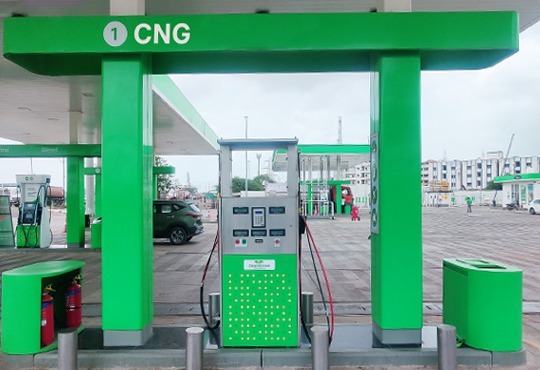
Private downstream petroleum sector operators and marketers are shying away from investing in Compressed Natural Gas (CNG) stations and facilities across Nigeria, citing the huge capital outlay required to build the infrastructure and the long break-even period before such investments become profitable.
LEADERSHIP’s findings show that President Bola Tinubu’s directive for an additional 500 CNG refuelling stations nationwide, which would bring the total under the Presidential CNG Initiative to 1,000, is being met with scepticism by marketers who ordinarily deliver such infrastructure through their networks, largely due to the absence of an adequate financing framework.
Investigations revealed that an existing strategic partnership between NNPC Ltd. and NIPCO Gas Ltd. to deploy CNG stations nationwide is already facing serious difficulties, with NIPCO unable to deliver the 35 stations targeted under the agreement. NIPCO, a pioneer CNG marketing company, had nine stations before the agreement was signed and, under the new arrangement, was expected to deliver 26 more.
Inadequate infrastructure and funding challenges, combined with a lack of political will and what was described as poor financial returns for political actors assigned to drive the project, have continued to work against its success, industry sources said.
The stalled NNPCL/NIPCO collaboration was described as a landmark initiative meant to expand Nigeria’s CNG infrastructure, improve access to the fuel and accelerate adoption of a cheaper, cleaner alternative for buses, cars and Keke NAPEP.
Tinubu disclosed the October mandate during a meeting with the Nigeria Governors’ Forum.
In a statement personally signed by him and posted on his X handle, the president said the governors had, on their own initiative, resolved to take immediate measures to bring down transportation costs in their states, with a strong focus on leveraging the cost benefits of CNG and electric vehicles.
He said the federal government was already investing significantly in the energy transition, adding that efforts were ongoing to expand conversion centres and refuelling infrastructure nationwide.
The national president of the Petroleum Products Retail Outlets Owners Association of Nigeria (PETROAN), Dr Billy Gillis-Harry, said the CNG refuelling project, though ongoing, had been significantly stalled due to the absence of a financing framework to support it.
He explained that a daughter CNG facility costs between $250,000 and $300,000 to build, while a mother CNG facility costs between $500,000 and $1 million, an outlay he said was too heavy for many private operators to bear without external support.
Gillis-Harry said PETROAN had sent a proposal to the federal government, requesting about $100 million to enable the association to deploy 100 such stations nationwide.
“Because it is of public interest, we also urged for a customs duty waiver for imported components and a tax holiday for PETROAN members who have shown interest in the business,” he said.
“We advocated for a Domestic Energy Bank with a $300 million capital outlay to provide the necessary financing for the programme, since financial institutions are not willing to fund it,” he said.
Gillis-Harry also called for the establishment of a ₦100 billion intervention fund to serve as seed capital for retail marketers, proposing that the fund be situated within the Energy Bank of Nigeria.
Beyond the upfront cost, findings show that the length of time it takes to recoup investment in CNG infrastructure is a further deterrent to private operators.
A technical and economic evaluation of CNG as a potential public transport fuel in Nigeria found a payback period of about 4.24 years, with a net present value of $2.27 million and an internal rate of return of 14.42 per cent.
A separate industry analysis of a CNG mother station and manufacturing hub projected a payback period of 3.8 to 4.5 years, with an internal rate of return of 22 to 30 per cent over 10 years.
Analysts say the situation is worse further upstream. A cost-benefit study of Nigeria’s natural gas pipeline infrastructure, which feeds CNG stations, found a payback period of roughly 14 years, a timeline that puts such projects at a disadvantage compared with other investments that recoup capital in under five years.
This gap between the multi-year wait for returns and the immediate scale of capital required, sources say, is central to marketers’ reluctance to commit to the federal government’s accelerated rollout.
Following the removal of the petrol subsidy, NNPCL entered into a partnership with NIPCO Gas Limited to establish CNG stations across Nigeria, in line with presidential directives to provide alternative fuel options for Nigerians.
The then Group Chief Executive Officer of NNPC Limited, Mallam Mele Kyari, unveiled the partnership on August 3, 2023, in Abuja, at an event attended by Nagendra Verma, managing director of NIPCO Gas; Engr. Adokiye Tombomieye, NNPC Executive Vice President, Upstream; and other senior officials.
The partnership was designed to construct 35 CNG stations nationwide, including three mother stations, with capacity to serve over 200,000 vehicles daily once fully operational. It was to be delivered in two phases: 21 stations for intra-city transportation by the first quarter of 2024, and 35 stations for inter-city transportation by the first quarter of 2025.
In April 2026, NIPCO Gas commissioned CNG stations in Asaba and Warri, Delta State, on behalf of Governor Sheriff Oborevwori, represented by the Secretary to the State Government, Dr Kingsley Eze Emu. Officials at the event, including the Commissioner for Transport, Onoriode Agofure, and NIPCO Gas COO, Mr Sanjay Tarat, described the project as transformative for the state’s transport sector.
The Asaba and Warri stations were said to be capable of serving over 2,000 motorists and tricycle operators daily.
Earlier, in 2025, NIPCO Gas commissioned its fourth CNG station in Abuja, located in Lugbe, bringing its nationwide total to 21 stations, with two more at Madalla Junction and Mabushi awaiting commissioning after regulatory compliance.
Despite these milestones, industry sources say the NNPCL/NIPCO deal is now in limbo, with funding constraints limiting NIPCO’s capacity to deliver the agreed number of stations.
A top industry operator said the failure of NIPCO and NNPCL to deliver even a fraction of the targeted stations, despite NIPCO’s technical expertise, suggests that CNG development in Nigeria will take longer than expected to materialise.
The operator expressed doubt about the federal government’s approach to meeting the October deadline.
“It’s a political statement. Since this transition began, how many stations have been delivered? How do you bring such numbers in a few weeks? All this requires planning, funding and management strategies,” the source said.
NIPCO could not be reached for comment, but it was understood that the agreement is stalled.
Despite the setbacks, the federal government said it was pressing ahead with investment in the energy transition.
Tinubu said more than 120,000 vehicles had been converted nationwide through the Presidential CNG Initiative, with over 100,000 additional conversion kits in progress, alongside continued expansion of conversion centres and refuelling infrastructure.
He said the federal government, through the Midstream and Downstream Gas Infrastructure Fund, was financing more than 100 gas projects nationwide, including 15 CNG mother stations and 86 daughter stations.
Four of the projects, he said, were commissioned in May in Lagos, Abuja and Owerri, including a 15-station refuelling network in Lagos and an Abuja facility capable of serving 1,000 cars and tricycles and 50 trucks and buses daily.
“I have also directed the additional rollout of another 500 CNG refuelling stations nationwide, in addition to the 500 stations ordered earlier in the year by the Fund, bringing the programme to 1,000 stations across the country,” Tinubu said.
He said the expansion was particularly important for intra-state transportation, where Nigerians felt the cost burden most directly, adding that the federal and state governments had agreed to set up a joint committee to begin implementing measures to reduce transport costs immediately.
“A vehicle running on CNG spends 60 to 80 per cent less on fuel than one running on petrol,” Tinubu said. “From October 1, our goal is that Nigerians begin to partake in those savings through lower transport fares.
“We have agreed that cheaper fuel should result in cheaper fares. Each tier of government must keep doing its part and work together for the benefit of every Nigerian.”
We’ve got the edge. Get real-time reports, breaking scoops, and exclusive angles delivered straight to your phone. Don’t settle for stale news. Join LEADERSHIP NEWS on WhatsApp for 24/7 updates →
Join Our WhatsApp Channel