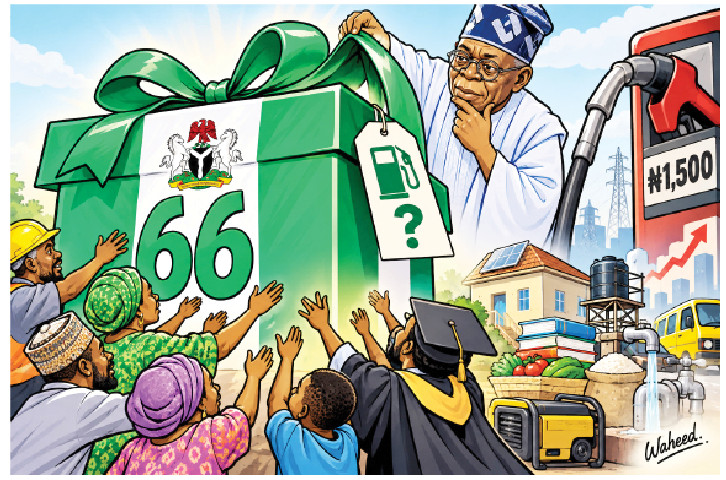
Today, Nigeria stands at a harrowing crossroads, marking 66 years of independence from colonial rule with an agonising question: has it fared any better? As the giant of Africa limps through this anniversary, citizens are trapped in a relentless economic stranglehold. The air is thick with despair, and the nation is bleeding. What is the single most valuable, life-saving gift President Bola Ahmed Tinubu can offer a traumatised population on this historic day?
With fuel prices skyrocketing to a staggering N1,500 per litre, the breaking point is no longer a distant threat—it is here. The crushing weight of this reality demands an urgent, unavoidable reckoning: isn’t it time for the federal government to re-examine the devastating fallout of fuel subsidy removal?
The ongoing debate across Nigeria highlights the intense tension between national sovereignty and crushing economic realities. The political battle lines were drawn when the African Democratic Congress (ADC) presidential candidate, former Vice President Atiku Abubakar, injected new energy into the discourse. Ahead of the 2027 general election, Abubakar made a firm commitment to a high-stakes campaign promise: the immediate reintroduction of the fuel subsidy if elected president.
Atiku said that, if elected, he would reinstate the fuel subsidy because President Tinubu’s removal of the subsidy had subjected most Nigerians to sustained hardship. That is true.
Expectedly, his statement provoked a strong reaction, with the ruling All Progressives Congress (APC) and the presidency dismissing the proposal as voodoo economics.
In a clear attempt to whip up political sentiment, the APC claims that returning the subsidy would cripple the North, the nation’s largest vote bank. In a laughable display, APC National Chairman Professor Nentawe Yilwatda brazenly said that returning the subsidy would push northerners back into poverty—as if the majority of northerners had already been lifted out of poverty.
What has changed?
The subsidy is gone, but every home is now pursuing solar as an alternative power source because the nation has failed to address the recurring challenge of unreliable electricity supply. What exactly has improved with the removal of the subsidy? Power? Security? Infrastructure? Education? The economy?
The argument for removing the fuel subsidy was that it would free up resources to address other critical sectors of the economy. We have since realised that removing the subsidy has meant more money for the subnationals, with governors having a field day.
What exactly is the Nigerian government subsidising for citizens? Nigerians fortunate enough to build houses, whether in rural or urban areas, often provide key infrastructure such as electricity, water and even security. Due to widespread reliance on private water supplies, millions of boreholes have been sunk, and major cities now feature private boreholes in almost every residential compound or business.
If Nigerians provide these basic services for themselves, while security remains deplorable and citizens battle excruciating hardship caused largely by the astronomical rise in the cost of essential services, school fees, rent and transport following subsidy removal, what benefit has really accrued to them?
Time for review
Perhaps the time is ripe to revisit the removal of the fuel subsidy, which was carried out with scant regard for citizens’ suffering. If anyone still doubts that Nigerians want a return to the subsidy—especially since its removal appears to benefit only a few—the recent SBM Intelligence survey provides an answer. At least 67 per cent of respondents demanded the restoration of the fuel subsidy. One of the key takeaways from the survey is that Nigerians bearing the brunt of the rising cost of living want immediate relief.
There is no harm in the federal government taking another look at its decision to suspend fuel subsidy payments. More than three years after the removal, the government has had sufficient time to reflect on and re-examine the policy. Has it delivered the desired results? Has it benefited the vast majority of Nigerians? Is the time not ripe for a review?
The lie repeatedly told to Nigerians is that the government cannot afford to continue paying the fuel subsidy and that, once it is reintroduced, there would be no money for critical infrastructure. The subsidy is never the issue. It never has been. The key challenge is the corruption that permeates subsidy payments. Because the government is a beneficiary of this grand sleaze, removing the subsidy, rather than confronting the graft, appears to be its safe landing point. Sad.
Lessons from Abroad
It is a global practice, especially among major oil-producing countries, to provide direct or indirect energy and consumer subsidies to keep fuel, electricity, and living costs low for citizens. Saudi Arabia keeps domestic gasoline and utility prices low through price controls and subsidies funded by petroleum revenues.
Iran combines discounted state fuel with direct cash subsidies to offset energy costs. Venezuela provides heavily subsidised domestic fuel and basic utilities, while Kuwait offers extensive welfare benefits, including support for fuel, electricity, water and housing.
Other countries, such as Algeria, keep domestic energy, fuel, and basic food prices low through government subsidies, whereas the United Arab Emirates (UAE) provides social welfare, housing grants, and utility support to its nationals.
Governments exist for one primary purpose: to protect and serve their citizens. National security, public safety, and basic welfare are not political favours—they are fundamental constitutional duties. By these standards, the Nigerian government is failing its people.
The government’s catastrophic failure to protect lives and property is deflating the defence. This week, at least 115 citizens were abducted from Niger and Zamfara states, further swelling the ranks of Nigerians trapped in abductors’ dens.
Unanswered questions
If the government discontinued fuel subsidy payments to free up resources for security and other services, why have security challenges not yet been effectively addressed? If the removal of the subsidy was intended to increase government revenue, why is the administration still on a borrowing spree?
Given that Nigerians are paying more for transport, school fees, rent, and food due to the removal of the fuel subsidy, and that they have yet to feel the impact of the increased revenue accruing to the three tiers of government, it’s time to reconsider the policy. President Tinubu can make this reconsideration his Independence Day gift to Nigerians.
As Nigeria marks its 66th Independence Anniversary, my thoughts and prayers go to the families whose loved ones remain in the custody of kidnappers, and to the parents struggling to pay their children’s school fees. These challenges are a clear testament to the fact that the gains from the subsidy removal have not been effectively utilised.
The Class Of 1996 States
Thirty years after General Sani Abacha granted them statehood, the Class of 1996—Bayelsa, Ebonyi, Gombe, Ekiti, Nasarawa, and Zamfara—is celebrating its anniversary today. They stand as a testament to the grand vision of drawing lines on a map and hoping that economic prosperity will follow by sheer spiritual manifestation.
Of the thirty-six states, not a single one of these six privileged states has managed to claw its way into the top 10 for Internally Generated Revenue (IGR). Of the entire batch, only one state managed to scrape into the top 10 for GDP and revenue. Happy 30th anniversary to the Class of 1996!
We’ve got the edge. Get real-time reports, breaking scoops, and exclusive angles delivered straight to your phone. Don’t settle for stale news. Join LEADERSHIP NEWS on WhatsApp for 24/7 updates →
Join Our WhatsApp Channel