
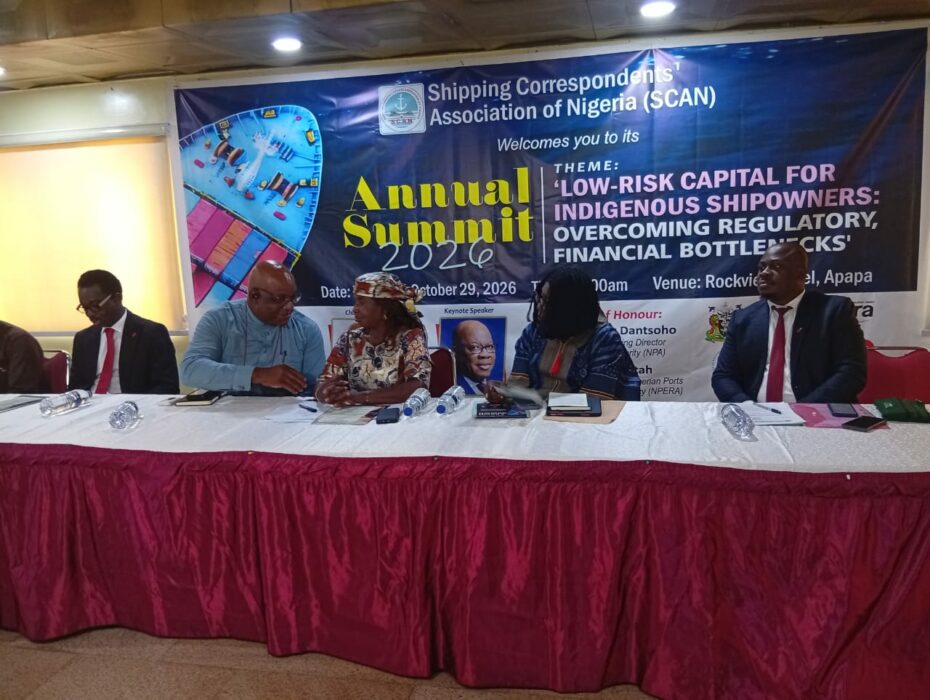
The Nigerian Ports Economic Regulatory Agency (NPERA) has identified regulatory reforms, transparent port charges and predictable business conditions as critical to unlocking affordable capital for indigenous shipowners, saying uncertainty in the maritime business environment continues to increase investment risks and constrain access to finance.
The director-general/chief executive officer of NPERA, Dr Akutah Pius Ukeyima, stated this at the Annual Summit of the Shipping Correspondents Association of Nigeria (SCAN), held in Lagos, with the theme, “Low-Risk Capital for Indigenous Shipowners: Overcoming Regulatory, Financial Bottlenecks.”
APC Stakeholders Warn Against Moves to Undermine National Youth Leader
Oyetola Unveils Gazetted NPERA Act, Logo, Reaffirms Commitment To Port Reforms
Port Efficiency Vital To Nigeria’s $1trn Economy Goal – NPERA
Akutah, who was represented by the director, Consumer Affairs Department, Ify Okolue, said Nigeria could not achieve its ambition of becoming a major maritime power if indigenous entrepreneurs lacked the financial capacity to own, operate and compete with vessels transporting the nation’s international trade.
He described indigenous ship ownership as an important instrument for economic sovereignty, national competitiveness, employment creation and greater participation in international commerce, stressing that a stronger Nigerian-owned fleet would create jobs for seafarers, stimulate maritime services, support exporters and deepen local participation in the shipping value chain.
According to him, the capital-intensive nature of shipping, coupled with the high costs of vessel acquisition, maintenance, insurance, fuel, crew and regulatory compliance, makes access to affordable financing particularly difficult for indigenous operators.
He said financial institutions were often compelled to demand stronger collateral, higher interest rates and more stringent conditions because of the risks associated with shipping investments.
“Our task, therefore, is not simply to demand more lending to indigenous shipowners. It is to reduce the risks that make legitimate maritime investments expensive to finance.
“Low-risk capital does not mean risk-free capital. It means creating conditions in which risks can be properly assessed, managed and shared among shipowners, lenders, insurers, cargo owners, investors and government institutions,” he said.
The NPERA boss maintained that effective economic regulation could play a significant role in reducing investment risks by creating an environment where investors and lenders have confidence in the rules governing port operations and commercial activities.
He explained that investors require clear regulations, transparent charges, consistent regulatory decisions and confidence in commercial arrangements, noting that uncertainty increases the cost of doing business and could determine whether a shipping investment proceeds or is abandoned.
“At NPERA, we recognise that credible economic regulation is essential to building confidence in Nigeria’s port economy. Within our statutory mandate, our responsibility is to promote transparency, fair competition, efficient port economic practices and a regulatory environment that supports legitimate investment.
“We emphasise that good regulation should not create unnecessary barriers to business; it should reduce uncertainty, promote fairness and strengthen investor confidence,” Akutah stated.
He, however, noted that the financing challenges confronting indigenous shipowners extended beyond port economic regulation, requiring coordinated interventions in access to credit, vessel acquisition, insurance, foreign exchange, maritime safety and other operational matters.
According to him, no single government agency can independently resolve the challenges, making collaboration among maritime regulators, financial institutions, development finance partners, shipowners and other stakeholders imperative.
He urged indigenous shipowners to embrace innovative financing arrangements, stronger commercial partnerships and improved business discipline, saying these measures, alongside predictable and coordinated regulation, could create a more supportive investment environment without compromising safety and accountability.
Akutah further explained that regulatory certainty could improve the ability of shipping companies to prepare credible financial projections, negotiate long-term commercial contracts and demonstrate their capacity to meet debt obligations.
“When regulatory arrangements are transparent and predictable, a shipping company is better positioned to prepare credible financial projections, negotiate long-term contracts and demonstrate its ability to meet debt obligations.
“When avoidable uncertainty is reduced, financiers have a stronger basis for evaluating the underlying commercial merits of an investment,” he said.
He stressed that the relationship between regulation and finance must be better understood, arguing that effective economic regulation could support access to affordable financing, even though it could not replace the role of financial institutions.
The NPERA chief executive also called for greater stakeholder engagement in addressing structural challenges within the maritime sector, urging industry associations and indigenous shipowners to present documented concerns and practical recommendations to the Agency.
He said NPERA remained committed, within its statutory mandate, to promoting a transparent, competitive and efficient port economic environment capable of supporting legitimate investments and national development.
Akutah also called on indigenous shipowners to demonstrate transparency, professional standards and financial discipline, noting that a sustainable investment environment required responsibilities from both regulators and operators.
He said the objective should go beyond increasing the number of Nigerian-owned vessels to building a financially sustainable, professionally managed and internationally competitive indigenous shipping industry.
“Let us remember that capital follows confidence; confidence grows with predictability; and predictability is strengthened by transparent institutions, sound business practices and consistent rules.
“Government declarations alone cannot build a competitive indigenous shipping industry. It requires sound policies, credible regulation, responsible entrepreneurs, innovative financiers and sustained public-private collaboration,” he said.
The NPERA boss also commended SCAN for its contribution to maritime journalism and public accountability, describing the media as an important stakeholder in informing policy, scrutinising institutions and bringing industry challenges to national attention.
He urged maritime journalists to sustain accurate, balanced and evidence-based reporting capable of deepening public understanding of shipping finance, port economics and indigenous maritime development.
He added that NPERA welcomed constructive engagement and informed criticism that could contribute to improved regulation and a stronger maritime industry.
Akutah reiterated that Nigeria must move beyond being merely a destination for maritime trade to developing the capacity for Nigerians to own, finance and participate meaningfully in the businesses that make the country’s trade possible.
We’ve got the edge. Get real-time reports, breaking scoops, and exclusive angles delivered straight to your phone. Don’t settle for stale news. Join LEADERSHIP NEWS on WhatsApp for 24/7 updates →
Join Our WhatsApp Channel