
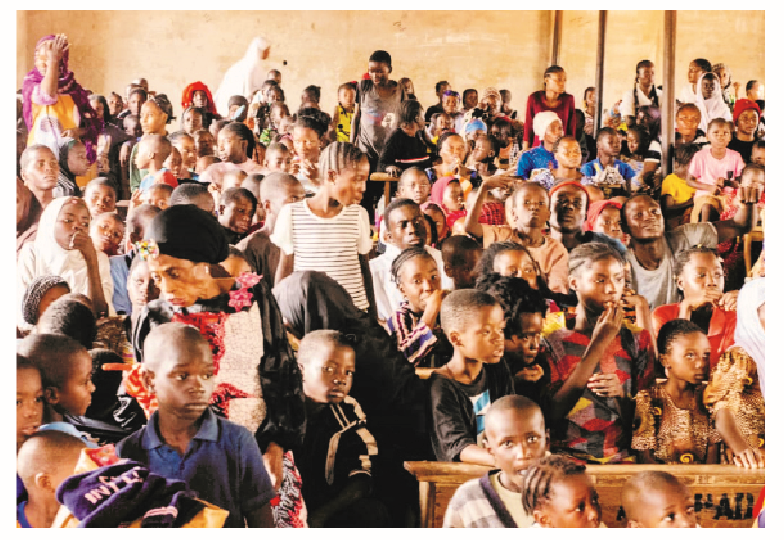
Stakeholders in the education sector have called on the Federal Government and governors in Northern Nigeria to urgently address the growing number of out-of-school children, estimated at over 7.4 million in the North-West and North-East.
They also demanded greater accountability and judicious utilisation of funds allocated to basic education.
Speaking in an interview with LEADERSHIP yesterday, education stakeholders and parents warned that despite successive government interventions, budgetary allocations and programmes aimed at increasing school enrolment, millions of children remain outside the classroom.
According to UNICEF’s recent humanitarian assessment, published in March 2026, Nigeria has more than 10.2 million out-of-school children, with the majority concentrated in the North-West and North-East.
The North-West accounts for approximately 45 per cent of the national figure, while the North-East represents 28 per cent. Based on these percentages, the two regions jointly account for an estimated 7.45 million out-of-school children, comprising approximately 4.59 million in the North-West and 2.86 million in the North-East.
The figures, calculated from UNICEF’s reported regional percentages, exclude the North-Central geopolitical zone.
The education crisis affects both boys and girls, with UNICEF data indicating that approximately 6.48 million girls and 6.42 million boys of primary and junior secondary school age are out of school nationwide.
However, UNESCO’s Global Education Monitoring Report puts Nigeria’s out-of-school population at approximately 18.2 million children and young people, comprising about 8.58 million primary-school-age children, 4.06 million junior-secondary-school-age children and 5.54 million senior-secondary-school-age children.
The figures suggest that girls account for approximately 50.2 per cent of the affected population, while boys represent 49.8 per cent, underscoring the need for interventions that address the educational challenges confronting both genders.
Speaking on the development, the Founder and Executive Director of AfroTechXcel, Emerald O Akhaumere, identified corruption and the lack of accountability in education spending as major factors undermining government efforts to tackle the crisis.
She said government must move beyond announcing budgetary allocations, intervention programmes and enrolment targets to ensuring that resources actually reach schools and children.
“In my view, corruption and the lack of accountability in education spending are among the most serious reasons government interventions continue to fall short.
“We cannot keep announcing education budgets, intervention programmes and enrolment targets without establishing whether the resources allocated are reaching the schools and children they are intended to serve,” she said.
Akhaumere stated that when funds were diverted, poorly managed, delayed or inadequately monitored, the consequences were borne directly by children who needed access to education.
She called for transparent expenditure reporting, independent monitoring, and appropriate sanctions for the misuse of educational resources, insisting that every naira allocated to basic education should be traceable from government authorities to the schools and to the services delivered to pupils.
She, however, noted that corruption was not the only challenge, saying that household poverty, insecurity, displacement, cultural expectations and inadequate school facilities continued to prevent children from enrolling and remaining in school.
According to her, families struggling to provide food and other necessities often depend on their children’s contributions to household income, while insecurity in conflict-affected communities makes access to conventional schools difficult.
She added that girls faced additional challenges, including domestic responsibilities, early marriage, inadequate sanitation facilities and social expectations that sometimes discourage them from pursuing education.
Akhaumere stressed the need for the government to adopt interventions that reflect the peculiar circumstances of different communities rather than treating Northern Nigeria as a uniform educational environment.
She also raised concerns about the condition of public schools, citing overcrowded classrooms, dilapidated or non-existent buildings, unreliable electricity, inadequate learning materials and insufficient support for teachers.
“In government schools I have visited, classrooms accommodating approximately 70 to 100 learners, dilapidated or non-existent buildings, unreliable electricity, inadequate learning resources and limited support for teachers present significant obstacles to effective teaching.
“We cannot expect strong learning outcomes when teachers are overstretched, and the basic conditions for learning are missing. Even when children enrol, poor learning experiences can eventually discourage attendance and contribute to dropout,” she said.
On practical measures to reverse the trend, the AfroTechXcel executive director said the government must address the basic conditions that prevent children from learning, particularly those in the Almajiri system, where many young children struggle to access food, shelter, and other necessities.
She also advocated flexible learning arrangements, particularly for girls who combine domestic responsibilities and economic activities with their desire to acquire formal education.
The education advocate also called for greater community involvement, urging traditional rulers, religious leaders and community-based organisations to participate in the design and implementation of local learning programmes.
She also urged government to strengthen monitoring systems to identify pupils at risk of dropping out and provide timely interventions.
“Ultimately, the question should not simply be how many children we can convince to enrol. It should be how many we can support to remain, learn, progress and complete their education,” she said.
Also speaking, a parent and staff member of the Nigerian Postal Service, Mr Uge Ver, called on governments in Northern Nigeria to prioritise basic education by increasing investment in school infrastructure, recruiting qualified teachers, and providing adequate learning materials.
He said tackling the crisis of out-of-school children required collective responsibility, stressing that parents must recognise education as a fundamental investment in their children’s future.
“Government cannot do it alone, just as parents cannot do it alone. We must work together to ensure that every child has access to quality education. It is not enough to build schools; government must provide teachers, learning materials and a conducive environment where children can learn,” he said.
Ver also urged traditional rulers, religious leaders and community-based organisations to intensify awareness campaigns against cultural practices, poverty and other barriers preventing children, particularly girls, from attending school.
“As a parent, I believe no child should be denied the opportunity to go to school because of poverty or the circumstances of their birth. Parents must take responsibility, while government should introduce practical support programmes, including scholarships, school feeding and financial assistance for vulnerable families,” he added.
We’ve got the edge. Get real-time reports, breaking scoops, and exclusive angles delivered straight to your phone. Don’t settle for stale news. Join LEADERSHIP NEWS on WhatsApp for 24/7 updates →
Join Our WhatsApp Channel