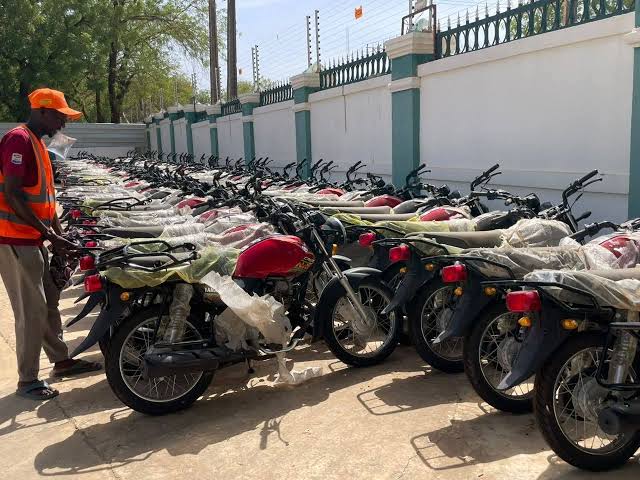
Yobe State government has reduced the repayment requirement under its motorcycle loan scheme for civil servants from 60 per cent to 40 per cent, in a move aimed at easing workers’ financial burden and making the programme more accessible.
The chairman of the Nigeria Labour Congress (NLC), Yobe State Chapter, Comrade Muktar Musa Tarbutu, disclosed this in an interview with LEADERSHIP Friday explaining that the adju stment was intended to accommodate the financial realities of workers and encourage wider participation in the scheme.
Tarbutu said about 2,000 civil servants were expected to benefit from the programme, with 1,724 workers already captured in the first batch.
He explained that civil servants who had submitted their application forms, completed the screening exercise and fulfilled the required financial arrangements would be eligible to collect their motorcycles.
According to him, repayment would be made through monthly deductions from beneficiaries’ salaries, allowing workers to spread their financial obligations over time rather than struggle with a single payment.
The NLC chairman said the reduction from 60 to 40 per cent represented an important adjustment that would make the initiative less financially demanding for civil servants.
For many government workers, the cost of daily transportation has become an additional pressure on already stretched household budgets, particularly for those who commute long distances to their workplaces.
A civil servant in Damaturu, Umar M. Sulaiman, welcomed the reduction, saying the new arrangement would encourage more workers to participate in the scheme.
“The reduction from 60 to 40 per cent is a welcome development.
I would like to benefit from the scheme because having my own motorcycle would make movement from home to the office easier. It would also help me take my children to school without spending money on commercial transportation every day,” he said.
Another applicant, Usman Ahmad, said owning a motorcycle would significantly reduce his daily transportation expenses, which he described as a considerable burden on his monthly salary.
“On a normal working day, I spend about N3,000 on transportation from my house to the office. When you calculate that over several working days in a month, it becomes a huge expense. Having my own motorcycle would help me save that money and make commuting to work much easier,” he said.
However, another civil servant, Fatsuma A. Lawan, said the scheme might not appeal to every worker, particularly those who do not need motorcycles and have other financial priorities.
“While the initiative may be helpful to many workers, the government should also consider individual needs before making the loan arrangement compulsory or placing financial expectations on everyone. As a woman, I may not need a motorcycle, as I have other family and personal responsibilities to take care of,” she said.
The workers expressed hope that the scheme would be implemented transparently and that those who had completed the application and screening processes would receive their motorcycles without unnecessary delays.
The initiative is expected to improve workers’ mobility, reduce their dependence on commercial transportation and provide some relief to civil servants struggling with the rising cost of daily commuting.
We’ve got the edge. Get real-time reports, breaking scoops, and exclusive angles delivered straight to your phone. Don’t settle for stale news. Join LEADERSHIP NEWS on WhatsApp for 24/7 updates →
Join Our WhatsApp Channel