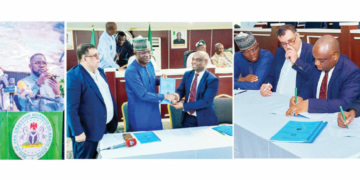
At the 2026 management retreat in Abuja, the Executive Chairman of the Nigeria Revenue Service (NRS), Dr. Zacch Adedeji, opened proceedings with an unusual request. He asked senior leaders to “suspend the comfort of familiarity” — to momentarily set aside titles, tenure and the habits of long-held systems — and imagine the kind of leadership Nigeria now requires.
It was not a routine exhortation. It was a defining statement about an institution in transition.
The rebranding and restructuring of the former Federal Inland Revenue Service (FIRS) into the Nigeria Revenue Service marks more than a change of name. It represents a deliberate recalibration of Nigeria’s revenue architecture at a time when fiscal sustainability, economic diversification and public trust have become urgent national priorities.
According to Adedeji, “new eras demand new postures,” and the success of the NRS will not be secured by the weight of positions or the familiarity of inherited structures, but by the institution’s capacity to adapt, stretch and lead at a higher standard of excellence.
From reform agenda to institutional reset
Over the past few years, Nigeria’s revenue system has undergone some of its most significant reforms since the country’s return to democratic governance in 1999. Under the current administration, the push for a more efficient, technology-driven and transparent tax administration system has been central to broader economic reforms aimed at strengthening non-oil revenue and improving fiscal discipline.
The transition from FIRS to NRS is both symbolic and structural. Symbolically, it signals a break from legacy constraints and a commitment to modernisation. Structurally, it aligns revenue administration with contemporary global standards — emphasising data intelligence, automation, taxpayer service, compliance efficiency and inter-agency collaboration.
The reforms have focused on several pillars: digitisation of tax processes, expansion of the tax base, harmonisation of revenue collection systems, enhanced dispute resolution mechanisms, and stronger enforcement frameworks. Technology has become a central driver. Integrated tax administration platforms now enable real-time data matching, reduce leakages and limit human discretion in routine processes. Electronic filing and payment systems have simplified compliance for businesses and individuals, reducing physical contact points and opportunities for inefficiency.
Yet, as Adedeji reminded his management team, structural and technological reforms alone cannot guarantee institutional success.
The leadership question
Reflecting on an article from the Harvard Business Review titled The Hidden Beliefs That Hold Leaders Back, Adedeji confronted a less visible but equally powerful dimension of reform: mindset.
“Leaders rarely fail because they lack intelligence, experience, or strategy,” he noted. “More often, they fall short because of the invisible beliefs they carry.”
n a revenue institution of NRS’s scale — with thousands of employees, nationwide operations and complex stakeholder networks — unexamined assumptions can quietly shape culture and performance. The chairman identified subtle leadership blockers that often masquerade as good intentions: the belief that leadership means always having the answer; the assumption that tight control equates to accountability; the unconscious expectation that others must work at the leader’s speed or style.
Such beliefs, he warned, create bottlenecks, stifle innovation and discourage initiative.
For an institution repositioning itself as a modern revenue authority, empowerment and agility are no longer optional. Nigeria’s evolving economic landscape — characterised by digital commerce, cross-border transactions, emerging industries and complex value chains — demands adaptive leadership capable of fostering collaboration rather than control.
Adedeji’s candour was striking. He shared his own experience of confronting a long-held assumption: that if he could execute a task in a particular way, others should be able to do the same. What appeared, on the surface, as a commitment to excellence had subtly translated into pressure, rigidity and over-control. Over time, he recognised that his real fear was not substandard performance, but personal accountability for potential failure.
His turning point came with the realisation that “efficiency does not require uniformity, that excellence does not require my style, and that trust is not the absence of oversight, but the willingness to allow people to rise.”
The message resonated beyond personal reflection. It underscored a broader institutional truth: reform is as much about internal transformation as it is about external restructuring.
Building a culture of trust and innovation
For the NRS, the stakes are high. Nigeria’s revenue-to-GDP ratio has historically lagged behind peer economies, limiting government capacity to fund infrastructure, healthcare, education and social protection. Increasing revenue is not simply a fiscal objective; it is a developmental imperative.
However, revenue generation must be accompanied by public confidence. Tax compliance improves when citizens perceive fairness, transparency and efficiency in administration. The NRS’s reforms therefore extend beyond enforcement to taxpayer engagement and service delivery.
Modern service centres, simplified tax guides, clearer communication channels and responsive complaint mechanisms are part of the institutional reorientation. The emphasis is on building a taxpayer-centric culture — one that balances firmness in enforcement with clarity in guidance and respect in engagement.
Internally, this requires a leadership culture that encourages questioning, learning and innovation. Adedeji cautioned against projecting certainty at the expense of honesty. When leaders suppress vulnerability, they inadvertently create environments where employees hesitate to admit gaps or challenge assumptions. In a complex revenue system, such silence can be costly.
By placing leadership self-examination at the beginning of the retreat — ahead of strategy, structure or technology — the chairman signalled that cultural reform is foundational. Without confronting internal barriers, even the most sophisticated roadmaps risk underperformance.
Anchoring reform on national economic confidence
The transformation to the NRS also aligns with Nigeria’s broader macroeconomic reform agenda. As the government seeks to diversify revenue sources away from oil dependency, improve debt sustainability and attract foreign investment, the credibility of the revenue authority becomes central.
Investors consider tax clarity, administrative efficiency and dispute resolution mechanisms when assessing risk. A modern, transparent and predictable revenue authority enhances Nigeria’s competitiveness. Conversely, uncertainty or inefficiency can deter investment and undermine reform gains.
“The credibility of Nigeria’s revenue architecture, and confidence in the Nigerian economy, rests in our hands,” Adedeji told his colleagues.
That statement reflects the strategic weight of the NRS. Beyond collecting taxes, the institution now occupies a pivotal role in shaping economic confidence. Its data systems inform fiscal planning. Its enforcement decisions influence compliance behaviour. Its service culture affects public perception of governance.
In this context, leadership rigidity would be counterproductive. Adedeji warned that clinging to familiar systems and legacy norms, even when circumstances demand change, risks building walls where bridges are required. Cross-agency data sharing, collaboration with financial institutions, and coordination with subnational governments all require flexibility and openness.
A legacy in the making
Institutional transformation of this magnitude is rare. It demands continuity of purpose and clarity of vision. The NRS’s reform journey — from digitisation to structural realignment and cultural recalibration — represents one of the most ambitious administrative overhauls in Nigeria’s recent history.
Yet, as the chairman emphasised, the Service will not be defined by the rhetoric of retreats or the elegance of policy documents. It will be defined by conduct after the conference rooms are empty.
“The Nigeria Revenue Service will not be defined by what we say in this room. It will be defined by who we become after we leave it,” he declared.
The statement encapsulates the essence of the moment. Institutional names may change, structures may be redesigned and systems may be automated, but enduring transformation rests on leadership character — humility to learn, courage to adjust and discipline to sustain reform momentum.
As the retreat concluded, the call was clear: remove the inherited scripts, release rigid assumptions and lead with renewed minds. For the Nigeria Revenue Service, the journey from reform to reinvention is underway. If successfully anchored in adaptive leadership and a culture of trust, it could redefine not only revenue administration, but also the fiscal trajectory of Africa’s largest economy.
In that sense, the transformation to NRS is more than an administrative evolution. It is a statement of intent — that Nigeria’s revenue institution is prepared to meet the demands of a new era with clarity, integrity and excellence.
We’ve got the edge. Get real-time reports, breaking scoops, and exclusive angles delivered straight to your phone. Don’t settle for stale news. Join LEADERSHIP NEWS on WhatsApp for 24/7 updates →
Join Our WhatsApp Channel