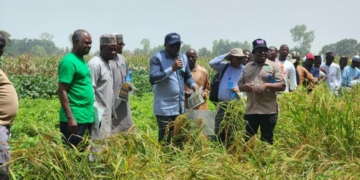

The Bank of Agriculture (BOA) with support from the Africa Climate Foundation (ACF) is intensifying efforts to expand access to clean energy technologies for farmers through a new financing framework aimed at reducing energy poverty, curbing post-harvest losses and improving agricultural productivity.
The financing programme is expected to support investments in cold-chain facilities, irrigation systems, mechanisation and electric-powered transportation solutions that can help farmers move produce from farms to markets more efficiently.
Speaking during a capacity-building workshop on the operationalisation of the bank’s Clean Energy Delivery and Innovation in Abuja yesterday, unit, executive director, operations, BOA, Tosin Salami, said the initiative forms part of a strategy to unlock climate finance and channel investments into energy-smart agricultural infrastructure.
He explained that access to the technologies would largely depend on the financing structure of individual interventions, noting that support could come in the form of grants, loans or interest-free facilities.
Salami acknowledged concerns about the poor penetration of government-backed agricultural programmes at the grassroots level, stressing that the bank plans to work through farmer aggregation companies, cooperatives, development finance institutions and other partners to ensure interventions reach intended beneficiaries.
“Today marks the operationalisation of that initiative with the training, workshop and capacity building for all of our staff. With this initiative, we have the strategy, we have the framework, and we are also developing very good concept notes around bankable projects that will enable us to clear out energy poverty, post-harvest losses and resolve some of the problems within the agricultural sector.
It would definitely not be for free because it has to be based on funding. Some of them might be a grant, some of them might be a loan, some of them might be an interest-free loan. It all depends and we’re working on all of those,” he said.
Head of the clean energy delivery and innovation unit and project lead of the clean energy implementation programme funded by the Africa Climate Foundation (ACF), Dr Adnan Aminu, said the initiative is designed to position BOA as a leading financier of clean energy solutions in agriculture.
He explained that the ACF grant is supporting the development of frameworks, risk assessment tools and financing guidelines that will enable the bank to lend confidently to clean energy projects across agricultural value chains.
He noted that Nigeria’s agricultural sector stands to gain significantly from increased electrification, particularly in addressing post-harvest losses.
He said, “The objective is to set up a Clean Energy Delivery and Implementation Unit within the bank that will help the bank finance clean energy programmes so that more farmers get access to power, energy, climate-smart and energy-smart technologies.
Like we lose more than 50 per cent of the tomatoes and onions produced in this country. A simple technology that can solve this problem might be cold rooms. If we can finance large-scale cold rooms across production communities, we can solve that issue of post-harvest loss”.
The clean energy programme, which is expected to conclude its current phase in July, will hand over its frameworks, strategies and toolkits to BOA for implementation, paving the way for wider deployment of clean energy financing solutions to farmers, cooperatives and agribusinesses nationwide.
We’ve got the edge. Get real-time reports, breaking scoops, and exclusive angles delivered straight to your phone. Don’t settle for stale news. Join LEADERSHIP NEWS on WhatsApp for 24/7 updates →
Join Our WhatsApp Channel