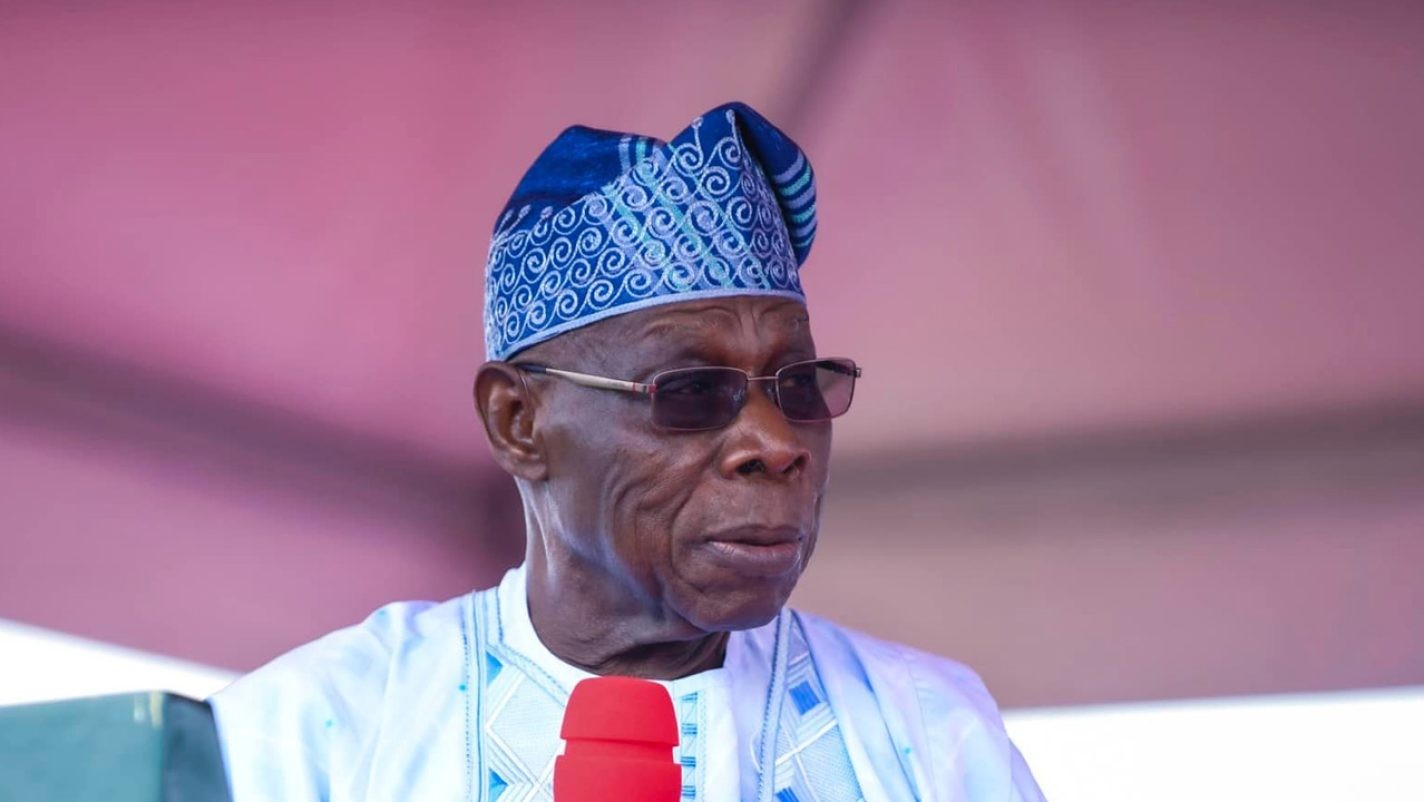
Former President Olusegun Obasanjo has said Africa must grow its economies at 9–10 per cent annually to “come of age.”
He warned that the continent risks stagnation without bold reforms and production-driven policies.
Obasanjo spoke at the Murtala Muhammed International Lecture and Leadership Conference organised by the Murtala Muhammed Foundation in Abuja.
The former President, who chairs the foundation’s Board of Trustees, said Africa had achieved such growth levels before and could do so again.
“For Africa to come of age, we must grow at 9–10 per cent GDP annually. We have done something like that before, and we can do it again. When we do, Africa will truly come of age,” he said.
He added, “What we need to do is reform and produce. Reform and produce.”
Obasanjo lamented Nigeria’s economic decline, recalling that the country once ranked 37th among the world’s economies.
“There was a time when Nigeria ranked 37th among the economies of the world. If we had continued at that rate for 20 years, we would now be among the top 10. Today, I don’t even know where we stand,” he said.
He cited cocoa production as an example of policy-driven growth, noting that output rose from 150,000 metric tonnes to 450,000 metric tonnes within four to five years under his leadership.
“We tripled output,” he said. “President Kufuor once joked that Nigeria, as an oil-producing country, should leave cocoa to them. I told him we would produce cocoa while also producing oil.”
He, however, expressed concern that production had since dropped to about 300,000 metric tonnes.
“We have gone backwards. That is not how Africa will come of age,” he added.
Reflecting on leadership, Obasanjo described the late General Murtala Ramat Mohammed’s greatest achievement as grooming a successor who could carry on his legacy.
“The greatest achievement of Murtala was that we created a successor who could continue after him,” he said.
He admitted that subsequent leaders, including himself, failed to build enduring succession structures.
“The failure of all leaders after Murtala, including myself, is that we have not been able to create successors who could go on after us,” he stated.
Turning to food security, Obasanjo said that by July 1979, Nigeria was on the verge of attaining self-sufficiency in rice production, only for policy shifts to reverse the gains.
Also speaking, former President of Ghana, John Kufuor, cautioned Africa against being drawn into global power rivalries.
“Africa and the Africans must not be drawn into these vain rivalries called back by nuclear threats,” he said.
“In short, Africa must in no way be entrapped into a master-servant relationship ever again, no matter the temptation.”
Kufuor warned that the continent risks becoming a reservoir for exploitation amid growing geopolitical tensions between global powers.
“Hegemonism is the West’s endless struggle for global dominance,” he said, adding that Africa’s youth — who make up about 60 per cent of the population — must be empowered to shape the continent’s future.
“Our youth must therefore be prepared and tasked to take up this challenge of maturation of this continent with confidence,” he said.
Chief Executive Officer of the Murtala Muhammed Foundation, Dr Aisha Muhammed-Oyebode, said Africa’s challenge was no longer political independence but economic self-determination.
“We are politically independent, yet we are still negotiating our economic independence,” she said.
She added that coming of age required stronger institutions, greater accountability and renewed confidence in African systems.
“If indeed Africa has come of age, we must prove it, not with speeches, but with systems that work for our people,” she stated.
In his remarks, Ambassador Joe Keshi identified leadership failure and weak institutions as Africa’s greatest obstacles.
“For me, the greatest problem is that we must address the issue of leadership,” he said.
He argued that political independence without economic transformation would weaken sovereignty.
“You cannot make your own decisions independently if you do not have economic, fiscal and security sovereignty,” Keshi added.
.
UniAbuja Matriculates 8,000 Students
BY HENRY TYOHEMBA, Abuja
The University of Abuja has matriculated over 8,000 students into its various academic programmes for the 2025/2026 academic session.
Speaking at the matriculation ceremony yesterday, Vice-Chancellor of the institution, Prof. Hakeem Fawehinmi, charged the new students to uphold discipline and pursue excellence throughout their academic journey.
Prof. Fawehinmi described the event as a significant milestone in the lives of the new students and a reaffirmation of the university’s mandate to promote national unity and intellectual development.
The Vice Chancellor disclosed that out of more than 30,000 candidates who applied for admission, only a little above 8,000 were offered admission due to capacity constraints and the institution’s commitment to maintaining academic standards.
“From today, you have become an integral part of this University, and your conduct will henceforth be subject to public scrutiny. You are therefore expected to conduct yourselves in a manner worthy of this reputable institution of higher learning.
“Let it be clearly understood that the University has zero tolerance for acts of indiscipline, including cultism, examination misconduct, sexual harassment, drug abuse, unruly behaviour and other forms of antisocial conduct. Ignorance of the rules will not be accepted as an excuse,” he said.
He also encouraged the students to embrace the institution’s diversity, cultivate mutual respect, engage meaningfully with lecturers and mentors, and make full use of available academic and welfare services.
We’ve got the edge. Get real-time reports, breaking scoops, and exclusive angles delivered straight to your phone. Don’t settle for stale news. Join LEADERSHIP NEWS on WhatsApp for 24/7 updates →
Join Our WhatsApp Channel