Homicide cases appear to be rising across Nigeria, with an increasing number occurring within families. In this report, SAMUEL ABULUDE and KINGSLEY OKOH examine a disturbing case in which siblings are accused of killing their brother, an incident that highlights the deep emotional and social toll such crimes inflict on families and communities.
Every family hopes to build a legacy, uplift one another, and preserve its name with pride. But what happens when those ties are broken, when trust collapses, and family members turn on each other, ending in a devastating act of violence?
The recent grim discovery in Akute, Ogun State, where police foiled a secret burial and arrested three suspects (siblings) over the alleged murder of 38-year-old Stanley Okirie, is far more than a routine crime story.
It is a stark reflection of a troubling pattern, one that suggests homicide is no longer an isolated occurrence in Nigeria, but an increasingly common and deeply unsettling reality.
Across the country, accounts of violent deaths are surfacing with unsettling regularity. What may begin as domestic disagreements, simmering community tensions, or concealed criminal acts too often escalates into tragedy. The growing frequency and shifting nature of these incidents are forcing difficult questions about public safety, the effectiveness of justice systems, and the strength of the social ties that hold Nigerian communities together.
In Ogun State, what may have passed as yet another quiet, unreported burial was interrupted by a swift police response. Acting on a tip-off, officers moved into the Akute area, where they allegedly discovered a suspect in the act of burying a blood-soaked body in a shallow grave.
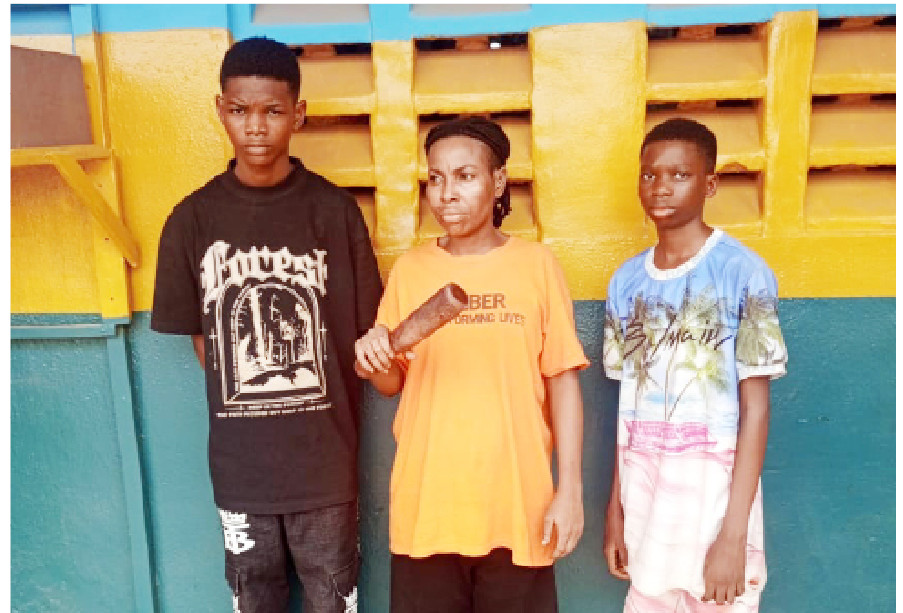
The victim, identified as Stanley Okirie, was discovered with severe head injuries, with investigators concluding that efforts had been made to conceal a violent crime. In connection with the incident, three suspects were arrested: Maureen Okirie, 35, alongside two minors, Salia Karikari, 15, and Jubril Karikari, 12.
Authorities allege that the suspects, who are related to the deceased, were not only involved in his death but also in attempts to secretly dispose of the body. A suspected murder weapon, a wooden pestle, was recovered from the scene, while the remains were later transferred to a mortuary for autopsy.
The Ogun State Commissioner of Police condemned the incident in strong terms, describing it as “cruel, inhumane, and deeply disturbing,” especially given that those allegedly involved were members of the same family.
Beneath the surface of the crime lies a narrative that complicates the initial impression of cold-blooded murder. In a confession reportedly obtained by LEADERSHIP Weekend, Maureen Okirie, believed to be one of the suspects, gave her account of the events that led to her brother’s death.
According to her confession statement, reportedly obtained from sources within the Ajuwon Police Station, the incident began as a domestic altercation. She alleged that the deceased returned from work and started physically assaulting a younger relative, Salia. When she stepped in to intervene, she claimed she also became the target of his aggression.
What followed, according to her account, was a chaotic struggle. She alleged that her brother picked up an object from the kitchen and turned it on her. In the course of defending herself, while Salia also tried to intervene, she said she managed to seize the object and struck him repeatedly on the head. “He collapsed and died,” she was reportedly quoted as saying in her confession. She further claimed that, after the incident, she reached out to members of the community.
While her account raises the possibility of self-defence, it does little to diminish the gravity of the outcome. Rather, it highlights how swiftly domestic disputes can spiral into irreversible violence, particularly in settings where effective conflict resolution mechanisms are limited or absent.
The Ogun case is not an anomaly. In recent months, Nigeria has witnessed a series of homicide cases that point to a broader and more alarming trend.
In Lagos, for instance, a widely reported case involved a young man allegedly killed during a dispute over a minor financial disagreement. What began as a verbal altercation reportedly escalated into physical violence, ending in death. The incident sparked outrage and renewed calls for greater awareness of conflict de-escalation.
Similarly, in Kaduna State, security agencies confirmed the killing of multiple individuals in what was initially described as a communal clash. Investigations later revealed that long-standing grievances, combined with a lack of timely intervention, had created a volatile environment where violence became almost inevitable.
In another reported case from Rivers State, a woman was arrested in connection with the death of her partner under circumstances that authorities described as “suspicious and avoidable.” Reports suggested that repeated domestic conflicts had gone unaddressed before culminating in tragedy.
These cases, though different in context, share a common thread: they reflect a society where tensions, whether domestic, economic, or communal, are increasingly being resolved through violence.
One of the most disturbing aspects of the Ogun incident is not just the killing itself, but the alleged attempt to conceal it through a secret burial. This points to a broader issue: the culture of silence that often surrounds violent crimes in Nigeria.
In many communities, there is a reluctance to report suspicious activities, either due to fear of reprisal, distrust of law enforcement, or cultural norms that prioritise internal resolution over external intervention. This silence can allow crimes to go undetected, or, worse, unpunished.
In this case, the police credited a tip-off for enabling their intervention. Without it, the crime might have been buried, literally and figuratively.
Security experts and social analysts have increasingly raised concerns about the rising tide of violence.
Lagos-based criminologist George Imoeleme observed that what is unfolding reflects a convergence of pressures: economic hardship, social fragmentation, and the weakening of traditional conflict-resolution systems. “When people are burdened by harsh economic realities and have no meaningful outlets for resolving disputes, violence can become a dangerous fallback,” he noted.
A community leader in Ogun State, Elder Samuel Opeyemi, echoed similar concerns, emphasising the need for grassroots awareness. “We must teach people how to manage anger, how to seek help, and how to resolve disputes without violence. Otherwise, these incidents will continue.”
Law enforcement agencies, for their part, have reiterated their commitment to tackling violent crime. The Ogun State Police Command has assured the public that the suspects in the Akute case will face thorough investigation and prosecution.
Beyond statistics and headlines, each homicide represents a life lost and a family shattered. In the Ogun case, the tragedy is compounded by the involvement of close relatives. A family has been torn apart, not just by death, but by the circumstances surrounding it.
For the minors involved, the implications are even more profound. Early exposure to such violence raises serious concerns about psychological trauma and its long-term effects on their development.
Addressing the rise in homicide requires more than reactive policing. It demands a multi-layered approach that includes strengthening community policing and fostering trust between citizens and law enforcement to ensure timely reporting of suspicious activities. It also involves promoting conflict-resolution education and integrating anger management and mediation skills into community programs and school curricula.
There is also a need for the provision of robust social support systems, as well as accessible mental health services and support networks for individuals facing domestic or economic stress.
In a similar vein, there is a need to ensure swift justice, demonstrating that violent crimes will be met with firm and transparent legal consequences.
The foiled secret burial in Ogun State serves as a grim reminder of what often lies beneath the surface of many communities: unresolved tensions, concealed violence, and a growing normalisation of lethal outcomes.
Nigeria stands at a crossroads. The rising frequency of homicide cases is not merely a law enforcement concern; it is a broader societal crisis. It demands introspection, accountability, and collective action.
If this trend is to be reversed, the response must be as multifaceted as the problem itself. Without such urgency and coordination, stories like Stanley Okorie’s risk becoming less shocking exceptions and more tragic norms.
We’ve got the edge. Get real-time reports, breaking scoops, and exclusive angles delivered straight to your phone. Don’t settle for stale news. Join LEADERSHIP NEWS on WhatsApp for 24/7 updates →
Join Our WhatsApp Channel