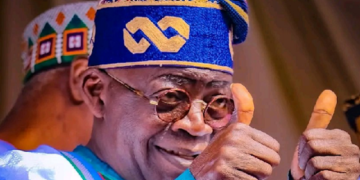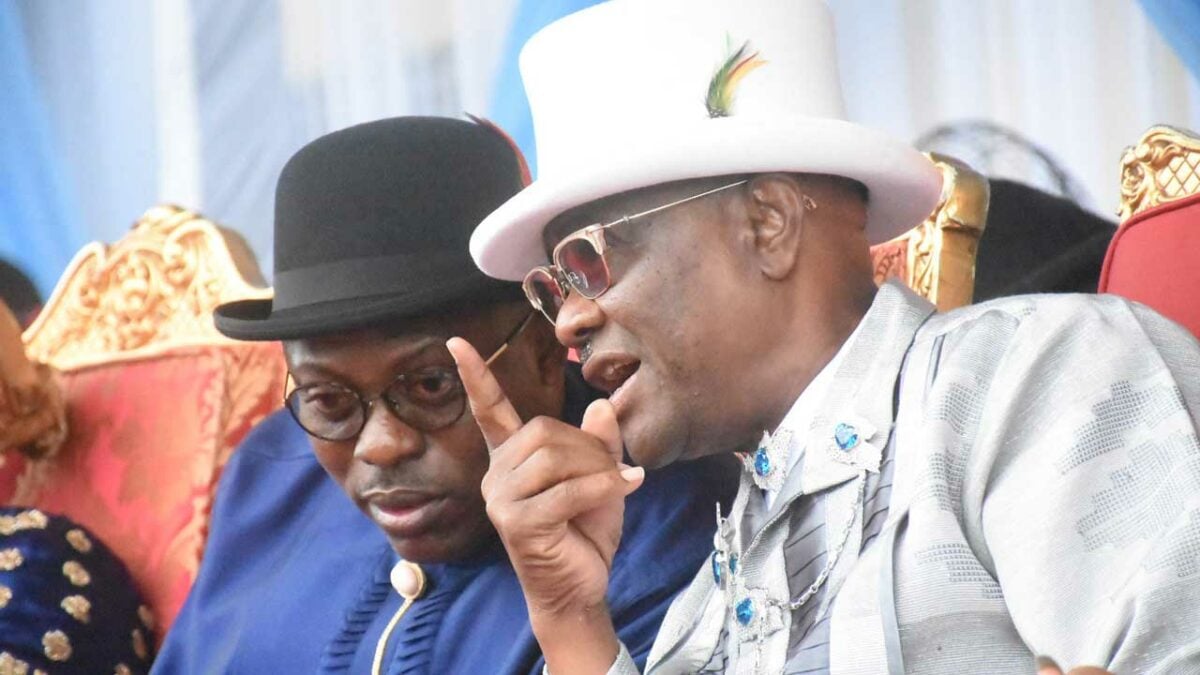
What began as a routine succession arrangement in Rivers State has evolved into a national political test case. As ADEMU IDAKWO reports, the prolonged standoff between Governor Siminalayi Fubara and his predecessor, Nyesom Wike, goes far beyond personal rivalry, exposing how godfatherism, elite bargaining and informal power networks continue to shape governance in Nigeria
The unfolding crisis in Rivers State reflects a deeper fault line within Nigeria’s political system.
The clash between Governor Siminalayi Fubara and Nyesom Wike is not merely the fallout of a broken political relationship; it lays bare how power is brokered, defended and deployed through informal structures that frequently override democratic norms.
Beneath the surface drama, the Rivers crisis is fundamentally about control: control of institutions, political loyalty networks, party structures and economic resources in one of Nigeria’s most strategic states.
What is playing out in Port Harcourt mirrors a broader national pattern in which informal authority, federal influence and elite bargaining continually test the limits of democratic governance.
Fubara’s emergence as governor followed a familiar Nigerian political script: a powerful incumbent installs a trusted successor to retain influence after leaving office.
Rivers was not unusual in this regard. What made the state different was the rebellion that followed.
By asserting autonomy early in his tenure, Fubara disrupted a political culture in which loyalty is not symbolic but transactional and enforceable.
Within Nigeria’s elite power structure, successors are expected to remain politically indebted.
Once that expectation collapsed, confrontation became inevitable, with quiet disagreements escalating into open institutional warfare.
The Rivers State House of Assembly soon emerged as the most visible battlefield. Rather than functioning as a lawmaking body, it became an instrument of political enforcement.
Suspensions, counter-suspensions, impeachment threats and parallel sittings paralysed governance and exposed a deeper problem: state legislatures are often less about representation and more about enforcing elite interests.
Lawmakers aligned with rival power centres turned the Assembly into a theatre of conflict, diverting attention from public welfare.
.This weaponisation of legislative institutions is not unique to Rivers State. Similar patterns have played out across Nigeria.
In Anambra, the bitter fallout between Governor Chris Ngige and his godfather, Chris Uba, triggered a major political crisis after Ngige broke away from the arrangement that brought him to power in 2003.
In the same state, Governor Peter Obi was impeached in 2006 by the Anambra State House of Assembly under controversial circumstances widely criticised for lacking due process.
His removal was later overturned by the courts, reinforcing concerns that impeachment had been deployed as a political weapon rather than a constitutional safeguard.
In Lagos, Deputy Governor Femi Pedro was impeached during Bola Tinubu’s second term, only to be pardoned close to the end of that administration. In Edo State, political tensions between Governor Godwin Obaseki and his deputy, Philip Shaibu, culminated in Shaibu’s impeachment.
In Abia, Enyinnaya Abaribe, now a senator, was impeached as deputy governor following a confrontation with then-Governor Orji Uzor Kalu.
In Kogi, Deputy Governor Simon Achuba was impeached in 2018 amid intense political rivalry.
In Adamawa State, Governor Murtala Nyako was impeached in 2014 after a prolonged confrontation with the federal government and the state legislature.
The process, which followed accusations of gross misconduct, was viewed by critics as politically motivated and reflective of deepening centre–state tensions at the time.
Together, these cases point to a nationwide erosion of legislative independence and the steady hollowing out of democratic institutions.
That pattern has an even deeper history. One of the most consequential examples remains the 2005 impeachment of Bayelsa State Governor Diepreye Alamieyeseigha, widely viewed as having been driven through the instrumentality of the federal government under President Olusegun Obasanjo.
Following Alamieyeseigha’s arrest in London and his controversial return to Nigeria, the Bayelsa State House of Assembly,operating under intense federal pressure, conducted an impeachment process so hurried that serious questions arose about quorum, due process and constitutional compliance.
The episode marked a turning point in Nigeria’s post-military democracy, signalling how federal power could be deployed to discipline subnational actors through compromised legislative institutions, setting a precedent that continues to shape centre–state relations.
Although framed as a state-level dispute, the Rivers crisis cannot be separated from federal power dynamics. Wike’s current position within the federal structure has given the conflict a national dimension, raising questions about the neutrality of federal institutions in subnational political battles.
Security agencies, expected to act as stabilisers, have been accused, rightly or wrongly, of selective enforcement, while conflicting court orders deepened the stalemate. Politics, once settled in party rooms, is increasingly adjudicated in courtrooms.
This intersection of federal power and state politics exposes a fundamental flaw in Nigeria’s federalism.
States may be constitutionally autonomous, but politically, they remain vulnerable to external influence.
At the heart of the crisis lies Nigeria’s enduring problem of godfatherism. Godfathers are not merely political mentors; they are power brokers who finance campaigns, control party machinery and demand returns on political investment.
The Fubara–Wike standoff illustrates what happens when a successor refuses to play the expected role, raising uncomfortable questions about whether elected officials are accountable to voters or to political benefactors.
Rivers is simply louder because of its economic and political weight; similar conflicts simmer quietly across the country.
The crisis assumed a sharper national dimension following Governor Fubara’s alignment with the All Progressives Congress (APC).
Wike dismissed claims that the move was driven by any external conspiracy against him, insisting that political defections remain personal decisions.
While acknowledging that Fubara required no one’s permission to join the APC, he took strong exception to comments from outside Rivers State, particularly attacking the APC National Secretary, Senator Ajibola Basiru,whom he accused of meddling in the state’s volatile political environment.
Wike warned Basiru to stay away from Rivers politics, describing his remarks as reckless and capable of escalating tensions.
In response, Basiru accused Wike of overstepping his bounds and questioned his continued influence within APC affairs despite not being a party member. He challenged the minister to separate his federal responsibilities from his Rivers political battles, or resign if he could not.
The exchange underscored how Rivers State has become a proxy battleground for wider elite and party power struggles. Beyond Basiru, other high-profile figures,including a sitting governor and serving ministers from the South-South and South-East,were accused of quietly fuelling the conflict.
These actors were allegedly working to curtail Wike’s growing influence ahead of 2027, in what insiders describe as a pre-emptive elite power realignment.
Sources familiar with the crisis claim tensions intensified after Wike allegedly attempted to influence succession politics in another eastern state through a close associate,a move that reportedly unsettled the incumbent governor involved.
The fallout, insiders say, triggered a strategic counteroffensive that brought the battle directly into Rivers.
Wike was said to have been caught off guard when Fubara defected to the APC with backing from eastern power brokers, without consulting him as political godfather.
Yet Rivers is not an isolated case. In Kogi, judicial interventions have become routine tools of political survival. In Lagos, silent battles persist between incumbents and entrenched legacy networks. In Kano, state politics frequently collide with federal calculations.
In Edo and Abia, succession disputes continue to reshape party loyalties. Collectively, these cases suggest that Nigeria’s democracy is increasingly shaped by elite negotiations rather than popular mandate.
While political elites manoeuvre, ordinary citizens bear the cost. Civil servants face uncertainty, investors hesitate, youth groups are mobilised not for development but for political defence, and governance slows as economic hardship deepens. For Rivers State,already grappling with environmental degradation and youth unemployment,the cost of prolonged political paralysis is severe.
Although the next general elections are still ahead, the Rivers crisis is unmistakably shaped by 2027 calculations. Control of political structures today determines tickets tomorrow. Political wars are no longer episodic; they are continuous, with Rivers offering a preview of future national alignments and power permutations.
Ultimately, the Fubara–Wike conflict is not about two men. It is about a political system struggling to reconcile democratic ideals with entrenched elite control. Until institutions become stronger than individuals, and loyalty to voters outweighs loyalty to godfathers, such crises will persist. Rivers State has become a mirror,reflecting Nigeria’s unresolved struggle between democracy as an ideal and power as a lived reality.
Former senator Shehu Sani commented on the political crisis in Rivers State, stating that the dispute surrounding the impeachment threat against Governor Fubara is rooted in struggles over political control rather than the interests of the people. Sani made the remarks during an interview on TVC News on Wednesday, January 14, 2026, while speaking on the ongoing tensions involving key political actors in the state.
Speaking on the limits of political influence once an individual assumes executive office, Sani said the authority of a sitting governor is constitutionally defined and cannot be overridden by external forces.
According to him, “Well, the point is that once a person assumes the position of authority or power as a governor of a state, he has limits of power to him, and you cannot dictate to him, you cannot manipulate him, you cannot play him around except if he wants to, despite the role you have played.”
Referring to Nyesom Wike, Sani said the former governor should be mindful of his own political history and public positions. He stated, “And for Wike, he ought to understand that he was once a governor who has spoken out against godfatherism, and he should not overstretch his control to the point that it will lead the governor to revolt against him.” The former senator suggested that attempts to exert excessive influence could deepen the crisis rather than resolve it.
Sani further addressed the broader implications of the political standoff, distancing it from public welfare or governance concerns. According to him, “Now, what is happening in Rivers state is not about the people of Rivers state.” He continued by identifying what he described as the core issue driving the conflict, stating, “It’s about control of political power.”
Speaking to LEADERSHIP Weekend, former minister of Youth and Sports under the immediate past administration, Bar Dalung said in an ideal democracy there is mentorship while god- fatherism is a commercial version of it that is obtainable in Nigeria.
Dalung who mocked the FCT minister,.Nyesom Wile on his role in Rivers state crisis said he was clever by half by taking the matter to President Tinubu who is more politically adept than all of them .
“ Wike who was playing the role of god- father in Rivers state has made Abuja seat of power to have inherited him and the governor as the political godsons given equal rights and privileges Wike had to the embattled governor of Rivers State , Sim Fubara .” He said.
Going back to memory lane , the former minister said since the advent of democracy, there have been no houses of assembly in any state because the majority of them were hand picked by the same god father to do their bidding at the expense of the people.
Also , the Peoples Democratic Party , PDP governorship aspirant for 2027 election in kogi state , Aminu Nda said the endless crisis in Rivers state has greatly affected the lives of the people negatively and appealed to governor Sim Fubara and the assembly members to bury their differences in the interest of peace in the state.
Nda, in an interview with our correspondent in Abuja, said, “The animosity cannot continue because when two elephants are fighting, it is the grass that suffers. We cannot continue this way. The elders must intervene to bring lasting peace,” he appealed.
We’ve got the edge. Get real-time reports, breaking scoops, and exclusive angles delivered straight to your phone. Don’t settle for stale news. Join LEADERSHIP NEWS on WhatsApp for 24/7 updates →
Join Our WhatsApp Channel