If BudgIT had not deployed its Tracka, a civic-tech platform that monitors and reports the status of government projects, the world would not have known that the Borno state government was being economical with the facts when it claimed it had spent N4 billion on rail projects.
The Borno state government stated, in a document it later claimed was an administrative error, that it had spent N4 billion on rail projects within the Maiduguri Municipal Council and the Jere local government area.
Specifically, in its 2025 Budget Implementation Report, the state stated that N2 billion per project was fully spent on the rail projects in the two local government areas, with both projects being 100 per cent completed.
However, the facts on the ground painted a very different picture: rust, abandoned, and deteriorating rail infrastructure, with no evidence of a completed rail project.
There was a clear discrepancy between the budget implementation report and the physical reality, underscoring the importance of citizens monitoring project implementation and scrutinising the government’s claims, including budget reports.
Essentially, this disclosure exposes not only the media, which has the constitutional duty to hold the government to account, but also the state legislature, which is empowered to exercise oversight of the executive. Were the members of the state assembly aware that N4 billion was recorded for projects that were never carried out? How come the media didn’t report that until BudgIT found out?
When it realised it had been caught off-guard, the Borno state government, as a face-saving measure attributed the report to an administrative error.
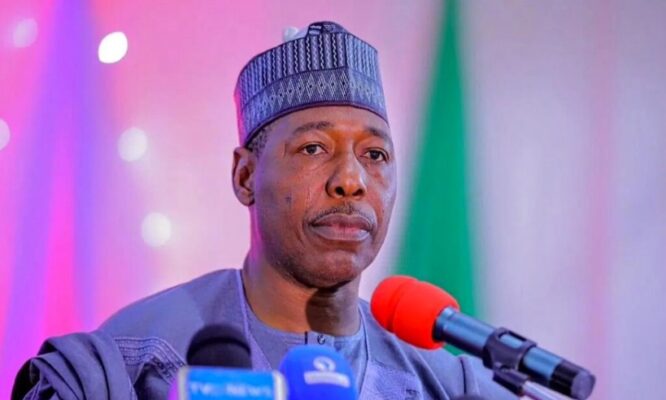
Usman Tar, the commissioner for information and Internal Security, admitted that an internal review conducted by relevant ministries confirmed that no rail project was awarded, funded or executed by the state government during the 2025 fiscal year.
“It was, however, noted that the inclusion of rail project entry in the 2025 Budget Implementation Report, indicating 100 per cent completion, was an administrative error and does not reflect the true position of the matter as the said project was neither executed nor paid for,” Tar said.
A document as significant as the budget implementation report is typically produced through multiple layers. It is mainly a compilation of the quarterly implementation reports from government ministries, departments, and agencies. Therefore, the essential question will be: at what point did the so-called administrative error occur?
Assuming, without conceding, that it was indeed an administrative error, how many such instances are in the 2025 budget implementation report? How did the state make such a serious mistake? What actions have been taken to penalise those responsible for the error and to prevent future occurrences?
The only people who believe the story of administrative error are perhaps the state government itself. Most Nigerians can sense that the Borno state government is making a mild but deliberate effort to be economical with the truth.
If there is any lesson from this embarrassing attempt to cover up what is plainly a deliberate effort by the Borno state government to mislead the public, it is that citizens must be more vigilant and consistently oversee government projects.
As the opposition correctly pointed out, there is a clear “lack of accountability and transparency. There is no way that something as serious as a state budget will have such errors. We are not talking about millions, but billions of naira”.
The Borno State Government must be clearly made aware that its claims of an administrative error did not sit well with most Nigerians, including this newspaper. It should come clean, straightforward and transparent.
It should be noted that the impression this supposed error created in most Nigerians’ minds was that the Borno state government was desperately trying to balance its books. Only an independent investigation can confirm whether that is the case here.
As a newspaper, we fully support the opposition’s calls for an independent investigation, not because we see the opposition parties as different, but because we believe it is the right thing to do. The disclosure has revealed an alarming discrepancy that casts doubt on the entire document. Therefore, there is a strong need to thoroughly investigate the whole document.
When a state claims it has spent a staggering N4 billion on projects that do not exist, it raises serious doubts among citizens about how their resources are allocated and fosters the impression of corruption. This is especially concerning in a country where public trust in the government is at its lowest level.
We’ve got the edge. Get real-time reports, breaking scoops, and exclusive angles delivered straight to your phone. Don’t settle for stale news. Join LEADERSHIP NEWS on WhatsApp for 24/7 updates →
Join Our WhatsApp Channel