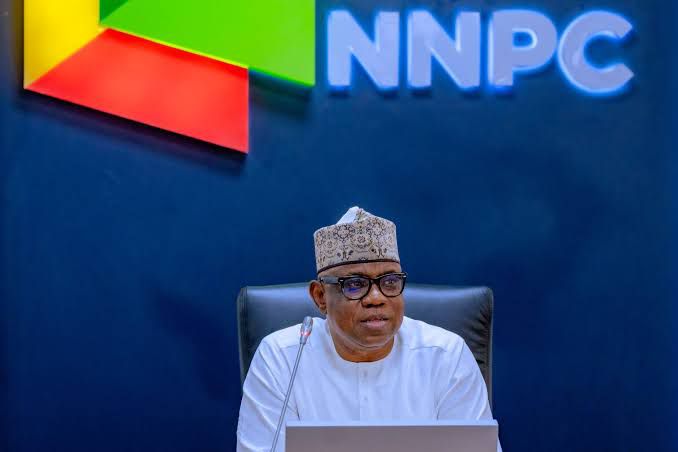
The Centre for Energy Governance and Public Finance Accountability (CEGPFA) has dismissed allegations by the African Democratic Congress (ADC) that President Bola Ahmed Tinubu’s approval of the reconciliation and removal of certain Nigerian National Petroleum Company Limited (NNPC Ltd) legacy balances from the Federation Account was unconstitutional or financially harmful to states and local governments.
Speaking at a press conference on Friday at the Transcorp Hilton, Abuja, the centre described the claims as “unfounded” and “misleading,” arguing that they ignored the historical, legal and fiscal realities surrounding the disputed balances.
Dr. Julius Osagie Eromonsele, Executive Director of CEGPFA, clarified that the balances in question were not fresh revenues generated under the current administration but long-standing legacy entries accumulated over several decades, many predating the Petroleum Industry Act (PIA).
“It is crucial to note that the balances in question are not recent revenues generated under the current administration. They are long-standing legacy entries accumulated over decades, many of them arising before the enactment of the Petroleum Industry Act,” Eromonsele said.
He explained that the disputed figures stemmed from unresolved production sharing contract disputes, domestic crude supply obligations under the former fuel subsidy regime, royalty assessment disagreements, and reconciliation gaps between NNPC, regulators and revenue agencies.
According to him, these balances had remained on the Federation Account books for years despite repeated audits that questioned their accuracy, legal enforceability and collectability, creating a distorted picture of public finances across all tiers of government.
Countering claims that the balances were arbitrarily written off by presidential fiat, Eromonsele said the approval followed a formal reconciliation process involving relevant fiscal and regulatory institutions, with presentations made to the Federation Account Allocation Committee (FAAC).
“Official records show that approximately $1.42 billion and N5.57 trillion were removed from the Federation Account books after reconciliation established that these figures were either duplicated, overstated, unsupported by verifiable documentation, or no longer legally recoverable,” he said.
He stressed that the directive applied strictly to legacy balances accumulated up to December 31, 2024, adding that reconciliation should not be confused with the cancellation of valid revenue.
“Reconciliation is a recognised public finance practice. It is not the same as cancelling valid revenues. Rather, it is the process of aligning records to reflect economic and legal reality,” Eromonsele explained.
The executive director clarified that no cash was removed from the Federation Account and that no allocations to states or local governments were reversed.
“The funds in question were not sitting as cash in the Federation Account. What occurred was the correction of inherited accounting distortions that had long outlived their practical relevance,” he said.
Addressing constitutional concerns raised by the ADC, the centre noted that Section 162 of the Constitution applies only to revenues that are lawfully due and payable, not to disputed or extinguished claims.
“Public finance administration requires constant reconciliation to ensure that only valid, auditable and legally enforceable revenues are presented for distribution,” Eromonsele stated.
He argued that sustaining false receivables undermines budgeting, fiscal discipline and revenue predictability for subnational governments, noting that credible and realistic revenue flows are more beneficial than inflated figures that never materialize.
The centre said the reconciliation aligns with reforms introduced by the PIA, which repositioned NNPC Ltd as a commercial entity operating under international accounting standards.
Concluding, CEGPFA commended President Tinubu for approving what it described as a difficult but necessary decision.
“Writing off long-standing, unverifiable legacy balances required political will and a commitment to fiscal honesty over convenience. It sends a clear signal that Nigeria is prepared to confront the structural weaknesses of its energy revenue system rather than perpetuate them,” Eromonsele said.
He urged politicians and stakeholders to approach the issue responsibly and support reforms that strengthen transparency and accountability in Nigeria’s public finance system.
We’ve got the edge. Get real-time reports, breaking scoops, and exclusive angles delivered straight to your phone. Don’t settle for stale news. Join LEADERSHIP NEWS on WhatsApp for 24/7 updates →
Join Our WhatsApp Channel