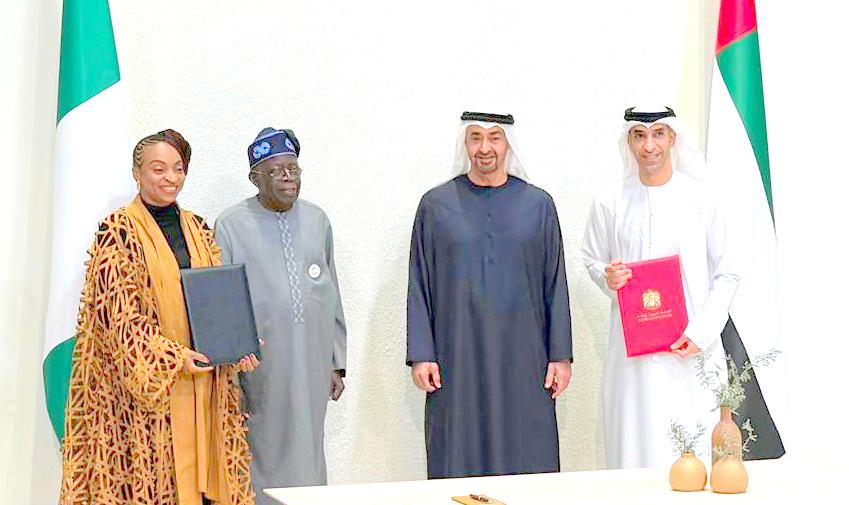
President Bola Tinubu has said global climate action must go beyond environmental targets to directly deliver jobs, economic growth and expanded energy access, particularly for developing countries.
Speaking at the Abu Dhabi Sustainability Week on Tuesday, Tinubu told world leaders, investors and development partners that sustainability would only succeed if climate policies were aligned with human development, social inclusion and economic opportunity.
According to the President, the links between climate change, the global economy, health, food security and energy access, must now shape how governments design and implement public policy.
“At this defining moment in history, climate action must work for people,” Tinubu said. “It must power homes, create jobs, unlock opportunity and lift communities, especially in developing economies.”
He said Nigeria viewed the global energy transition as an opportunity to expand electricity access, stimulate industrial growth and create employment, rather than as a constraint on development.
Tinubu noted that Nigeria has taken concrete regulatory and policy steps to strengthen its climate governance framework, including the adoption of a National Carbon Market Activation Policy and the launch of a national carbon registry to improve emissions reporting and verification.
The President said these reforms were designed to attract investment, improve transparency and position Nigeria to benefit from global carbon markets while advancing domestic development priorities.
Highlighting energy reforms, Tinubu pointed to the Electricity Act of 2023, which allows for decentralised and inclusive power generation, enabling states, communities and private investors to expand electricity supply, particularly to rural and underserved areas.
“In practical terms, this means reliable power for health facilities, schools, markets and communities that have long been left behind,” he said.
The President also stressed the importance of technology and innovation, noting that artificial intelligence and digital solutions were increasingly critical to improving efficiency across energy systems and infrastructure.
As part of Nigeria’s green transition, Tinubu said the country was actively seeking international partnerships focused on technology transfer, innovation and capacity building.
On climate finance, the President said developing countries required equitable access to funding and affordable technologies to meet climate commitments without undermining growth and poverty reduction efforts.
He disclosed that Nigeria was pursuing major climate and green industrialisation investments aimed at mobilising tens of billions of dollars annually in climate finance, alongside expanded access to green bonds and multilateral funding for clean energy projects.
Tinubu reaffirmed Nigeria’s commitment to an energy transition that integrates climate mitigation, industrial development and social progress, adding that sustainability would only be meaningful if it improves livelihoods and economic outcomes.
“Nigeria stands ready to work with the global community to ensure climate action delivers real impact for people,” he said.
The Abu Dhabi Sustainability Week brings together heads of state, policymakers, business leaders and development institutions to shape global responses to climate change, energy transition and sustainable development.
We’ve got the edge. Get real-time reports, breaking scoops, and exclusive angles delivered straight to your phone. Don’t settle for stale news. Join LEADERSHIP NEWS on WhatsApp for 24/7 updates →
Join Our WhatsApp Channel