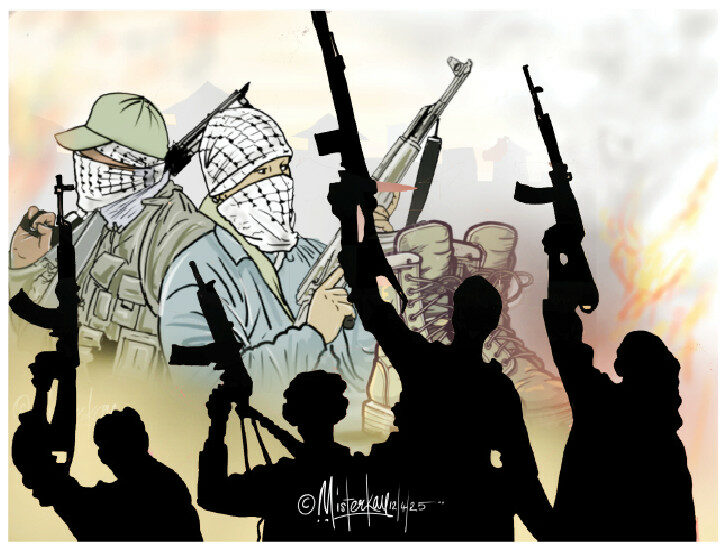
Scholars have contested the concept of radicalisation. There have been arguments for and against it. Some argue that radicalisation is religious indoctrination, while others argue that it is a result of ignorance. They can sustain their arguments. However, I hold a third view. Radicalisation might be a state of fantasy. It is a distorted view of reality. You are mentally caged to the point where you imagine the improbable as possible. For example, why would a group of people think that Western education is “haram?” What alternative form of education have they proposed? I would assume the original Boko Haram plot was not intended to be a violent campaign. But the plot was hijacked after the death of Mohammed Yusurf in 2009. And the rest is history.
Mischief in the Name of Religion
Religion is often a victim of mischief. And mischief sticks like glue. Sometimes, its interpretation is skewed. This is so because there are various sects, and these sects interpret religious doctrines in the way that suits their purpose. For example, Islamic groups with violent tendencies often engage in such behaviour for political or economic purposes, rather than for purely religious reasons. They typically claim it is for the sake of “Allah/God,” and this claim can be persuasive. However, other reasons are advanced in hushed tones. This is also the case for other religions. Many groups fall into this category and are responsible for the confusion between radicalization and extremism. And the concept of “deradicalization” only adds to the complexity of the issue.
Radicalisation and Extremism
Radicalisation and extremism are distinct. But they result in unpleasant consequences. Radicalisation is intangible. It is a mental addiction. Extremism is tangible. It is an action. It could be violent or non-violent. Most often, it is violent. Attributing radicalisation or extremism to religion is a hoax. Extremism is big business, and the players are enjoying themselves. I am glad the motive behind the Boko Haram insurgency is gradually unfolding. The religious coloration it once wore is gradually fading. Boko Haram insurgency can be argued from a sociopolitical standpoint. The arms and ammunition they use come from where? Don’t they use phones and other electronic gadgets? It is not a religious agitation. If it were, it would have countered Iqra, the first command in the Quran. It is a broad command to “read, recite, study, understand, examine, and know.” It emphasises that education and knowledge are fundamental to faith, guiding Muslims to understand Allah’s command and contribute positively to society. In this case, where does the Boko Haram ideology stem from? The Quran, Sunnah, or Hadith?
Ted Robert Gurr, an Emeritus American Professor of political conflict and instability, provides insight into what may drive groups towards violent actions. He argues that “relative deprivation (economic inequality, political exclusion) creates grievances that can push groups towards radical violence.” In his work “Why Men Rebel,” he analyses the “frustration-aggression” hypothesis, which states that “prolonged feelings of frustration can lead to aggressive behaviour.” Gurr suggests that while not everyone who experiences frustration will resort to violence, those who feel a strong sense of relative deprivation are more likely to do so. He raises a pertinent point that has not received its due attention in the global discourse on “violent extremism.”
The Quilliam Foundation
What the Quilliam Foundation presents to the world is balderdash. It formalized “Islamic deradicalisation” as a counter-terrorism goal in 2008. It turned radicalism and extremism upside down and gave it a religious identity. Sayeeda Warsi, the first female Muslim member of a British Cabinet, was apt in her description of the Quilliam Foundation. In her book “The Enemy Within,” she described it as “a bunch of men whose beards are tame, accents crisp, suits sharp, and who have a message the government wants to hear.” This was corroborated by Malia Bouattia, the former president of the National Union of Students in the United Kingdom, who said that “after 13 years, Quilliam leaves behind a toxic legacy, which will continue to harm the Muslim community in the United Kingdom and beyond.”
Operation Safe Corridor
In my doctoral thesis at the Leadership School of the University of Abuja, I interrogated the “Nigerian military and non-kinetic strategies towards addressing insecurity, Operation Safe Corridor in perspective.” In my research, I identified lapses in the operational effectiveness of the programme. I argued that radicalisation is a deep mental addiction that often leads to violent behaviours. I concluded that the Operation Safe Corridor concept is superficial. However, it is not a completely bad case. It was established by the Muhammadu Buhari administration in 2015 to “deradicalize, rehabilitate, and reintegrate repentant Boko Haram ex-combatants into society.” Operation Safe Corridor cannot be effective under its present setup. The reason is simple. We need to come to a clear understanding of the factors that breed radicalism and extremism.
What we have in place at the moment won’t work. I predict that we will struggle with Operation Safe Corridor for a while. There is already a debate around it in the public space. It is an attempt to fix what is not broken. There are many unanswered questions. For example, are the ex-combatants actually members of Boko Haram or a group of opportunists looking for a life and a sense of direction? Let’s assume they are members of Boko Haram. Can they be deradicalized between 6 and 12 months? Is there a mechanism to monitor and track their progress after graduation from the programme? The confusion is palpable and cuts across borders. Operation Safe Corridor is not alone in this confusion. From a distance, it seems the global deradicalisation concept is succeeding. But it is not when you look strategically. It’s more like treating a symptom, while neglecting the underlying cause of the illness. For example, if you have a swollen foot, and the doctor prescribes a balm to treat the pain and swelling, rather than looking at what caused the swelling and pain in the first place. The concept “Deradicalization” has to be redefined. We need to factor in immediate, remote, and other causes that breed radicalism and extremism.
My key recommendation is to de-emphasize the role of religion in its definition, and understand that extremist groups wreaking havoc across the world have their motives beyond religion. They simply hijacked religious doctrines as a cover for their nefarious activities. And their victims are human beings. Bullets and IEDs don’t discriminate. They kill everybody. We have fantasized enough. This is food for thought.
And one more thing…
Twenty-eight Brigadier Generals were recently promoted to the rank of Major General. Among them were Major General O Adegbe, Major General S. M. Uba, Major General A. Babalola, Major General S. S. Tilawan, Major General I. O. Bassey, Major General E. A. Orakwe, Major General U. G. Yusuf, Major General I. D. Oloyede, Major General M. A. Agi, Major General I. M. Abass, and Major General F. O. Omata. Their exploits in the theatre of operations in the north-east, north-west, and north-central at various stages were impressive. I congratulate these officers and gentlemen Generals.
We’ve got the edge. Get real-time reports, breaking scoops, and exclusive angles delivered straight to your phone. Don’t settle for stale news. Join LEADERSHIP NEWS on WhatsApp for 24/7 updates →
Join Our WhatsApp Channel