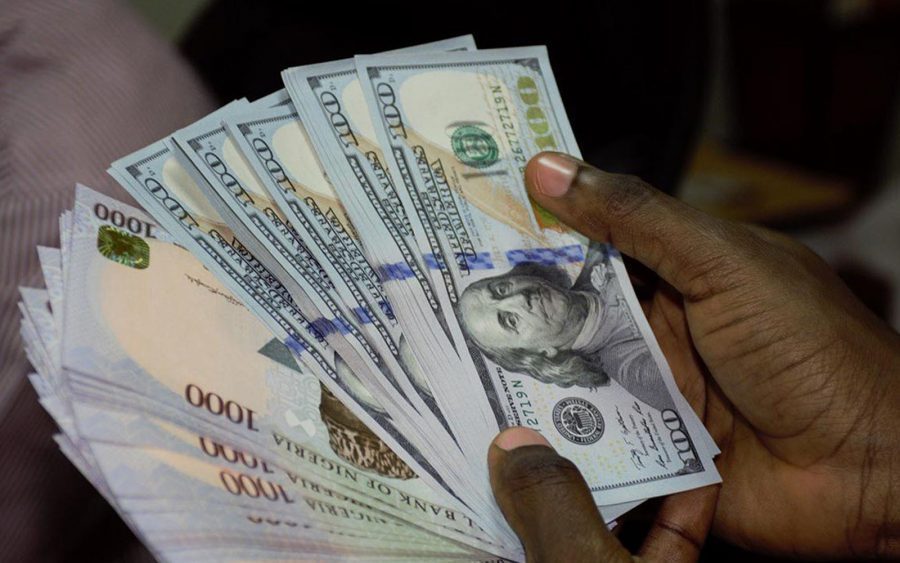
Dollar inflows into Nigeria’s foreign exchange market surged sharply in 2025, reflecting stronger confidence and improving market conditions, data from FMDQ has shown.
Total inflows into the Nigerian Foreign Exchange Market climbed by 62.9 per cent year on year to $50.67 billion in 2025, compared with $31.11 billion recorded in 2024.
Relatively higher exports underpinned the strong performance, improved market confidence, and more attractive carry-trade opportunities. The momentum was sustained till the end of the year as inflows into the market continued to strengthen.
FMDQ data showed that total inflows rose by 17.5 per cent month on month to $3.37 billion in December from $2.87 billion in November. The improvement reflected gains from both local and foreign sources, signalling a broader-based recovery in dollar supply to the market.
Local sources remained the dominant driver of inflows, accounting for 74.9 per cent of total inflows in December. Inflows from local sources rose by 24.2 per cent month on month to $2.52 billion in December, up from $2.03 billion in November.
The increase was primarily supported by larger contributions from the Central Bank of Nigeria, individuals, and exporters and importers, suggesting improved liquidity conditions in the domestic economy.
Specifically, inflows from the CBN recorded a substantial increase of 51.7 per cent month on month, while inflows from individuals rose by 36.9 per cent.
Exporters and importers also recorded a notable 32.8 per cent increase, benefiting from improved trade flows and better pricing conditions. However, inflows from non-bank corporates declined by 8.9 per cent over the same period, slightly moderating the overall growth from local sources.
Foreign inflows also posted modest gains, accounting for 25.1 per cent of total inflows into the market in December. Inflows from foreign sources increased marginally by 1.2 per cent month on month to $847.40 million, compared with $837.10 million in November. The improvement was driven mainly by stronger inflows from foreign direct investment and other corporate sources.
According to the data, inflows from the FDI segment more than doubled, rising by 102.4 per cent month on month, while inflows from other corporate sources increased by 40.2 per cent.
These gains helped offset a decline in portfolio inflows, as the foreign portfolio investment segment recorded a 7.9 per cent drop during the month.
Analysts say the overall growth in dollar inflows in 2025 reflects improving sentiment toward the Nigerian foreign exchange market, supported by reforms, better price discovery and increased confidence among both local and foreign participants.
According to analysts at Cordros Research, inflows from both domestic and foreign sources are expected to remain robust this year, supported by rising exports, sustained market confidence, and still-attractive carry-trade opportunities.
Meanwhile, the value of the naira depreciated last week by 0.1 per cent week on week to N1,418.28 to the dollar amid demand pressures. In the forwards market, the naira appreciated by 1.0 per cent across the 1-month contract to N1,444.96 per dollar, and by 0.7 per cent across the 3-month contract to N1,490.77 per dollar. The 6-month contract was also up by 1.3 per cent to N1,545.97 per dollar, and the 1-year contract rose by 1.5 per cent to N1,661.55 per dollar.
Gross foreign reserves increased last week by $156.40 million week on week to $45.82 billion as of January 14. Analysts say they expect the naira to remain broadly stable in the near term, supported by a favourable external position characterised by a sustained current account surplus and substantial foreign exchange reserves. Continued investor confidence, alongside elevated naira yields, is expected to underpin steady capital inflows and further anchor exchange rate stability.
We’ve got the edge. Get real-time reports, breaking scoops, and exclusive angles delivered straight to your phone. Don’t settle for stale news. Join LEADERSHIP NEWS on WhatsApp for 24/7 updates →
Join Our WhatsApp Channel