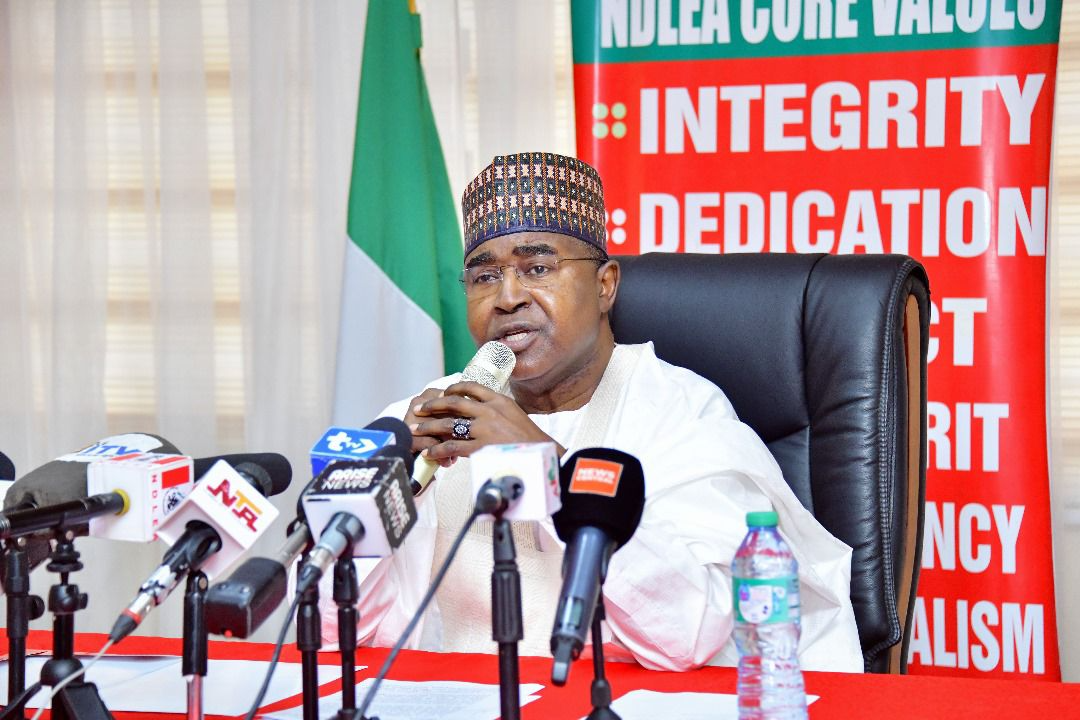
As Nigerians joined the rest of the world to mark the 2026 International Day Against Drug Abuse and Illicit Trafficking on June 26, the figures presented by the Chairman of the National Drug Law Enforcement Agency, Brigadier General Mohamed Buba Marwa (retd.), at the Presidential Villa in Abuja could not have arrived at a more instructive moment.
In the last 18 months, the agency arrested 29,262 suspected drug offenders, seized over 5.3 million kilograms of assorted illicit drugs valued at more than N1.5 trillion, and secured the conviction of 5,225 offenders.
In our view, these are numbers that demand serious reflection, not simply as a record of institutional achievement, but as a measure of the scale of a crisis that continues to threaten the fabric of Nigerian society.
This newspaper commends the NDLEA and its leadership for these results. They vindicate those who argued, when the agency was re-energised, that disciplined, intelligence-driven
enforcement could make a difference. The dismantling of the Amadi Simon drug cartel in collaboration with the United States Drug Enforcement Administration and agencies from Greece, France and Switzerland; the arrest of a cross-continental methamphetamine syndicate involving a Nigerian drug baron, three Mexican nationals and six accomplices; and the discovery of an industrial-scale clandestine laboratory in a forest in Oyo State all demonstrate what is achievable when Nigerian institutions are led with purpose and backed by genuine political will.
Yet the same figures that speak to the NDLEA’s effectiveness also speak to the depth of the problem it is combating. Five million kilograms seized and nearly 30,000 arrested in 18 months are not the statistics of a crisis in retreat. They are the statistics of a crisis that has entrenched itself across airports, seaports, land borders, forests and communities, one that has corrupted institutions, destroyed families and robbed a generation of young Nigerians of their futures.
On a day such as this, the question that must be asked is not simply what the NDLEA has achieved, but whether Nigeria as a whole, its federal and state governments, its legislature, its communities, and its civil society are responding to the drug emergency with the seriousness it demands.
The honest answer is that it is not. As General Marwa himself acknowledged at the Abuja event, enforcement alone cannot solve the drug problem. This is a truth that must be translated into policy with far greater urgency than has so far been shown. The agency’s own demand-reduction figures illustrate the gap: 13,508 drug users received counselling, treatment and rehabilitation across 31 centres nationwide within the period under review.
For a country of over 220 million people, one that the United Nations Office on Drugs and Crime consistently ranks among the highest in Africa for rates of substance abuse, 31 rehabilitation centres is an indictment of the government’s commitment to the other half of the drug war. State governments, which bear primary constitutional responsibility for healthcare delivery, cannot continue to leave the treatment burden entirely to a federal agency.
Every state must establish and fund rehabilitation infrastructure, train addiction counsellors and integrate substance abuse treatment into its primary healthcare system. This is not optional.
The NDLEA’s Alternative Development Programme, described as the first of its kind in Africa, points in precisely the right direction. By providing illicit cannabis growers with legitimate sources of income through the cultivation of cassava, maize, cowpeas and cocoa, the programme addresses a truth the evidence has long established: that for many Nigerians, particularly in rural communities, the drug economy is not a moral failure but a rational response to the absence of viable alternatives.
Pointedly, poverty, unemployment and the collapse of legitimate rural livelihoods have consistently delivered recruits to drug networks. Any strategy that focuses exclusively on supply suppression while ignoring the conditions that generate supply will produce only temporary gains.
The 2026 World Drug Report released by the UNODC on the same day underscores this challenge with particular urgency. The rapid transformation of global drug markets through technology and synthetic substances presents threats that outpace many of Nigeria’s current capabilities. New psychoactive substances, the use of encrypted digital platforms for trafficking, and the integration of drug networks with terrorism and organised crime demand that the country invest without delay in deep-web intelligence capabilities, advanced forensic analysis and international law enforcement cooperation.
The NDLEA has indicated its commitment to building these capabilities. The government must provide the funding to make that commitment real.
We note with approval the call by the First Lady, Senator Oluremi Tinubu, for greater investment in prevention and for governments, families, schools, faith-based organisations and civil society to work in concert to protect children and young people from substance abuse.
Prevention is universally acknowledged as the most cost-effective intervention in any public health crisis, yet it remains one of the most consistently underfunded areas of Nigeria’s drug control response. The 6,645 sensitisation programmes conducted by the NDLEA across schools, worship centres, markets and communities in the period under review reached nearly five million Nigerians. That figure, commendable as it is, still leaves the overwhelming majority of at-risk communities without adequate protection.
President Tinubu’s administration has affirmed its commitment to evidence-based interventions, stronger border management and international cooperation. These are the right priorities. What must now follow is a budget that reflects them. An agency that has delivered results of this magnitude and earned Nigeria recognition across Africa and the international community deserves equipment, technology, personnel, and the full interagency cooperation of sister agencies, including the Nigeria Customs Service and the Nigerian Immigration Service, without which the NDLEA’s effectiveness will remain constrained.
We have said before on this page that the fight against crime, in any form, cannot be won by a single agency acting in isolation. The drug war is no exception. Until government at all levels matches the NDLEA’s institutional commitment with the resources, the policy framework, and the social interventions the crisis demands, the gains being recorded, as significant as they are, will remain insufficient to turn the tide. Nigeria’s young people deserve better. The country cannot afford to settle for less.
We’ve got the edge. Get real-time reports, breaking scoops, and exclusive angles delivered straight to your phone. Don’t settle for stale news. Join LEADERSHIP NEWS on WhatsApp for 24/7 updates →
Join Our WhatsApp Channel