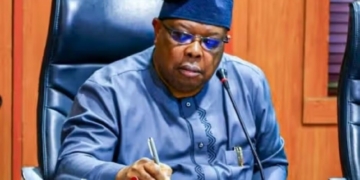
The minister of Finance and Coordinating Minister of the Economy, Mr. Wale Edun, has assured Nigerians that the federal government remains focused on keeping food prices stable despite growing global uncertainties that could impact the domestic economy.
The finance minister gave the assurance on Wednesday during an appearance on Politics Today, a programme on Channels Television, where he addressed concerns about the potential economic implications of global geopolitical tensions and domestic reforms.
Mr Edun said recent economic gains, including declining food prices and moderating inflation, demonstrate that the government’s policy measures are beginning to produce results.
According to him, while there are no absolute guarantees in managing a complex economy, the administration remains committed to policies that will sustain lower food prices and ease inflationary pressures on households. “There are no guarantees,” Edun said, noting that economic management often involves responding to unpredictable global developments.
“But what we can guarantee is that that is what we are focused on. That’s what we are working towards, and that’s what we have achieved to date,” he added.
The minister emphasised that government policy is now centred on ensuring adequate domestic food production in order to maintain affordability and reduce the risk of supply disruptions.
He said the economic management team recently reviewed developments in the agricultural sector and is considering additional initiatives to strengthen local food production.
According to him, the government’s strategy prioritises boosting domestic output before resorting to imports to stabilise the food supply.
Edun said the approach aligns with a broader global shift towards strengthening local production systems in response to rising geopolitical tensions and supply chain vulnerabilities. “What we are seeing around the world today reinforces what had already started, which is a move to domestic production,” he said.
“We have a huge domestic market in Nigeria, and we need to ensure that investors are adequately supported to produce locally.”
The minister also defended the administration’s economic reforms, particularly the removal of petrol subsidy and the shift to market-based foreign exchange pricing, which triggered sharp price increases shortly after their introduction.
Nigeria recorded inflation above 30 per cent in 2024 following the policy adjustments, while petrol prices surged significantly after subsidy removal.
Edun said the reforms were necessary to correct distortions that had made the economy unsustainable.
According to him, the previous system of administratively allocating foreign exchange at artificially low rates and selling petrol below international market prices created large inefficiencies and encouraged cross-border smuggling.
He explained that under the former arrangement, Nigeria was effectively subsidising fuel consumption in neighbouring countries because domestic prices were far below regional levels.
“Those were unsustainable situations,” he said.
He noted that the shift to market pricing has helped restore stability in fuel supply and created incentives for domestic refining and value addition within the country.
Edun said the policy environment is already encouraging increased local production, which is expected to gradually ease price pressures across key sectors of the economy.
He also highlighted the role of monetary policy in addressing inflation, noting that the Central Bank of Nigeria’s tighter financial conditions have helped reduce excess liquidity in the economy.
According to him, the combination of supply-side reforms and tighter monetary policy has helped moderate inflation.
Edun said inflation has declined significantly from about 34 per cent at its peak to around 15 per cent, although he acknowledged that the government’s target is to reduce it further to single digits.
“We’re not there yet, but it is a tremendous achievement in the right direction,” he said.
He added that the progress reflects the impact of the administration’s economic reform agenda and President Bola Ahmed Tinubu’s political will to implement difficult but necessary policies.
Edun expressed confidence that continued reforms and stronger domestic production will help protect Nigerian households from global economic shocks while ensuring stable food prices in the months ahead.
We’ve got the edge. Get real-time reports, breaking scoops, and exclusive angles delivered straight to your phone. Don’t settle for stale news. Join LEADERSHIP NEWS on WhatsApp for 24/7 updates →
Join Our WhatsApp Channel