
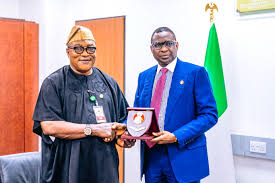
The Economic and Financial Crimes Commission (EFCC) and the Alumni Association of the National Institute for Security Studies (AANISS) have pledged closer collaboration to tackle vote buying and other forms of electoral fraud, as part of efforts to ensure credible elections in Nigeria.
The commitment was made on Wednesday, March 18, 2026, when AANISS President, Mike Ejiofor, led members of the association on a courtesy visit to the EFCC chairman, Ola Olukoyede, at the Commission’s headquarters in Jabi, Abuja.
Speaking during the visit, Ejiofor said the theme of the association’s 2026 annual lecture: “Credible Elections in Nigeria and National Security,” informed its engagement with the EFCC, citing the Commission’s visible efforts in curbing vote buying.
“I must commend the EFCC, because I see the arrests you made over vote buying, which is the greatest challenge we are facing right now in the electoral process. I must commend you,” he said.
He, however, urged the anti-graft agency to scale up its strategies as the 2027 general elections approach.
“As the general election is coming up in 2027, you should intensify and work out more modalities to ensure that vote buying is curtailed. We’re also available to cooperate with you. We will collaborate with the EFCC in terms of consultancy and advice. If you need resource persons, we are available to assist,” Ejiofor added.
Responding, Olukoyede reaffirmed that tackling vote buying falls squarely within the EFCC’s mandate, noting that the Commission has recorded significant convictions in that regard. He assured that preparations for the 2027 elections were already underway.
“With regards to the 2027 general election, the Commission is not going to wait until election day to go into action. Contingent planning and intelligence gathering are crucial to tackle fraudulent actors in any electoral process,” he said.
The EFCC chairman also called on AANISS members to take on greater responsibility in promoting national security, stressing the link between corruption, financial crimes, and insecurity.
“There’s this strong link between national security and financial crimes and that is where we need our collaboration. We need to collaborate and synergize. We need you to support the agencies to ensure that we fulfil our mandate,” he stated.
Olukoyede further highlighted the Commission’s preventive approach in tackling corruption, including the establishment of a Fraud Risk Assessment and Control Directorate to monitor financial activities across Ministries, Departments, and Agencies (MDAs).
“One of the critical things we did was to ensure that we don’t always wait for money to be stolen before we start rolling up our sleeves. So, I set up a Directorate called Fraud Risk Assessment and Control. Now, they are working with MDAs, tracking releases on a monthly basis. We are looking at where the money is going because it costs more to recover than to prevent,” he explained.
He also underscored the importance of asset recovery in the anti-corruption fight.
“As a matter of fact, from day one, we made asset recovery key, because depriving those who perpetrate crime the proceeds of their crimes is a sure way to discourage them. If you allow them to have access to those assets, they will get the best of lawyers and continue to fight you with matters going on for 10 to 15 years in court,” Olukoyede said.
The EFCC boss urged AANISS to use its platform to sensitise Nigerians on the dangers of financial crimes, warning that corruption remains a major threat to national security.
“If we don’t take the issue of the fight against corruption, economic and financial crimes as a national policy, there is no way we can find security. They are like twins. They are tied together. So, we need your cooperation. Even more, we need your support,” he added.
We’ve got the edge. Get real-time reports, breaking scoops, and exclusive angles delivered straight to your phone. Don’t settle for stale news. Join LEADERSHIP NEWS on WhatsApp for 24/7 updates →
Join Our WhatsApp Channel