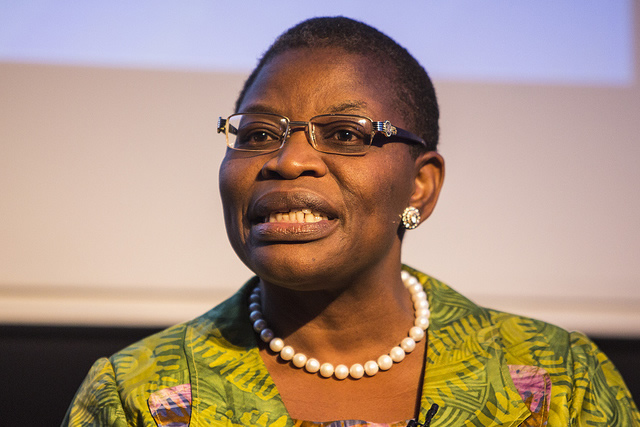
When Dr Obiageli Katryn Ezekwesili recently stepped onto the global stage in Doha, Qatar, to receive the International Anti-Corruption Excellence Lifetime Achievement Award, it was more than a personal honour.
It was a moment that symbolised decades of principled struggle, institutional reform and unrelenting advocacy for transparency and accountability in Nigeria, across Africa and on the world stage.
The award recognised a career defined by courage, competence and a refusal to compromise on integrity, qualities that have come to define Ezekwesili’s public identity.
Widely known as Oby Ezekwesili, she has spent over three decades shaping policy debates, reforming institutions and challenging entrenched systems of corruption.
From the early years of her professional life to her current role as a global civic leader, her journey has followed a clear and consistent path based on the belief that nations only progress when public resources are managed transparently and leaders are held accountable.
Born in Nigeria, Ezekwesili’s formative years laid the intellectual foundation for her later influence. She earned a Bachelor’s degree from the University of Nigeria, Nsukka, before proceeding to the University of Lagos for a Master’s degree in International Law and Diplomacy.
Her academic journey later took her to the Kennedy School of Government at Harvard University, where she obtained a Master’s degree in Public Policy and Administration. Complementing this strong academic background was her qualification as a chartered accountant, a skill set that sharpened her understanding of financial systems, governance structures, and institutional accountability.
Her professional career began in the private sector with Deloitte and Touche, where she worked as an auditor and management consultant. There, she gained practical experience in financial oversight, compliance and organisational efficiency.
These early years exposed her to the inner workings of institutions and reinforced her conviction that systems, not personalities, determine outcomes in governance.
A defining chapter of her career opened in 1993 when she co-founded Transparency International, the Berlin-based global anti-corruption organisation. As a founding director and later regional director for Africa, Ezekwesili helped shape the organisation’s global agenda and its flagship tools, including the Corruption Perceptions Index.
Through this work, she became one of the earliest African voices to place corruption firmly within the global development discourse, arguing that it was not merely a moral issue but a structural obstacle to economic and social progress.
Her return to Nigeria in 2000 marked the beginning of one of the most consequential eras of reform in the country’s recent history. Invited by then-President Olusegun Obasanjo, she established and led the Budget Monitoring and Price Intelligence Unit, which later became the Bureau for Public Procurement.
In a system long plagued by opaque contracting and inflated costs, Ezekwesili introduced strict due process mechanisms that prioritised transparency, competition and value for money. The impact was immediate and measurable, with procurement costs reduced and public confidence partially restored. It was during this period that she earned the enduring nickname “Madam Due Process.”
In 2005, Ezekwesili was appointed minister of Solid Minerals Development. At the time, the sector was largely underdeveloped and poorly regulated. She led the passage and implementation of the Minerals and Mining Act and established the Nigerian Mining Cadastre Office, laying the groundwork for private sector participation and a more competitive mining industry.
Her subsequent appointment as minister of Education in 2006 placed her at the centre of another critical national challenge. During her tenure, she pursued ambitious reforms aimed at achieving “Education for All” and advancing the Millennium Development Goals.
She restructured the Federal Ministry of Education, strengthened institutional governance, revived the Federal Inspectorate Service and introduced data-driven planning through the Nigeria Education Management Information System. Her policies also promoted public-private partnerships and incentivised states to improve enrolment and retention, with particular attention to girls’ education.
Ezekwesili’s influence expanded beyond Nigeria in 2007 when she was appointed Vice President for the Africa Region at the World Bank. Overseeing operations in 48 sub-Saharan African countries, she managed a lending portfolio of nearly 40 billion dollars.
Her tenure focused on human capital development, infrastructure, agriculture, private sector reform and debt sustainability. She became known for bridging global financial frameworks with African development priorities, advocating policies that strengthened institutions rather than perpetuated dependency.
After leaving the World Bank in 2012, Ezekwesili returned to Nigeria as a prominent civic voice. In 2014, she co-founded the Bring Back Our Girls movement, which drew global attention to the abduction of schoolgirls in Chibok and highlighted broader issues of insecurity and governance failure. The movement underscored her belief in citizen-led accountability and moral leadership.
Her foray into partisan politics in 2018, when she sought the presidency, further demonstrated her commitment to systemic change.
During the 2019 Presidential Debate, she said, “Nigeria needs to be rescued urgently. What we see in our country is a massive failure of our leaders.
“To reduce government spending, the private sector must run the economy.”
During her campaign, she also said: “I have a dream of a new Nigeria that works for all, not just for a small clique.”
Although she later stepped aside to support coalition-building, her campaign injected conversations about ethical leadership, youth inclusion and governance reform into the national political discourse.
Today, Ezekwesili leads several platforms dedicated to leadership development and democratic renewal, including the FixPolitics Initiative, the School of Politics, Policy and Governance and Human Capital Africa.
We’ve got the edge. Get real-time reports, breaking scoops, and exclusive angles delivered straight to your phone. Don’t settle for stale news. Join LEADERSHIP NEWS on WhatsApp for 24/7 updates →
Join Our WhatsApp Channel