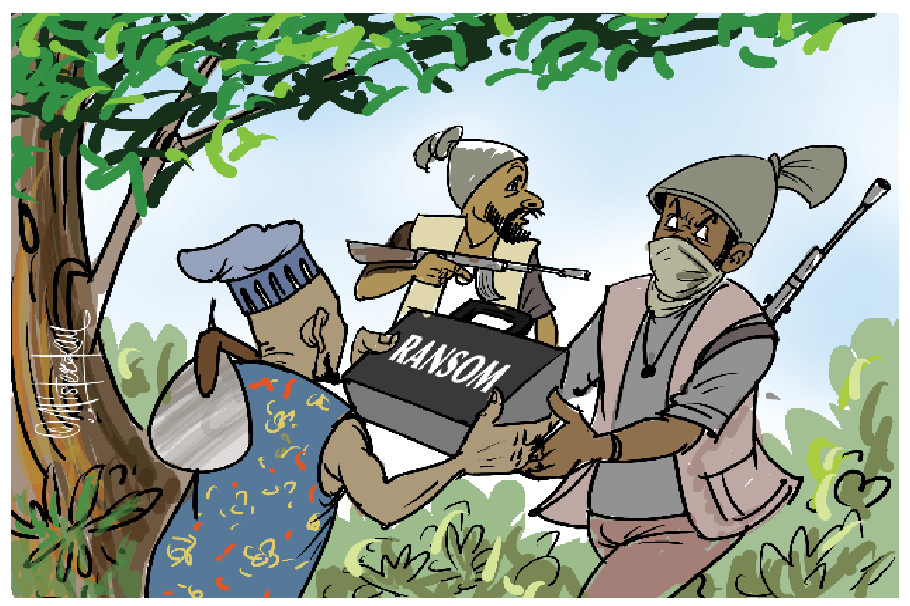
Earlier this week, residents of Gidan Waya Community in Jere Local Government Area of Kaduna State said they sold over 3,000 bags of maize to raise N40 million in ransom. The money was reportedly collected and paid to kidnappers who attacked the community and abducted thirteen residents.
Chairman of the Gidan Waya Elders’ Forum, Mallam Rabo Sambo, stated, according to media reports, that weeks after the ransom was paid, the abducted individuals have yet to be released and reunited with their families. More than two months have passed since armed men stormed the community on 11 November 2025, killing four people and abducting 13 others.
Like Gidan Waya, Like Kurmin Wali
While the people of Gidan Waya have raised N40 million through maize sales without securing the release of their loved ones, their counterparts in the Kurmin Wali community of Kajuru Local Government Area are struggling with a N250 million ransom demand, along with 20 motorcycles, as conditions for the release of their abducted members.
The Kurmin Wali incident is especially frustrating because, at the time it occurred, even the police, armed with all their intelligence, denied it. The Commissioner of Police in the state said there was no abduction, only for the police to retract this later when confronted with irrefutable evidence.
Eleven days after the incident, residents of Kurmin Wali reported that security operatives stationed in the area had abandoned the community. Ironically, this occurred at a time when their presence was most needed. It is deeply troubling that the security forces left the community precisely when they were required the most.
As we often say, Nigeria has happened to the people of Gidan Waya and their Kurmin Wali counterparts, just as it has continually happened to countless others in areas most affected by insecurity and governance failures.
Like the residents of Gidan Waya, there is no guarantee that even if the Kurmin Wali community manages to raise the staggering N250 million, the over one hundred persons abducted on 18 January 2026, will be reunited with their families in good health and on time.
About two weeks after the Kurmin Wali tragedy, an incident the police initially denied but later admitted, there has been no public apology from the police. Meanwhile, the abductees remain in captivity as their families make frantic efforts to raise ransom.
Terrifying dilemma
Essentially, the residents of Gidan Waya, Kurmin Wali, and other communities whose loved ones have been abducted face a terrifying dilemma. To save lives, they must sell their food, risking imminent hunger. It is a double burden: part with food and risk hunger that could itself claim lives, or keep the food and risk having abducted relatives killed by their captors.
These recurring attacks and abductions in communities with minimal or no police presence once again underscore the urgent need for effective policing. Now more than ever, calls for a State Police seem justified. However, one must ask: will it be any better, considering that reliance on the police and other security agencies to rescue abductees is increasingly appearing futile? This is the tragedy of our national existence.
It is disheartening that kidnappers and other criminals seem to be enjoying a successful streak, with the kidnap economy generating billions of naira each year. No part of the country appears safe, possibly due to the criminal enterprise’s extensive scale and reach.
In Nigeria today, a resident’s best option is simply to do everything possible to avoid being kidnapped. Otherwise, families face the grim choice of raising money, often through the sale of foodstuffs and household essentials, to secure the release of their loved ones or abandoning them to die in captivity.
In a country where the World Food Programme (WFP) has projected that 35 million citizens face hunger in 2026, it is tragic that a community has been forced to sell 3,000 bags of maize, food intended for storage and use during times of scarcity, to pay ransoms.
The WFP highlighted the gravity of the situation, noting that “35 million people in Nigeria are facing severe food insecurity; 37 per cent of the population lives below the poverty line; and 2.3 million Nigerians have been displaced by violence, resulting in food insecurity in the northeastern parts of the country.”
Governance failure
At the heart of these problems lies poor governance, which has fueled widespread insecurity and worsened many of the nation’s challenges, including the much-discussed threat of impending hunger.
In 2024, the National Bureau of Statistics revealed in its Crime Experience and Security Perception Survey that Nigerians paid N2.23 trillion in ransom within a single year. Yet government efforts at tackling insecurity have been, at best, disappointing.
Stories like these raise disturbing questions. Has Nigeria become a banana republic? How did we get to a point where terrorists operate so openly and confidently without interference? How were abductors able to contact the families of their victims on the phone without being traced? These questions remain unanswered, and until they are addressed, all talk of tackling insecurity will be nothing but empty words.
Yet, as you read this, the National Assembly, recently back from recess, is busy debating the Electoral Act and contentious tax laws. For them, it would seem that unless they or their loved ones are abducted, the situation does not qualify as a national emergency.
Successive governments at both the national and subnational levels have consistently paid little attention to vital issues of unemployment, poverty eradication, and education, factors that continue to drive the country’s stubborn security problems.
Our priorities as a nation seem seriously misplaced. A simple look at the 2026 budget tells the story. How else can one explain that, in a country with a weak technological base and a heavily import-dependent economy, only N838 billion is allocated to science, technology, and innovation, while a staggering N1.01 trillion is allocated to the Independent National Electoral Commission (INEC)?
Still on priority. The government allocated N16. 78 trillion to the Ministry of Finance in the 2026 budget, and the Ministry of Budget & Economic Planning got ₦9.10 trillion. As for the Defence Ministry? With all the raging insecurity, the government allocated ₦3.15 trillion to the Defence
How the ministry responsible for planning the budget receives nearly three times the allocation for defence, despite the increasing security challenges, defies logic. But that is Nigeria. Still questioning our priorities?
According to the 2025 Organised Crime Index (OCI) criminality score, which measures the level of organised crime in a country, Nigeria ranks third in Africa, behind the Democratic Republic of Congo and South Africa.
The government must urgently refocus its priorities by initiating a comprehensive, sincere, and persistent war against terrorism. A country where citizens pay over N2 trillion in ransoms within a single year, where impoverished and hungry communities are compelled to sell their farm produce to pay ransom for the rescue of abducted relatives because the state has failed to control insecurity, is simply fostering the conditions for even greater violence.
Alarming Rights Violation
The National Human Rights Commission (NHRC) said it received over 3.7 million petitions regarding rights violations in 2025. Although this figure is only a fraction of the actual situation, since many abuses go unreported, it is both significant and indicative of deeply rooted issues. But what can you expect in a country where inequality, unemployment, and limited access to justice are increasing amidst very weak institutions? All of these factors contribute to human rights abuses. Beyond reeling out the data, NHRC must ensure swift justice for victims of such abuses.
We’ve got the edge. Get real-time reports, breaking scoops, and exclusive angles delivered straight to your phone. Don’t settle for stale news. Join LEADERSHIP NEWS on WhatsApp for 24/7 updates →
Join Our WhatsApp Channel