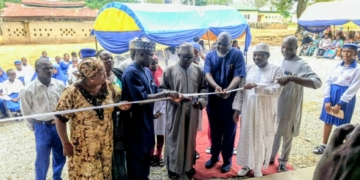

The federal government has commenced the distribution of Comprehensive Emergency Obstetric and Newborn Care (CEmONC) equipment valued at nearly $200,000 per state to 252 health facilities across 30 states.
The distribution, carried out under the Federal Ministry of Health and Social Welfare’s Sector-Wide Approach (SWAp) initiative, was launched in Abuja.
Speaking at the event on behalf of the Coordinating Minister of Health and Social Welfare, Prof. Muhammad Ali Pate, the Executive Director of the National Primary Health Care Development Agency, Dr. Muyi Aina, said more than 40,000 women had already benefited from life-saving interventions through the programme.
“Over 40,000 women have accessed timely interventions across our CEmONC facilities. These are our sisters, mothers and neighbours who have been given a second chance at life,” Aina said, noting that the newly deployed equipment would address major service delivery gaps in secondary health facilities nationwide.
He explained that the equipment packages were customised to each state’s needs, ranging from oxygen concentrators and pharmaceutical-grade refrigerators to incubators and baby warmers. “These are very targeted and deliberate interventions,” he added, while warning states against diverting the equipment for private use.
Aina stressed that while the intervention was critical, equipment alone would not solve Nigeria’s maternal mortality challenge, urging states to reinforce staffing, infrastructure and referral systems. “We need to ensure these facilities are not just equipped but truly functional,” he said.
Representing the Director-General of the National Health Insurance Authority (NHIA), Dr. Kelechi Ohiri, Dr. Nnena Kalu described the initiative as a milestone in reducing maternal deaths and financial hardship. She disclosed that the NHIA had supported CEmONC services in 245 facilities since 2024, processing over 45,000 maternal healthcare claims.
“Each of those statistics represents a life saved and a future protected,” she said, adding that neonatal care had also been strengthened, with over 3,000 newborn care claims recorded.
The national coordinator of the SWAp Coordination Office, Dr. Muntaqa Umar-Sadiq, said the intervention reflects the health sector compact signed under President Bola Tinubu’s administration and is built on sustainability and value for money. “States do the heavy lifting of achieving priorities, and we reward them for the results,” he said.
Ekiti State commissioner for health and human services, Dr. Oyebanji Filani, praised the incentive-based approach, noting that states were complementing the federal government’s equipment support with infrastructure and staffing. He added that many states had begun increasing salaries and allowances to curb the migration of health workers abroad.
The initiative is expected to significantly strengthen emergency obstetric and newborn care capacity and improve outcomes for mothers and babies across the country.
We’ve got the edge. Get real-time reports, breaking scoops, and exclusive angles delivered straight to your phone. Don’t settle for stale news. Join LEADERSHIP NEWS on WhatsApp for 24/7 updates →
Join Our WhatsApp Channel