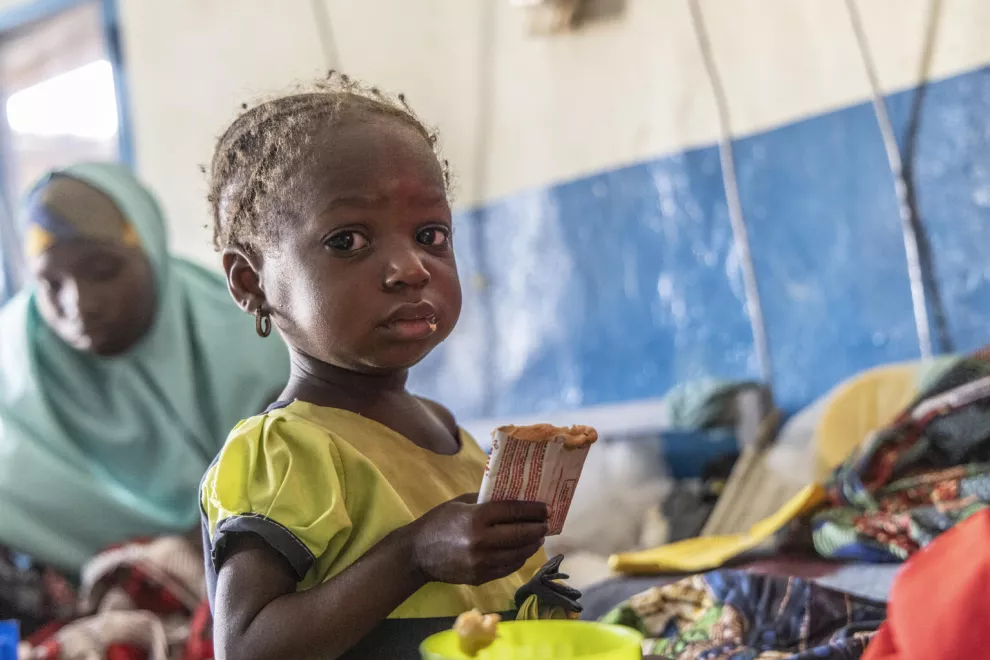
The federal government has renewed commitment to tackle the malnutrition crisis through large-scale food fortification, pledging stronger local solutions to reduce reliance on imports and improve nutrition outcomes for citizens.
Speaking at the Nigeria Health Watch Roundtable themed: “Fortifying Nigeria’s Future: Strengthening Nutrition Through Local Solutions,” on Thursday in Abuja, the permanent secretary in the Federal Ministry of Health and Social Welfare, Daju Kachollom, said the country must urgently address the triple burden of undernutrition, overnutrition, and micronutrient deficiency also known as “hidden hunger.”
Represented by the director of nutrition, Mrs. Ladidi Bako-Aiyegbusi, Kachollom described malnutrition as a major threat to national development, stressing that it undermines productivity, increases maternal and child mortality and fuels long-term economic losses.
“Nigeria cannot afford to lose another generation to preventable malnutrition. Fortification is not just a health intervention, it is an economic and social investment,” she said.
According to the 2024 Demographic and Health Survey, stunting among children under five years stands at 40 per cent, wasting at eight per cent, and underweight at 27 per cent. Micronutrient deficiencies are also widespread, with one in three children Vitamin A-deficient, more than one in three zinc-deficient and over 20 per cent iron-deficient. Adolescent girls and pregnant women were identified as especially vulnerable groups.
Despite progress in mandatory fortification, such as 95 per cent salt iodization and improvements in wheat flour, sugar and vegetable oil fortification, compliance remains inconsistent, particularly among Micro, Small, and Medium Enterprises (MSMEs). Challenges include weak enforcement, low awareness, and high costs of imported premix materials.
Kachollom emphasised that building domestic capacity for premix production is critical. “Strengthening local premix production is not just an economic necessity, it is a national imperative,” she said.
In her welcome remarks, the managing director of Nigeria Health Watch, Vivianne Ihekweazu, said Nigeria must urgently scale up food fortification and strengthen local solutions to address a deepening malnutrition crisis that continues to undermine the health and productivity of millions.
Describing the country’s nutrition challenge as a “silent crisis” that threatens national development, Ihekweazu noted that Nigeria ranks 110th out of 127 countries on the 2024 Global Hunger Index, reflecting a serious level of hunger and underscoring the need for urgent action.
“Malnutrition in Nigeria is not just about insufficient calories. It is about hidden hunger caused by micronutrient deficiencies, a crisis that stunts growth, weakens immunity, diminishes learning capacity, and undermines economic progress,” she said.
While food fortification remains one of the most proven and cost-effective public health strategies, Ihekweazu lamented that progress has been hampered by inconsistent compliance with fortification standards, particularly among Micro, Small, and Medium-sized Enterprises (MSMEs).
We’ve got the edge. Get real-time reports, breaking scoops, and exclusive angles delivered straight to your phone. Don’t settle for stale news. Join LEADERSHIP NEWS on WhatsApp for 24/7 updates →
Join Our WhatsApp Channel