The Federal Government, in partnership with the World Bank, is taking steps to formalise a certification framework for social standards practice in Nigeria as part of efforts to improve project delivery and ensure greater protection for communities affected by development initiatives.
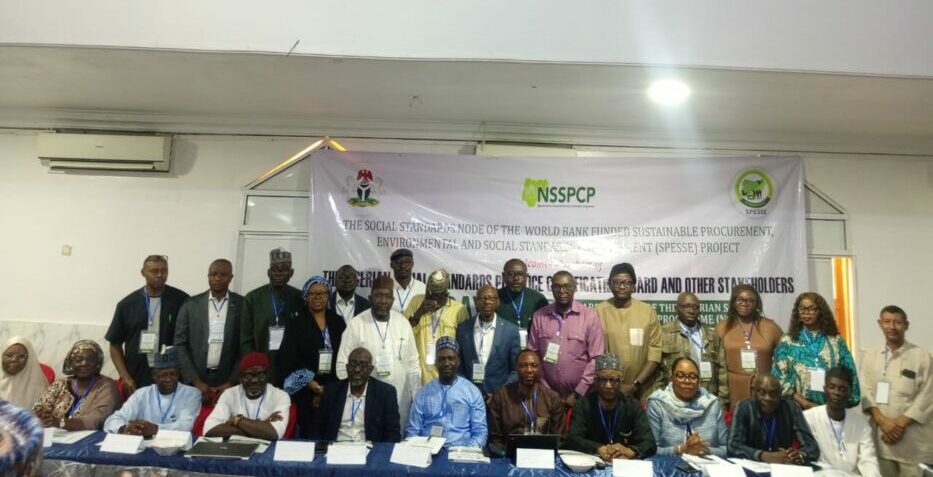
The move was disclosed at the Second Regular Board Meeting of the Nigerian Social Standards Practice Certification Programme (NSSPCP), held in Abuja.
The programme was organised by the Social Standards Node under the World Bank-funded Sustainable Procurement, Environmental and Social Standards Enhancement (SPESSE) Project.
Speaking at the opening session, Chairman of the Certification Board, Prof. Muhammad Nuhu, described the formalisation of the certification programme as a significant transition from informal practice to a structured and regulated professional system.
According to him, the programme aligns with both local realities and international best practices.
“For too long, social safeguards were treated as an afterthought, leading to project delays, community conflicts and avoidable costs. By formalising this certification, we are making it clear that only trained and certified professionals should manage these critical aspects of development,” Nuhu said.
He disclosed that more than 1,000 practitioners had already been certified, while an additional 700 candidates were being considered for certification, bringing the total number of certified professionals to over 1,700.
Also speaking, the Administrative Secretary and Project Coordinator of the programme, Mr. Okwesa Benjamin, said the initiative was established to bridge a longstanding gap in project implementation and ensure that social and environmental standards become integral to development planning.
“We are moving from treating social and environmental standards as optional formalities to making them essential requirements for quality project delivery. This certification will ensure that only competent professionals handle sensitive aspects of development work,” he said.
Benjamin noted that since its inception, the initiative has recorded significant milestones, with about 2,000 Nigerians fully certified and more than 40,000 participants completing various training and orientation programmes.
He added that the board meeting would review and approve certification for a new batch of qualified personnel, while also finalising operational guidelines that will govern the profession.
According to him, the programme is expanding training opportunities across the six geopolitical zones while establishing systems to ensure continuous professional development and quality assurance.
“This is more than a certificate; it is a mark of responsibility and professionalism,” he said.
A representative of the Federal Ministry of Women Affairs, Isibor Abdulsalami, said the framework would strengthen gender equity and social inclusion in development projects.
He noted that gender inclusion and protection of vulnerable groups are embedded in the programme’s curriculum.
“This certification guarantees that women, youth and vulnerable groups are not left behind. It ensures their voices are heard, their rights are protected, and that development benefits everyone,” he said.
Similarly, Director of Productivity Measurement and Labour Standards at the Federal Ministry of Labour and Employment, Emmanuel Igbinasun, said the certification had become increasingly important in ensuring compliance with social safeguard requirements in government and donor-funded projects.
“Formalising this framework provides a clear benchmark for competence. It builds trust between communities, investors and regulators, while improving the quality of project delivery nationwide,” he said.
Representing the World Bank, Dr. Tosin Oso said the initiative would help Nigeria attract responsible investment, meet international standards and ensure that economic growth remains inclusive and sustainable.
He reaffirmed the bank’s support for the programme, noting that strong environmental and social standards reduce risks, improve project outcomes and enhance investor confidence.
“Nigeria’s development goals can only be fully achieved if projects respect the rights of people and preserve the environment. This certification scheme is building the capacity required to deliver that promise,” Oso said.
The NSSPCP offers four levels of certification—Foundation, Intermediate, Associate and Specialist—and covers key areas such as gender inclusion, labour rights, stakeholder engagement, grievance redress, cultural heritage protection, land acquisition and resettlement, and social impact assessment.
The meeting brought together board members, technical experts, government officials and development partners to review the programme’s progress, establish operational guidelines and strengthen the implementation of global best practices in Nigeria’s development sector.
We’ve got the edge. Get real-time reports, breaking scoops, and exclusive angles delivered straight to your phone. Don’t settle for stale news. Join LEADERSHIP NEWS on WhatsApp for 24/7 updates →
Join Our WhatsApp Channel