
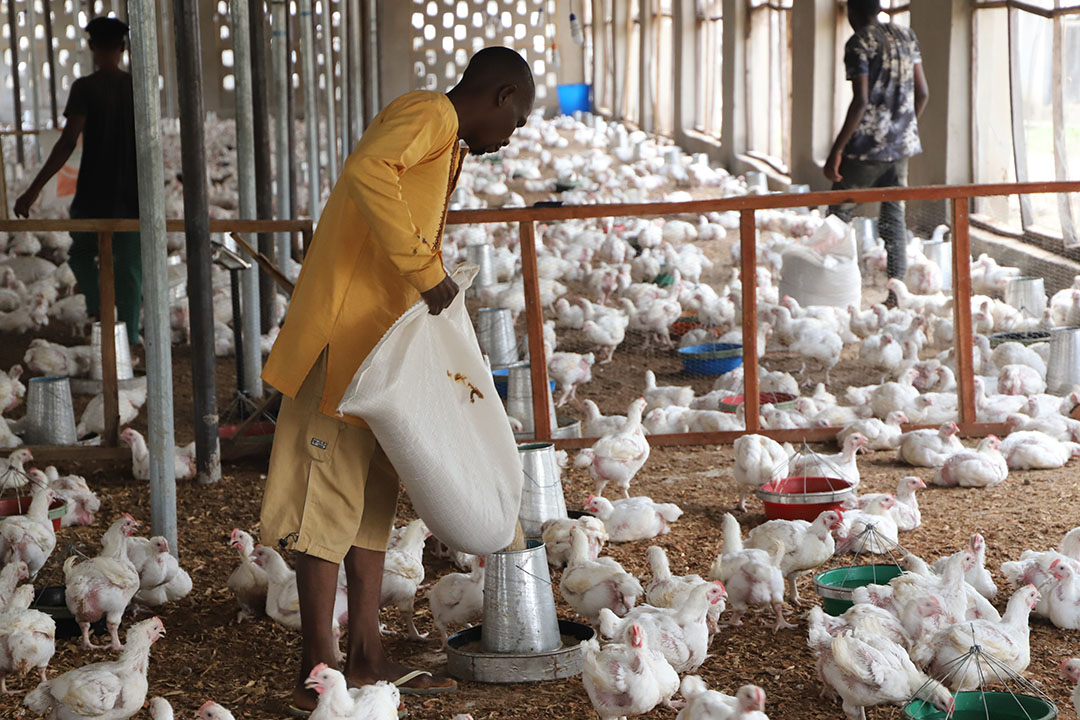
Poultry farmers in Nigeria are turning to local feed alternatives as persistently high feed costs, weak consumer purchasing power, and rising production expenses continue to threaten the sector’s survival, raising fresh concerns over food security and protein affordability.
Poultry production remains one of Nigeria’s major sources of animal protein and provides livelihoods for thousands of small and medium-scale farmers across the country. However, industry players say rising input costs are putting severe pressure on the value chain.
The president of the Nigeria Agribusiness Group (NABG) and the All Farmers Association of Nigeria (AFAN), Arc. Kabir Ibrahim said the crisis has gone beyond poultry farmers, affecting feed millers, marketers, and consumers across the agribusiness ecosystem.
According to him, although there has been a slight reduction in the prices of some raw materials such as maize, the overall cost of poultry feed remains unaffordable due to high energy, processing, and other input costs.
“Feed manufacturing is also under pressure because millers are struggling. While there is a slight reduction in maize prices, feed is made up of many components, including energy and processing costs, which remain very high,” Ibrahim said.
He explained that Nigeria’s broader economic challenges continue to push up production costs, despite pockets of price moderation in the market.
“The challenge is the Nigerian factor.
Everything is polarised. Even where raw material prices show a downward trend, other input costs, especially energy, continue to keep feed prices beyond what farmers can manage,” he added.
Poultry feed accounts for the largest share of production costs in the sector, making farmers particularly vulnerable to fluctuations in input prices.
Industry findings show that the cost of a bag of poultry feed remains significantly higher than last year’s levels, forcing many farmers to scale down operations, reduce flock sizes, or explore cheaper local feed substitutes such as cassava peels, rice bran, and other agro-by-products.
However, Ibrahim said the most critical problem facing poultry farmers is no longer production, but declining consumer demand driven by low purchasing power.
“The major problem is not egg production but sales. Purchasing power is very low, and many Nigerians now see eggs as a luxury they cannot afford,” he said.
Market observations indicate that many households have reduced egg consumption in recent months as prices continue to outpace income growth, further tightening the market for producers.
The situation has placed farmers in a difficult position, as rising costs coincide with shrinking consumer demand.
“We are caught between rising production costs and weak consumer demand. Even when prices fall slightly, low purchasing power means the market cannot absorb the products,” Ibrahim noted.
Field findings by LEADERSHIP at poultry farms in Abuja also confirmed the pressure on farmers.
A worker at Pedro Farm House Ltd, located along Zhidu Airport Road, Abuja, Mr. Peter Mbah, said feed prices have increased compared to last year, with a bag that previously sold for between N14,000 and N15,000 now selling for about N16,500, depending on location.
“There is no clear sign of reduction. Everything is still going up, especially with fuel and transportation costs,” he said, adding that many farmers were turning to local feed alternatives in order to keep their birds alive.
Peter also noted that some production costs remain unavoidable.
“Vaccines are mandatory. No matter how expensive they become, farmers must buy them to keep the birds healthy,” he said.
Industry players note that while local feed alternatives can offer temporary relief, they are often used as stop-gap measures rather than permanent solutions.
The federal government has, in recent months, reiterated its commitment to improving agricultural productivity and reducing production costs across key value chains.
Stakeholders, however, say stabilising input costs and strengthening consumer purchasing power will be critical to sustaining poultry production and improving access to affordable protein.
We’ve got the edge. Get real-time reports, breaking scoops, and exclusive angles delivered straight to your phone. Don’t settle for stale news. Join LEADERSHIP NEWS on WhatsApp for 24/7 updates →
Join Our WhatsApp Channel