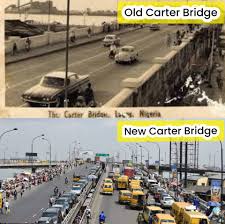
The federal government has announced plans to demolish and rebuild the Carter Bridge in Lagos as part of a broader infrastructure drive that includes the approval of road projects worth about N1 trillion across the country.
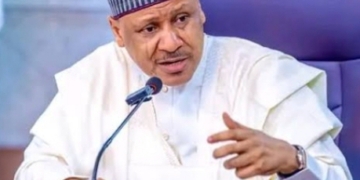
Minister of Works, David Umahi, disclosed this on Wednesday while briefing State House correspondents at the Presidential Villa, Abuja, after the Federal Executive Council (FEC) meeting presided over by President Bola Tinubu.
Umahi said the Council approved N5.6 billion for the design and cost assessment of a new Carter Bridge project, noting that technical evaluations had concluded that the existing structure could no longer be rehabilitated.
According to him, stakeholders’ consultations and engineering assessments showed that the bridge had reached a stage where complete demolition and reconstruction was the most viable option.
“The stakeholders’ engagement and technical reviews showed that the Carter Bridge can no longer be rehabilitated. It has to be demolished and a completely new bridge constructed,” the minister said.
He explained that Advanced Engineering Consultants had been engaged to undertake the detailed design and costing of the new bridge ahead of the procurement process for the full reconstruction project.
The Carter Bridge is one of the key links connecting Lagos Island with the mainland and plays a crucial role in traffic movement within the commercial capital.
Beyond the Lagos bridge project, Umahi said the Council also approved several major road projects nationwide aimed at improving connectivity, strengthening the country’s transport infrastructure, and boosting economic activities.
Among the projects is the completion of the long-delayed Suleja–Minna Road, originally awarded to Salini Construction Company but later terminated due to poor performance.
Umahi said only about 10 kilometres of the road had been completed before the contract was cancelled.
He explained that the government had now resolved to complete the remaining 71 kilometres of the dual carriageway, with one carriageway awarded to China Geo-Engineering Corporation (CGC) at a cost of ₦91 billion.
According to him, the second carriageway has also received clearance from the Bureau of Public Procurement (BPP).
The minister said President Tinubu directed that the road be constructed using reinforced concrete technology to enhance durability and reduce maintenance costs.
FEC also approved the review and rescoping of the Kano–Kongolam Road project, a tax credit initiative originally awarded in 2022.
Umahi said the 132-kilometre corridor linking Kano, Jigawa and Katsina states would now be constructed as a three-lane concrete carriageway instead of the earlier asphalt design.
He said the upgraded design would include solar-powered street lighting and closed-circuit television (CCTV) installations to enhance security along the route.
The revised project is estimated to cost ₦334 billion.
In another approval, the Council cleared the reconstruction of the Abuja–Lokoja Road following the termination of contracts earlier awarded to two underperforming contractors.
Umahi said the affected 86-kilometre stretch would now be reconstructed using reinforced concrete pavement and handled by five contractors, including Julius Berger, which is already executing other segments of the corridor.
The project is estimated to cost about ₦146 billion.
Similarly, the Council approved the reconstruction of the Ibadan–Ife–Ilesa Road, a 103-kilometre dual carriageway valued at ₦427 billion.
The minister noted that the project was initially awarded by the previous administration but recorded little progress before the current government reviewed and re-awarded the contract.
He added that the Governor of Osun State had already completed about five kilometres of the road as part of the state’s infrastructure development programme.
FEC also approved Phase Two of the Keffi–Nasarawa–Abaji Road rehabilitation project, covering 129.3 kilometres at a cost of ₦203 billion.
Umahi explained that the road would significantly improve connectivity between Nasarawa State and the Federal Capital Territory.
The minister further disclosed that the Federal Government plans to commission at least four major road projects in each of the six geopolitical zones by May 15.
“We are presenting a minimum of four completed projects in each zone for presidential commissioning by May 15. These are not palliative works; they are major infrastructure projects,” he said.
The approvals form part of the administration’s broader push to expand critical infrastructure and strengthen road connectivity across the country.
We’ve got the edge. Get real-time reports, breaking scoops, and exclusive angles delivered straight to your phone. Don’t settle for stale news. Join LEADERSHIP NEWS on WhatsApp for 24/7 updates →
Join Our WhatsApp Channel