
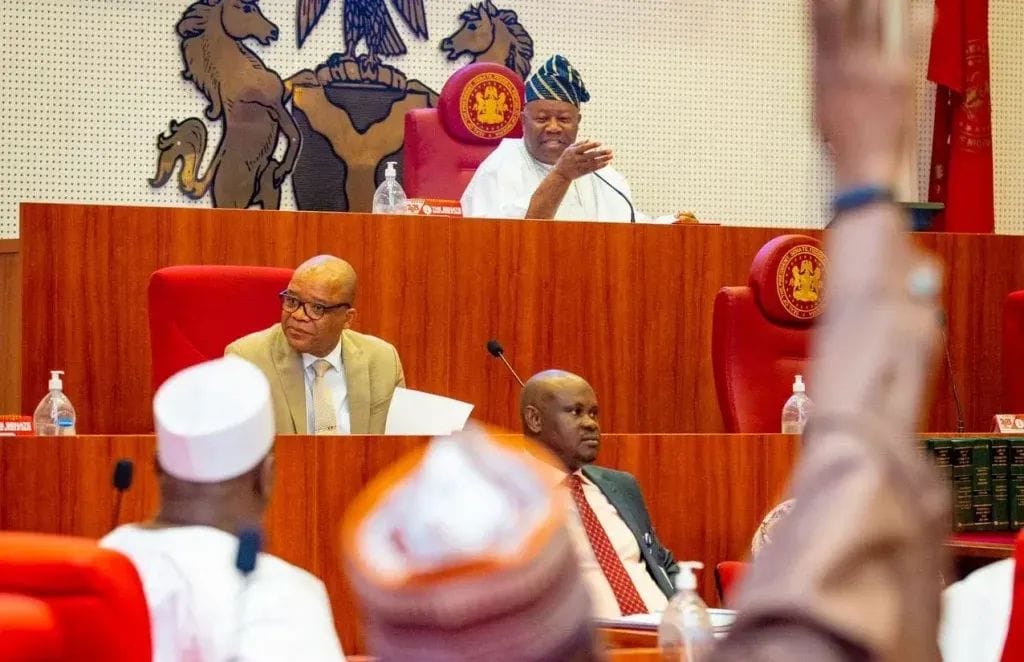
The Senate on Wednesday advanced proposed legislation aimed at strengthening the regulatory oversight of the Central Bank of Nigeria (CBN) over financial technology (fintech) operations in the country.
The upper chamber also considered tougher legislative measures to curb Ponzi scheme fraud, following a wave of recent financial scams, including the reported N1.3 trillion allegedly lost by Nigerians to Crypto Bullion Exchange (CBEX) in April 2025.
Both initiatives received broad support from stakeholders during a public hearing on the Banks and Other Financial Institutions Act (Amendment) Bill 2026, as well as a motion calling for an investigative hearing into the operations of Ponzi schemes in Nigeria.
The hearing was organised by the Senate Committees on Banking, ICT & Cybercrime, Capital Market, and Anti-Corruption and Financial Crimes.
Speaking at the session, Chairman of the Senate Committee on Banking, Senator Adetokunbo Abiru (Lagos East), said the proposed amendment seeks to strengthen the regulatory framework guiding the CBN’s oversight of the fintech sector.
According to him, the bill aims to amend the Banks and Other Financial Institutions Act (BOFIA) 2020 to provide a clear statutory basis for the designation, registration and enhanced supervision of Systemically Important Institutions—particularly technology-enabled financial service providers.
“Over the past decade, Nigeria’s financial ecosystem has evolved significantly. Fintechs—mobile money operators, payment platforms, digital lenders and settlement companies—now serve millions of Nigerians, process vast transaction volumes and hold sensitive financial data,” Abiru said.
“While their growth has strengthened financial inclusion, the law has not kept pace with their scale and systemic relevance. This creates a regulatory gap with implications for financial stability, data sovereignty, consumer protection and national security.”
He explained that the proposed amendment would empower the CBN to designate qualifying fintechs and digital financial institutions as Systemically Important Institutions; establish a national registry to enhance transparency and beneficial ownership disclosure; strengthen risk-based supervision tailored to technology-driven financial services; and promote data sovereignty and systemic stability.
In separate submissions, representatives of the CBN—including the Deputy Governor, Financial System Stability, Philip Ikeazor—along with the immediate past President of the Chartered Institute of Bankers of Nigeria (CIBN), Bayo Olugbemi, and representatives of the Nigeria Incentive-Based Risk Sharing System for Agricultural Lending (NIRSAL) and the Nigeria Deposit Insurance Corporation (NDIC), all expressed support for the proposed amendment.
Stakeholders at the hearing also backed the Senate’s move to introduce stricter measures against Ponzi schemes in the country, calling for enhanced enforcement, improved investor education, and stronger inter-agency collaboration to prevent further financial losses to fraudulent investment operations.
We’ve got the edge. Get real-time reports, breaking scoops, and exclusive angles delivered straight to your phone. Don’t settle for stale news. Join LEADERSHIP NEWS on WhatsApp for 24/7 updates →