
The federal government has reduced the interest rate payable on late tax payments from the Central Bank of Nigeria’s (CBN) Monetary Policy Rate (MPR) plus five percentage points to MPR plus one percentage point, in a move aimed at aligning the cost of tax arrears with prevailing market rates.
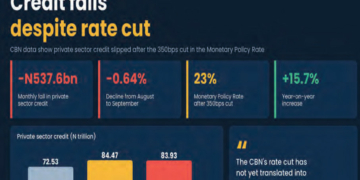
This follows the resetting of the MPR at the end of the Monetary Policy Committee (MPC) meeting on Tuesday from 26.5 per cent to 23 per cent, the first big cut in years. According to the Ministry of Finance in a statement, the cut which takes effect from October 1, 2026, will apply uniformly to tax administered by the Nigeria Revenue Service (NRS), state tax authorities and the Federal Capital Territory (FCT) Internal Revenue Service.
The Minister of Finance and Coordinating Minister of the Economy, Taiwo Oyedele, announced the new framework through the Nigeria Tax Administration (Interest on Late Payment of Tax) Order, 2026, issued pursuant to Section 65 of the Nigeria Tax Administration Act, 2025.
Under the new order, interest on tax payable in naira will be charged at the CBN’s MPR plus one percentage point, although the applicable rate will not fall below the yield on 364 day Treasury Bills. The ministry said the Treasury Bill floor reflects the cost of government funding and is intended to ensure that taxpayers do not benefit financially by withholding taxes that are due to government.
Explaining the rationale behind the new regime, Oyedele said, “Tax that is due belongs to the public. When it is paid late, Government may have to borrow to fill the gap, and the cost falls on everyone. This Order ties the cost of late payment to real market rates, so that delaying tax does not become a cheaper form of credit than the market itself.”
The minister said the reform would also provide greater certainty and consistency for taxpayers by establishing a uniform framework for determining interest on late payments. “Just as important is certainty. Every taxpayer, whether dealing with the Nigeria Revenue Service or a State revenue service, will know the rate in advance, see it published every month, and be charged in the same way. Clear rules make compliance easier and support a fair, predictable tax system,” he added.
It noted that the applicable interest rate will be determined once every calendar month, based on the market benchmarks specified by the government. It also directed the NRS to publish the applicable rate on its website by the third business day of every month, while the rate for each month will be set on the last business day of the preceding month.
For tax liabilities denominated in foreign currency, the government fixed the interest rate at the Secured Overnight Financing Rate (SOFR) plus six percentage points. Where SOFR is discontinued, its officially designated successor rate will apply.
The new interest regime will apply to self assessment, as well as assessments administered by the NRS, state revenue services and the FCT Internal Revenue Service.
We’ve got the edge. Get real-time reports, breaking scoops, and exclusive angles delivered straight to your phone. Don’t settle for stale news. Join LEADERSHIP NEWS on WhatsApp for 24/7 updates →
Join Our WhatsApp Channel