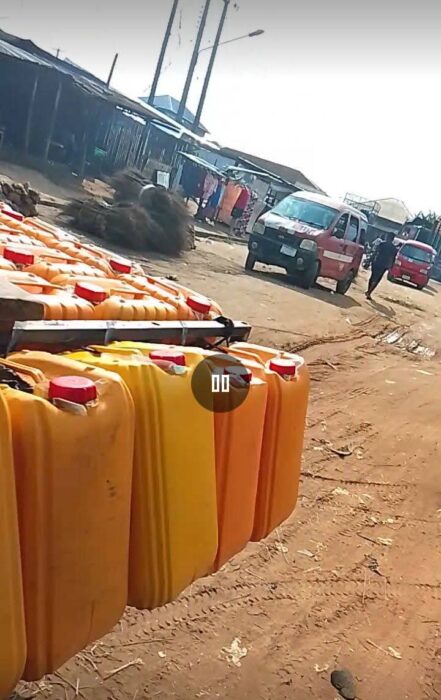
Residents and traders in Ekit Itam 2 and Mbak Itam 3 communities in Itu Local Government Area of Akwa Ibom State have lamented the collapse of the road linking the commercial hubs, blaming persistent flooding and heavy-duty trucks for the worsening condition.
The communities, which host major trading centres for palm oil, timber, livestock, jewellery and other commodities, were once bustling commercial outposts dominated largely by Hausa/Fulani traders. However, residents said the area has witnessed a sharp decline in economic activities due to the deplorable state of its only access road.
According to Chima Nkemdirim, a palm oil merchant, the busy corridor, which serves as a major route for livestock and food items such as onions, beans, potatoes, pepper, melon and maize transported into the Hausa/Fulani settlement popularly known as Nasarawa, is gradually losing its commercial appeal amid persistent rainfall and flooding.
A LEADERSHIP check revealed that the road overlooking Ibom Specialty Hospital has deteriorated significantly, leaving residents, traders and motorists stranded in traffic congestion for hours.
The road serves some of the area’s biggest commercial establishments, including Itam Timber Market, the popular Nasarawa Market, also known as Hausa Market, Itam Palm Oil Market and several transport businesses.
Udoette Akang, a resident, blamed the deterioration on the activities of heavy-duty trucks, which he said had compounded the damage caused by flooding.
“The road, which hosts some of the biggest commercial entities on the fringes of the Uyo metropolis, including the Itam Timber Market, the popular Nasarawa Market (Hausa Market), the Palm Oil Market, and several transport businesses, has been completely destroyed by the constant and unregulated activities of heavy-duty trucks compounding the only access road already wreaked by floods,” he lamented.
He added that the trucks conveying livestock, onions, tomatoes, grains and other commodities from northern Nigeria had turned the roadside into an unofficial loading and offloading point.
“These trucks, conveying livestock, onions, tomatoes, grains and other goods from the northern part of the country, now use the roadside as an offloading bay, turning the entire stretch into an impromptu trailer park.”
Another resident, Ifiokobong Ekanem, said the situation had resulted in failed road sections, stagnant water, waste accumulation and environmental pollution.
“The results are these failed portions, stagnant water, waste and pollution, as well as unbearable stench that has made life difficult for the people of Ekit Itam 2 and Mbak Itam 3,” Ekanem said.
Residents and business owners also accused the government and their elected representatives of abandoning the communities despite the area’s importance to commercial activities in the state.
They specifically called on the Deputy Speaker of the Akwa Ibom State House of Assembly, Rt. Hon. KufreAbasi Edidem, who represents Itu, and the member representing the area in the House of Representatives, Rt. Hon. Ime Okon, to intervene.
The residents also questioned the alleged neglect of the area by Okon, noting that his personal residence was located within the affected axis.
Commending Governor Umo Eno for what they described as his inclusive leadership, particularly the appointment of non-indigenes, including Hausa/Fulani and Igbo people, into his administration, a livestock dealer, Abubakar Umar, appealed to the appointees to draw the governor’s attention to their plight.
“We cannot have easy access to take our goods from northern Nigeria into the market because of the very bad nature of the road. We cannot also move essential goods here, especially palm oil, to the northern markets,” said Abdullahi Inua, a trader from Adamawa State.
He appealed to political representatives and government appointees to convey the traders’ concerns to the governor for urgent intervention.
“We are appealing to our representatives in the compassionate Governor Umo Eno’s administration to help us pass the appeals to the Governor for intervention,” he added.
A resident of Mbak Itam 3, Mr Edet Effiong, also raised concerns about environmental pollution and the health risks posed by emissions from heavy-duty vehicles trapped along the damaged road.
“This road is worst during the rainy season. You cannot pass without being extra careful. The pollution from the waste here is too much. We are breathing bad air every day. Government should come and help us,” he said.
Similarly, a businessman, Mr Emeka Okafor, said the deteriorating road had significantly affected businesses, as customers found it increasingly difficult to access shops in the area.
“My business has gone down because customers cannot access my shop. Vehicles break down here every day because of the bad road. We are losing money,” he said.
Okafor urged the government to construct a designated truck park for vehicles transporting goods from northern Nigeria to prevent them from obstructing the road.
“The government should build a lorry park where all these businesses coming from the north can operate, so that this road can be free,” he appealed.
A palm oil trader at Itam Oil Market, Mrs Imaobong Udo, said the situation had particularly affected women traders, whose businesses and livelihoods were disrupted whenever rainfall caused flooding.
“We women are suffering. When it rains, we cannot sell because everywhere is flooded and smelling. Our children fall sick because of the dirty environment.
“We are appealing to Governor Umo Eno to help us reconstruct this road and take these trailers to a proper park. If Nasarawa is relocated, this place will be clean again,” she said.
We’ve got the edge. Get real-time reports, breaking scoops, and exclusive angles delivered straight to your phone. Don’t settle for stale news. Join LEADERSHIP NEWS on WhatsApp for 24/7 updates →
Join Our WhatsApp Channel