
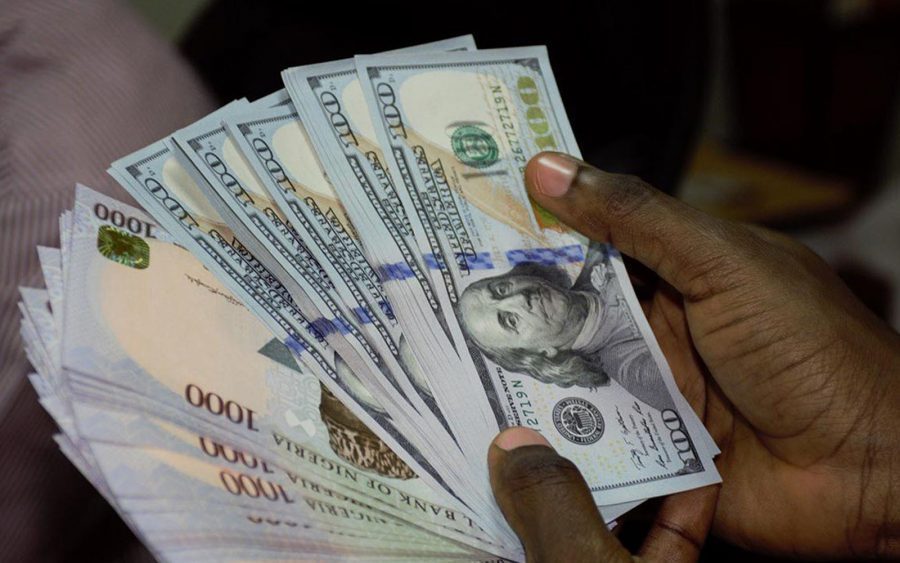
Total inflows into the Nigerian Foreign Exchange Market (NFEM) fell sharply in April 2026 as heightened geopolitical tensions and weaker participation from both domestic and foreign investors moderated liquidity in the market.
Data from the FMDQ Securities Exchange showed that total foreign exchange inflows declined by 30.1 per cent month-on-month to $2.86 billion in April, down from $4.09 billion recorded in March.
The decline was driven by reduced inflows from the Central Bank of Nigeria (CBN), exporters, importers, foreign portfolio investors and non-bank corporates, reflecting growing investor caution amid rising tensions in the Middle East and uncertainty surrounding the U.S.-Iran conflict.
Local inflows, which accounted for 42.8 per cent of total market inflows, dropped by 38.7 per cent to $1.22 billion from $2.00 billion in March.
The steepest decline came from the CBN, whose interventions in the market fell by 83 per cent month-on-month. Inflows from exporters and importers declined by 19.3 per cent, non-bank corporates by 18.2 per cent, while inflows from individuals fell by 33.3 per cent.
Foreign inflows, which contributed 57.2 per cent of the total, also weakened by 21.9 per cent to $1.63 billion compared to $2.09 billion in March.
A breakdown of the foreign component showed that foreign portfolio investment (FPI) inflows dropped by 17.8 per cent, foreign direct investment (FDI) plunged by 78.9 per cent, while inflows from other corporates declined by 54.6 per cent.
Analysts at Cordros Research said the decline underscores the impact of lingering geopolitical tensions, which have heightened risk aversion among global investors and slowed capital flows into emerging markets, including Nigeria.
Despite the drop in inflows, the naira posted a modest gain against the U.S. dollar during the week, appreciating by 1.2 per cent to close at N1,360 to the dollar supported largely by offshore investor inflows that helped offset domestic demand pressures.
However, the local currency ended the week slightly weaker at the official market, depreciating by 0.22 per cent to N,361.40 per dollar while gaining 44 basis points at the parallel market to close at N1,363.15.
In the forwards market, the naira strengthened across all tenors, with the one-month contract appreciating by 1.2 per cent to N1,384.53 to the dollar the three-month contract by 1.2 per cent to N1,424.08, the six-month contract by 1.3 per cent to N1,478.39, and the one-year contract by 1.5 per cent to N1,586.56.
Nigeria’s gross external reserves continued their downward trend, declining by $40 million to $48.33 billion as of May 7, 2026. This marked the eighth consecutive week of decline, attributed to sustained CBN interventions, debt service obligations, subdued oil receipts and foreign capital outflows.
Meanwhile, crude oil prices rose in the international market as renewed hostilities between the United States and Iran in the Strait of Hormuz raised concerns over potential supply disruptions.
Brent Crude gained 1.2 per cent to $101.30 per barrel, while West Texas Intermediate rose 0.5 per cent to $95.28 per barrel. Nigeria’s Bonny Light, however, declined by 16.98 per cent to $106.37 per barrel.
Analysts at Cowry Assets Management expect the naira to remain broadly stable in the near term, supported by relatively attractive yields and continued foreign portfolio interest. Nevertheless, they cautioned that persistent geopolitical tensions and renewed pressure in the foreign exchange market could prompt the CBN to resume measured interventions to contain volatility.
They also noted that stronger oil earnings and improved capital inflows would be critical to rebuilding external reserves and sustaining exchange rate stability in the months ahead.
We’ve got the edge. Get real-time reports, breaking scoops, and exclusive angles delivered straight to your phone. Don’t settle for stale news. Join LEADERSHIP NEWS on WhatsApp for 24/7 updates →
Join Our WhatsApp Channel