Until recently, life for many in Bauchi’s countryside whether farmers hauling produce to distant markets, expectant mothers rushing to clinics, or traders and travellers simply trying to get to town — meant enduring stomach-turning bumps, choking dust, endless delays and, all too often, unnecessary accidents on roads that barely qualify as passable. The weight of those journeys was heavy: perishable crops rotting before they could be sold, market days lost, and hopes of timely medical care slipping through stretched limbs and cracked tires.
For those families now seeing new roads snake through their villages, the change is already palpable. No longer cut off, they are rediscovering dignity and possibility: a farmer who once abandoned a crate of pods by the roadside can now reach town before dawn, a mother in labour might finally make it to the clinic on time, and children can move safely to school without fear of collapsing mud-holes. As these new roads begin to stitch communities back together, they carry more than wheels — they carry renewed hopes, restored livelihoods, and a clearer path toward a better tomorrow.
At dawn in Lanzai, a quiet agrarian hamlet in Darazo local government area of Bauchi State, 54-year-old farmer, Hassan Yusuf, leans over a mound of freshly harvested sorghum stacked beside his mud-brick home. The morning air is cool, but Hassan’s hope runs warm. For years, this community , like many others across rural Bauchi — was effectively cut off. Broken tracks turned routine trips to market into odysseys, while pregnant women and the sick faced nightmarish journeys to distant clinics over rutted paths.
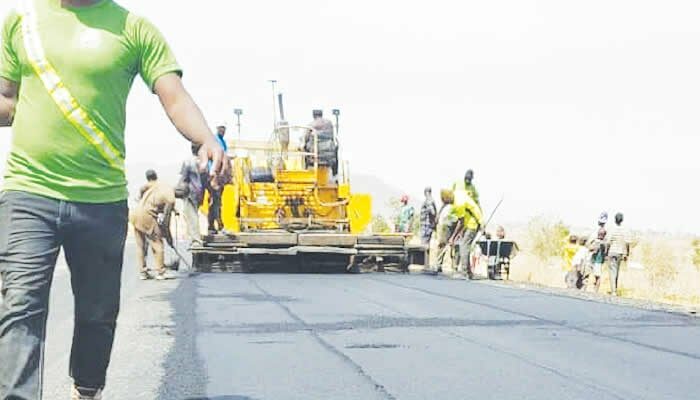
Now, under the Rural Access and Agricultural Marketing Project (RAAMP), a new 24-kilometre Lanzai–Papa road has been flagged off.
Today, when Hassan loads his sorghum onto a cart, there’s a quiet confidence: he believes the road will carry him to town before noon — a chance, finally, to sell his harvest before the rains or rot set in.
For Hassan’s neighbours , farmers, traders, mothers, children , this road is more than just concrete and gravel: it’s a renewed lifeline. It whispers that nights of dust and dread may be receding, and that the journey forward for communities like Lanzai could, at last, be measured in opportunity, not obstacles.
He said, “Sometimes we pushed our bicycles through water for hours, and many buyers refused to come here,” Yusuf recalls, lifting a dusty sack. “But now, with a new road being constructed, in less than 20 minutes, I’m in Papa and Soro. This road has changed everything.”
Over 100 kilometres away in Dajin, a farming community in Tafawa Balewa Local Government Area, 51‑year‑old farmer Hashim Isa recalls a harrowing night when bad roads nearly cost his wife’s life. The rough, gullied 6‑kilometre Dajin–Mararaban‑Dajin road delayed their transport to Dass General Hospital just as she went into labour.
For many rural residents like Isa, impassable roads have long meant danger, loss and missed opportunity. But with the recent inclusion of the Mararaban‑Dajin–Dajin route among the rural roads being constructed under Rural Access and Agricultural Marketing Project (RAAMP), hopes are rising that access to healthcare, markets and services will become faster, safer and more reliable.
He said, “She was bleeding and crying. I thought she would die that night,” he said, his voice low. “Now we reach Dass in 30 minutes. Our women feel safer. At night, we can take sick children without begging for help.”
In another community in Nabardo, Toro Local Government Area, 19‑year‑old student Jamilu Musa adjusts his schoolbag and heads out for the day. The long, roughly 8.86 km Nabardo–Gadan Doka–Jama’a road once made daily travel difficult and nearly forced him out of school. Now, with construction of the road under Rural Access and Agricultural Marketing Project (RAAMP), he hopes the journey will soon become easier and allow him to continue his education without fear.
According to him, “Before, when it rained, the whole place was like a river,” he recalled. “Sometimes we stayed home for days. Now, teachers come regularly, and our parents don’t worry about accidents anymore.”
A determined workforce and institutional framework are the faces behind the transformation sweeping through rural Bauchi communities as 12 new access roads — stretching 203.47 kilometres across farm belts, riverine communities and school corridors begin reshaping daily life for thousands. The roads are being constructed under RAAMP, a national‑level rural‑access programme led by the Federal Ministry of Agriculture and Rural Development (FMARD) and overseen by a Federal Project Management Unit (FPMU), with implementation through the state government. Supported by the World Bank (via its International Development Association) and the French Development Agency (AFD), the project aims not only to open up isolated agrarian communities, but also to provide sustainable rural transport infrastructure that links them to markets, clinics and schools , a long‑awaited transformation many residents say they have hoped to see for generations.
LEADERSHIP Weekend writes that RAAMP is a nationwide rural‑development initiative launched by Federal Ministry of Agriculture and Rural Development (FMARD), under the oversight of a Federal Project Management Unit (FPMU), and implemented in participating states (including Bauchi) through State Project Implementation Units.
Bauchi State Project Implementation Unit.
The project is financed by the federal government in partnership with the World Bank (via its International Development Association) and the French Development Agency (AFD).
Its core mission is to improve rural access and agricultural marketing in selected states — by rehabilitating and building rural roads, improving agro‑logistics infrastructure, and ensuring a sustainable institutional and financing base for maintaining the road network.
Bauchi State Project Implementation Unit
Through these interventions, RAAMP seeks to link isolated agrarian communities with markets, clinics, schools and social services; reduce post‑harvest losses; raise farm‑gate incomes; support smallholder farmers and micro‑processors; stimulate youth employment; and generally elevate livelihoods across rural Nigeria.
To several residents of the benefiting communities, the new roads are more than paved paths — they are expressions of hope. Farmers in Dott, Dado and Baraza in Dass now have access to a road that helps them transport grains with fewer losses. Livestock traders in Gamawa and Sakuwa receive more buyers. Health workers in Tagwaye reach emergencies faster. And residents of Liman Katagum, Polchi and Kastinawa — previously cut off during rainy seasons , say new opportunities are finally emerging.
These improvements come from a major push by RAAMP in Bauchi: just recently, the state government and partners flagged off 203.47 km of new rural roads across 12 routes, aimed at opening up farm belts, riverine communities and school corridors to markets, clinics and educational facilities.
RAAMP is a federal‑level rural infrastructure programme under the Federal Ministry of Agriculture and Rural Development (FMARD), implemented jointly with state governments including Bauchi. Its mission is to improve rural access and agricultural marketing, reduce post‑harvest losses, raise farm‑gate incomes and boost livelihoods for rural communities through sustainable rural road networks and agro‑logistics support.
LEADERSHIP Weekend reports that the roads being being constructed spans a wide geographic spread include the 24km Lanzai–Papa road; 14.45km Misau–Beti–Maladunba road; 28km Gamawa–Sakuwa road; 14.75km Dargazu–Gambaki–Chinade–Gangai; 6.68km Yana–Fago; 6.6km Giade–Tagwaye; 4.91km Gadar Maiwa–Zakara; 25km Dagu–Ningi road; 36.65km Dott–Dado–Baraza road; 8.86km Nabardo–Jama’a; 6.71km Maraban Dajin–Dajin and the 26.8km Liman Katagum–Polchi–Kastinawa road.
To members of the communities like Hassan, Ibrahim and Ushaq, these developments signal a new era. Traders now plan farther, farmers cultivate more confidently, and parents send their children to school without fear of floods or erosion. The roads have opened new trade routes, revived dying markets and connected forgotten settlements to the state’s economic heartbeat.
During the launch of construction of the roads, Governor Bala Mohammed said the new network represents a significant step toward closing Bauchi’s rural infrastructure gap and empowering agricultural communities long held back by poor mobility.
He described the RAAMP initiative as an embodiment of his administration’s commitment to inclusive development, saying the state had made “significant strides in rural infrastructure” despite the engineering challenges involved. Some of the roads passed through difficult terrain, particularly river crossings that required multiple-span bridges, structures not originally covered by RAAMP’s design. “The state government had to intervene because these bridges were crucial to completing the roads,” the governor said.
He added that Bauchi has strengthened its monitoring and evaluation systems to ensure contractors deliver quality work within set timelines.
Part of Bauchi’s emergence as one of the top RAAMP-performing states stems from its early fulfilment of legal requirements. Out of 19 states in the programme, Bauchi is among the first three to pass the laws establishing the State Rural Access Road Authority (RARA) and the State Road Fund (SRF), two institutions designed to support maintenance and long-term sustainability.
“We are committed to implementing these laws,” the governor noted, referencing the recent appointment of Directors-General and Boards for the agencies.
In anticipation, the governor said Bauchi has already identified and designed an additional 300km of rural roads that will be executed under RAAMP-SU.
The RAAMP National Coordinator, Aminu Bodinga, represented by Engineer Chinedu, commended Bauchi for its unprecedented commitment, particularly its payment of more than N6 billion counterpart funding, the highest among all participating states.
He said the gesture places Bauchi in a national leadership position for rural access governance.
“Bauchi has become a model. Its investment in rural roads is unmatched,” Bodinga said.
With Bauchi ranked among the top three RAAMP-performing states, Bodinga revealed that the state has qualified to be among the first five to benefit from the upcoming RAAMP Scale-Up (RAAMP-SU). Under this phase, Bauchi is eligible to access $30 million for rural roads.
Commissioner for Rural Development and Special Duties, Farouk Mustapha, said Governor Bala Mohammed’s decision to partner with the World Bank and the Federal Government to implement the RAAMP initiative has opened a new chapter of opportunity for the rural population in the state.
Mustapha said Bauchi State is not just participating in RAAMP, but it is setting a benchmark for how global partnerships can be harnessed to solve local challenges.
“As a result of our efforts, Bauchi State has been ranked in the first three amongst the 19 participating states of the Rural Access and Agricultural Marketing Project (RAAMP) nationwide, owing to the unwavering commitment of His Excellency, Senator Bala Mohammed.
“As we embark on this new phase, I want to make a strong and clear commitment on behalf of the Ministry of Rural Development and the RAAMP State Implementation Unit that we will work day and night to ensure the timely, transparent, and successful execution of all RAAMP projects in Bauchi State,” the commissioner said.
We’ve got the edge. Get real-time reports, breaking scoops, and exclusive angles delivered straight to your phone. Don’t settle for stale news. Join LEADERSHIP NEWS on WhatsApp for 24/7 updates →
Join Our WhatsApp Channel