In this report, JAMES KWEN writes about how the quest for political power has turned many hitherto friends and allies into sworn enemies.
Winston Churchill, a former Prime Minister of the United Kingdom, is famously associated with the quote: “In politics, there are no permanent friends or enemies, only permanent interests.”
Nigerian politicians often give this expression meaning in their relationships with one another, especially in the context of “no permanent friend.”
Historical accounts show that this is, in essence, a political phenomenon in Nigeria, dating back to the independence era, when Obafemi Awolowo and Nnamdi Azikiwe were once united in the fight against colonial rule.
However, their alliance broke down when Azikiwe’s National Council of Nigeria and the Cameroons (NCNC) struck a deal with the Northern People’s Congress (NPC), which subsequently blocked Awolowo from becoming premier of the Western Region.
The trend continues decades after independence and has taken a worrisome dimension since 1999, when Nigeria returned to democratic rule.
The era witnessed a growing number of friends who became sworn enemies over political party differences. Some are political godfathers and godsons, while others are close allies and supporters when the going was good.
Prominent among them include:
Kwankwaso/ Ganduje/ Yusuf
Upon the return of democracy in 1999, Rabiu Kwankwaso and Umar Ganduje were elected governor and deputy governor of Kano state, respectively, and Kwankwaso was appointed minister of Defence by the then President Olusegun Obasanjo, confirming their togetherness and perhaps friendship. After they could not secure a second term in the 2003 polls and Kwankwaso was appointed as the minister of Defence by the then President Olusegun Obasanjo, he took Ganduje as his top aide.
In the 2011 general election, Kwankwaso and Ganduje were elected for a second term as governor and deputy.
Towards the end of their last tenure, they joined the then newly formed APC in 2014. Kwankwaso supported Ganduje, who succeeded him as governor in the 2015 polls.
However, Ganduje and Kwankwaso were embroiled in a battle royale over control of APC structures in the state, a contest the incumbent governor eventually won from his predecessor.
As the love lost between the former Kano governor and his deputy persisted, Kwankwaso pitched a tent with the New Nigerian Peoples Party (NNPP), which made him its presidential candidate in the 2023 general election, which he lost.
The leader of the Kwankwasiya group found another loyal ally in Abba Yusuf, whom he supported in the 2023 governorship race.
However, history repeated itself recently when Yusuf dumped NNPP for APC and aligned with Ganduje.
Kwankwaso declared January 23 as the ‘World Day of Betrayal’ following the defection of Governor Yusuf, alongside key elected officials in the state from NNPP to APC.
Wike/ Makinde
Nyesom Wike, former Rivers state governor and current FCT Minister and Seyi Makinde, governor of Oyo state, were best of political friends who have turned sworn political rivals/enemies.
Wike and Makinde became political allies in early 2023, when the People’s Democratic Party (PDP)’s G-5 coalition was formed. It was made up of five governors: Nyesom Wike (Rivers), Seyi Makinde (Ibadan), Samuel Ortom (Benue), Okezie Ikpeazu (Abia), and Ifeanyi Ugwuanyi (Enugu).
The group grew stronger after the national leadership of PDP rejected the zoning scheme, which is part of the party’s standards, and gave the presidential ticket to Atiku Abubakar, a northern candidate.
However, Wike and Makinde’s friendship dwindled when their common enemy, Atiku, had even left the PDP for the African Democratic Congress (ADC). The battle shifted to who controls the soul of PDP.
As the cracks between the two political friends deepened, a faction loyal to Makinde expelled Wike and his allies from PDP, while the Wike-led faction also showed Makinde and his associates the way out of the party.
The Makinde-led faction last year convened the 103rd National Convention of PDP, where delegates chose Kabiru Turaki as the party’s National Chairman.
The Wike-led faction rejected the convention as unlawful and pitched a tent with the leadership of Abdulrahman Mohammed, whom they appointed acting chairman.
The battle of the estranged political bedfellows has also been taken to the media as Makinde had in an interview said the feud between him and Wike was not over policy.
According to Makinde, the schism occurred when Wike, in a private meeting with President Bola Tinubu, offered to keep the PDP for him until 2027.
Makinde described the situation as “shocking.” I challenged him, asking, “Wike, did we agree to this?” I subsequently pledged that I would never support Tinubu’s re-election because of that betrayal, he added.
He also accused Wike of violating reconciliation agreements and attempting to replace the real National Secretary, Samuel Anyanwu, with Ude Okoye, which Makinde’s camp claims is unconstitutional and part of Wike’s larger attempt to dominate the party.
He further stated that Tinubu has the constitutional right to call Wike to order if necessary, implying that the president should rein in his minister.
However, Wike’s special assistant on public relations, Lere Olayinka, described Makinde as a serial defector who plans to abandon the PDP after the 2027 general election.
He accused him of plotting against Governor Ademola Adeleke in 2022 to become the sole PDP governor in the South-West.
He also reminded readers that Makinde had left the PDP twice before, once for the ANPP in 2007 and again for the SDP in 2015, hinting that loyalty is not known with the governor.
Ribadu/ El-Rufai
Mallam Nuhu Ribadu, the National Security Adviser and Mallam Nasir El-Rufai also fall in the category of political friends turned foes. Providentially, both their friendship and enmity surged under two Yoruba presidents – Olusegun Obasanjo and Bola Tinubu.
Under Obasanjo’s presidency, Ribadu served as Chairman of the Economic and Financial Crimes Commission (EFCC), while El-Rufai held sway as the Minister of the FCT.
Both were reportedly key members of Obasanjo’s influential Economic Team and played pivotal roles in the emergence of Umaru Musa Yar’Adua as the PDP’s presidential candidate in 2007.
However, some accounts say both men were united in their criticism of Yar’Adua after failing to secure influential roles with El-Rufai — possibly as Minister of Energy and Ribadu — Inspector General of Police, respectively.
There were also reports that El-Rufai attempted to help Ribadu secure a Senate seat in 2019 after an unsuccessful attempt to become Adamawa state governor, but Ribadu rejected the offer, opting instead to run for governor, while others claimed that El-Rufai opposed Ribadu’s gubernatorial ambitions in Adamawa in the 2019 and 2023 elections despite being a major power broker in the ruling APC.
Their friendship was said to have further deteriorated over El-Rufai’s claim that Ribadu lied about never accusing President Bola Tinubu of corruption during his tenure at the EFCC, citing records from 2006–2007.
Tinubu, at the inception of his administration, appointed Ribadu NSA and nominated El-Rufai as minister, but he was screened out over issues relating to national security.
Since then, the former Kaduna governor has always fingered the NSA in most of his travails. Last year, he accused the NSA of masterminding the state assembly’s anti-corruption investigation of his government.
“Ribadu is the architect behind my investigation and the attack on my commissioners. He wants to be the president in 2031, so he is determined to eliminate any of us who he sees as an obstacle to his ambition,” the former governor claimed on a national television.
El-Rufai also alleged that Ribadu ordered the operatives of the Department of State Services (DSS) to arrest him at the Nnamdi Azikiwe International Airport in Abuja on return from Egypt last week.
Amaechi/Wike
Rotimi Amaechi and Nyesom Wike were also good political friends. Amaechi was the governor, Wike was his Chief of Staff, and he later nominated him for a ministerial appointment. However, their friendship turned into enmity in the twilight of the 2015 general election. While Amaechi joined the APC, Wike stayed back in the PDP and eventually emerged governor.
Even in their reversed roles with Amaechi as a minister and Wike as governor, the battle royale continued unabated. Now, as Wike, a member of the PDP, backs the APC-led government of Tinubu, his former boss has moved to the ADC, where he is seeking the presidential ticket for the 2027 general election.
They keep expressing their animosity. Amaechi had stated that he will not stoop to the level of a child by exchanging insults with Wike.
The FCT minister replied to him that: “We have no time to listen to nonsense in Nigeria. I don’t understand why a man like Amaechi would choose his 60th birthday to lie to Nigerians about being hungry.”
Tinubu/ Aregbesola
Tinubu, before becoming Nigeria’s President, had Rauf Aregbesola as of of his closest allies. It was said in political circles in the Southwest then that Tinubu could hardly attend to anyone without Aregbesola’s backing. He appointed Aregbesola a commissioner in his cabinet. Aregbesola was the political head of Alimosho Local Government in the state. It is the largest local government that brings the largest votes in the state. Aregbesola belonged to every political caucus in the state. Tinubu helped Aregbesola rise from a commissioner in Lagos to the governor of Osun state. However, by 2022, their relationship soured, and Aregbesola opposed Tinubu’s candidate, Gboyega Oyetola, as his (Aregbesola) successor, leading to the APC’s defeat in Osun and the PDP’s victory, which fielded Ademola Adeleke.
To crown it all, Aregbesola has dumped the APC for the opposition coalition, adopted ADC, for which he serves as its National Secretary. As the engine of the ADC, Aregbesola is leading the opposition against Tinubu’s re-election in 2027.
Akpabio/ Udom
In 2015, former governor of Akwa Ibom and now Senate president, Godswill Akpabio, solely anointed Udom Emmanuel, his then commissioner, as his successor. However, the political romance collapsed a little over a year later, forcing Akpabio to leave the PDP for the APC.
Udom won his re-election in 2019, successfully handed over the reins of power to his preferred successor in 2023, and moved on to other private endeavours. On the other hand, Udom’s successor, Governor Umo Eno, has joined Akpabio in APC.
Oshiomhole/ Obaseki
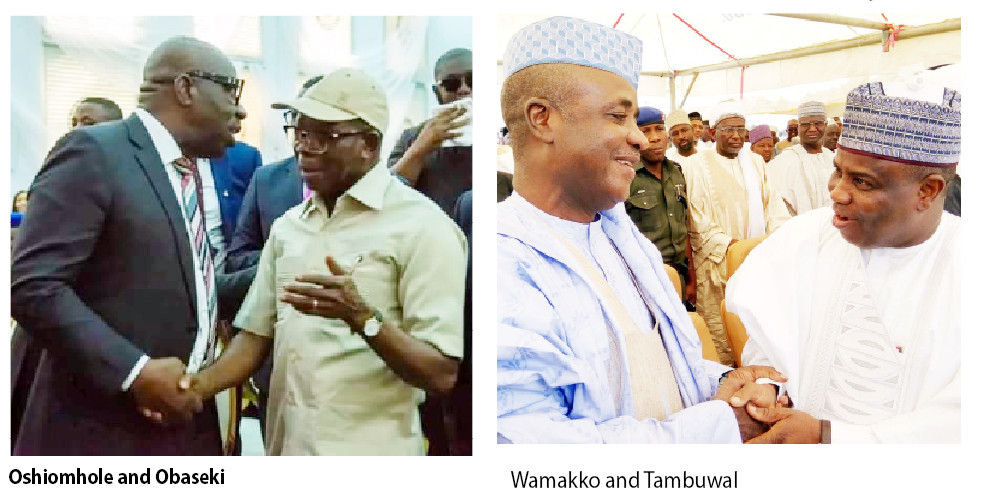
In 2018, as governor of Edo State, Adams Oshiomhole campaigned and fought a tough battle to ensure Godwin Obaseki succeeded him. Obaseki was Oshiomhole’s close ally, having served as the chairman of the Edo State Economic Team. The battle was won, and Obaseki became the governor.
Soon after, the relationship broke down, and the battle between the two was fierce, consuming members of the State House of Assembly.
Highpoint of the battle was when Oshiomhole, as APC national chairman, leveraged his influence to disqualify Obaseki during the APC primaries. Obaseki fired back by initiating Oshiomhole’s suspension at the ward level. Obaseki, however, moved to the PDP and won his re-election in 2020.
Obi/Obiano
The former governor of Anambra State and Labour Party presidential candidate in 2023, Peter Obi, also fell out with his successor, Willie Obiano, whom he had supported in 2014. They were both in the All Progressives Grand Alliance (APGA).
However, their political alliance soon failed. Obi left APGA and joined the PDP. During the 2017 election, Obi produced the PDP candidate, Oseloka Obaze, whom Obiano defeated to secure a second term in office.
Sheriff /Shettima (Borno)
A former governor of Borno State, Senator Ali Modu Sheriff, had supported the current vice president, Senator Kashim Shettima, in his bid to become governor in 2011.
Shettima had served as commissioner for local government and later as finance commissioner in the Sheriff’s administration. But not long after the latter became governor, he fell out with his predecessor.
The rivalry was so intense that Sheriff left the defunct ANPP and joined the PDP, while Shettima completed his constitutionally guaranteed two terms and appointed his successor, incumbent governor Babagana Zulum. Both men are now in the APC.
Wamakko/Tambuwal (Sokoto)
In 2015, former governor Aliyu Wamakko supported the then House of Representatives speaker, Hon. Aminu Tambuwal, to become governor of Sokoto State. They had both dumped the ruling PDP for the newly formed APC, which was the political arena’s beautiful bride.
But after a brief battle with his predecessor, the former speaker returned to the PDP. While Tambuwal won the 2019 election by a slim margin to serve a second term, his party, the PDP, lost the 2023 governorship election, allowing Wamakko to retain control of the state.
Imoke/Ayade
In 2015, former Governor Liyel Imoke supported then-Senator Ben Ayade in his bid to become governor. Not long after, Ayade, in an effort to expand his influence within the party, was opposed by forces loyal to Imoke.
Ayade eventually left the PDP and joined the APC. It is worth noting that Imoke had also fought his predecessor, Donald Duke, shortly after he took over, forcing the latter to abandon politics in the state for a long while.
Political analysts attributed this development to selfish politics, especially as it concerns governors and their predecessors – political godfathers and sons.
Leader of prominent civil society organisations, including Transparency International (TI), the Civil Society Legislative Advocacy Centre (CISLAC), and the Transition Monitoring Group (TMG), Awwal Musa Rafsanjani said proverbially that the people suffered as the grass do when elephants fight.
According to him, the impact of the crisis, especially between governors and their predecessors, has been so severe on the states and society at large, adding that such crises impede development.
Rafsanjani called on Nigerians to rise up against such politics, adding that they must take over the polity and decide who governs them.
He said if the politicians understand and appreciate the fact that democracy is about the people, good governance and transparent leadership they will not support candidates while having an ulterior motive.
“If Nigerians begin to work against any politician who supports candidates with ulterior motives, Nigeria will move forward.
“These crises are happening because of the commercialisation of politics. The governors who dictate to the people that come to power think they can still control how the resources of the states are spent,” Rafsanjani said.
He noted that the desperation to loot the state resources is the reason the governors and their predecessors fight.
“The outgoing governors feel it must continue the way they were doing it before. Once the new person comes, they want to continue.
“Also, they are fighting because of the political arrangement they made in the past, not based on a political manifesto. These agreements are not always for the interest of the people,” Rafsanjani said.
According to him, there is no way someone will run the government rather than the person elected, adding that such differences always bring fight.
“If we understand that democracy is about the people, they will be fighting because they will know that in another election, they will all be voted out.
“The outgoing governors did not allow a transparent process, but they put the people they will manipulate. This is the reason for the continued fight,” he added.
Also expressing concerns over this development, an elder statesman and former Senate Chief Whip, Prof. Olusola Adeyeye, maintained that power could be treacherous in Nigeria.
Adeyeye who spoke recently on Channels Television’s Sunday Politics, particularly as it concerns Tinubu and Aregbeshola, said betrayal of trust sometimes could be the reason for such animosity.
Recalling the level of trust that hitherto existed between the duo of Tinubu and Aregbeshola, he said:
“I was at a meeting where Tinubu said, ‘If you see me sleeping and you see Rauf coming with a dagger or a knife, don’t wake me up; Rauf will never injure me. That was how much trust he had in Aregbesola.”
“For Rauf, the only entity in the universe bigger than Tinubu was God. I have the feeling that what happened between them was Rauf thinking that Tinubu sided with his own brother against him.”
“I tried my best to settle them. I tried my very best. Not once, not twice, but several times. Power can be a terrible thing. It is treacherous in Nigeria.”
We’ve got the edge. Get real-time reports, breaking scoops, and exclusive angles delivered straight to your phone. Don’t settle for stale news. Join LEADERSHIP NEWS on WhatsApp for 24/7 updates →
Join Our WhatsApp Channel