The Nigeria Governors’ Forum (NGF) has identified policy inconsistencies, inadequate data, poor coordination and productivity challenges as major obstacles to rice production and food security in the country.
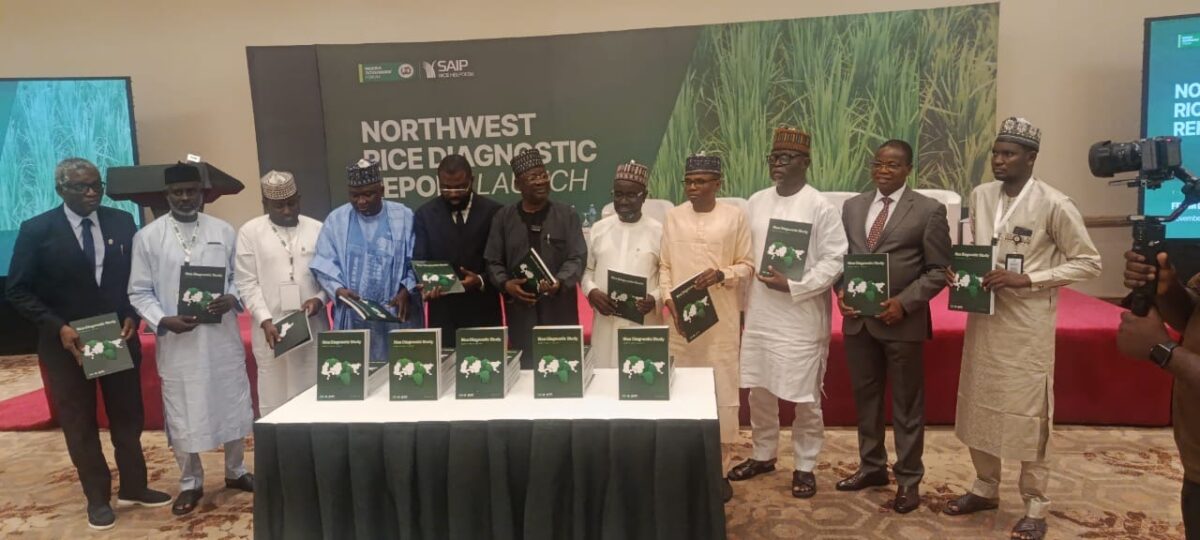
Director-General of the NGF, Dr Abdulateef O.T. Shittu, disclosed this at the launch of the Northwest Rice Diagnostic Report, organised in collaboration with the Nigeria Governors’ Forum and the SAIP Rice Help Desk.
Shittu said Nigeria had the land, human and material resources required to become a major rice producer and net exporter but needed to address the challenges affecting the agricultural value chain.
He noted that Nigeria consumes about 8.6 million metric tonnes of rice annually but produces only 3.3 million metric tonnes, creating a significant gap between domestic production and consumption.
According to him, the country’s rice consumption is projected to increase to 9.1 million metric tonnes next year, making it imperative to strengthen local production.
The NGF DG said, “There are a lot of policy flip-flops, policy mismatch, and quite a number of other challenges that we’ll all have to address.”
He stressed that the challenges were surmountable if governments and stakeholders committed themselves to finding practical solutions.
Shittu identified data as particularly critical to agricultural planning and development, noting that the absence of reliable information could undermine efforts to address challenges in the sector.
He disclosed that the NGF had established a dedicated department for data to support the collection and analysis of information across different sectors.
He also said the forum had encouraged every state in the country to establish its own State Bureau of Statistics to generate reliable data at the grassroots level.
According to him, accurate information generated by state governments would contribute to credible national statistics and help address discrepancies in figures being circulated by development partners.
The NGF DG further disclosed that the forum had established a committee of practice comprising heads of State Bureaux of Statistics, which meets quarterly to discuss data-related challenges and share experiences.
He added that the forum also provides platforms for commissioners of agriculture to exchange ideas and identify solutions to challenges affecting agricultural development.
Shittu said the NGF had recently signed collaborations with the International Institute of Tropical Agriculture (IITA) to deepen engagement and interventions in the agricultural sector.
He also highlighted the establishment of the NGF Academy and Leadership Centre as part of efforts to strengthen capacity development across different sectors.
On agricultural financing, the Managing Director of the Bank of Agriculture, Ayodeji Oludare Sotinrin, said the bank was expanding its support to farmers through input financing and partnerships with aggregators.
He disclosed that the bank financed 25 aggregators during the previous wet season, who provided input financing to more than 500,000 farmers.
Sotinrin said the bank was targeting at least 700,000 farmers in the current wet season.
He explained that the bank had moved away from direct cash disbursements to farmers, opting for input financing to improve accountability and address the problem of loan defaults.
He also disclosed that the bank was developing a guaranteed minimum price arrangement for rice and other commodities to protect farmers against market uncertainties.
Similarly, the Director-General of the Rice Processors Association of Nigeria (RIPAN), Dr Andy Ekwelem, identified poor farmer identification, unreliable data, insecurity and high energy costs as challenges affecting rice production.
Ekwelem said the country needed to identify genuine farmers, ensure the distribution of certified seeds and agricultural inputs, and strengthen extension services to improve productivity.
He also called for a security framework to protect farmers in major rice-producing communities, particularly in the Northwest.
The RIPAN DG said insecurity was affecting access to paddy by rice processors, while high energy costs were making it difficult for local mills to compete with imported rice.
Meanwhile, the Kebbi State Commissioner for Agriculture, Hon. Shehu Muazu, called for the harmonisation of agricultural data collection methods to address discrepancies in production figures.
He argued that some existing data collection methods failed to capture commercial farmers and farmers in remote communities, resulting in figures that did not accurately reflect agricultural activities.
Muazu urged stakeholders to adopt common data collection standards to ensure that information generated at state and national levels was reliable.
He also announced plans to establish a dedicated rice desk, provide adequate staffing and budgetary support, and convene a state rice stakeholders’ summit to develop a four-year development plan for the sector.
We’ve got the edge. Get real-time reports, breaking scoops, and exclusive angles delivered straight to your phone. Don’t settle for stale news. Join LEADERSHIP NEWS on WhatsApp for 24/7 updates →
Join Our WhatsApp Channel