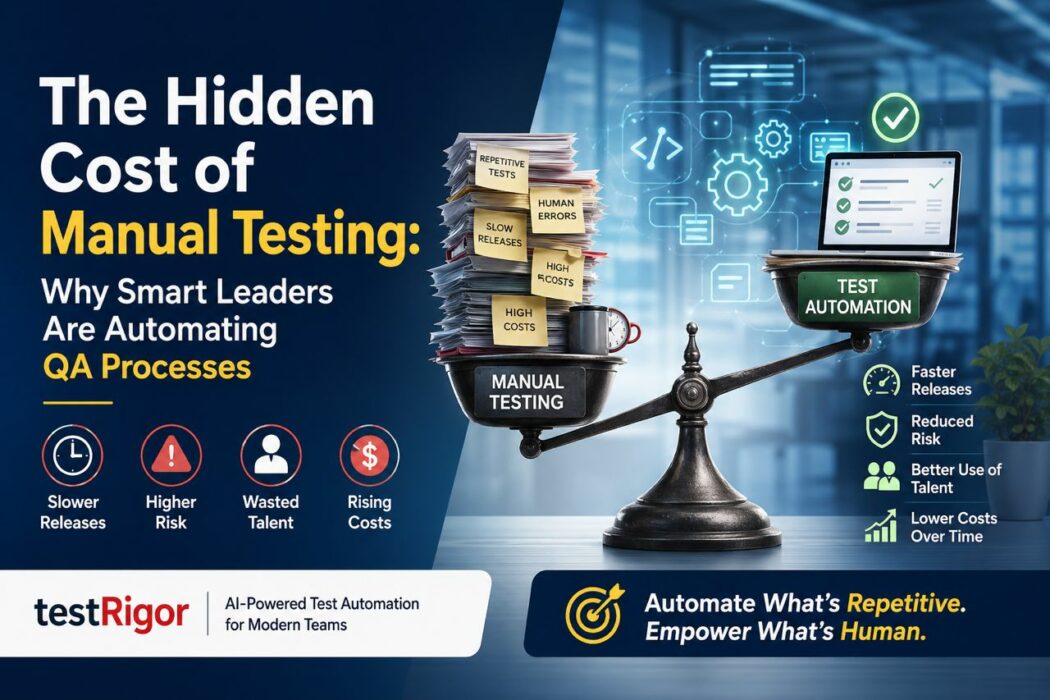
The Hidden Cost of Manual Testing: Why Smart Leaders Are Automating QA Processes
Every quarter, finance teams closely review staff numbers, software licenses, and cloud costs. But there’s one expense that gets overlooked in board meetings. One that’s quietly eating away at development budgets.
That’s manual testing.
That’s not to say that manual testing is wrong. It’s necessary. But many companies still do it the old way, with one person repeating the same test case hundreds of times.
That would have been enough for the slower software development processes of the past. But the software industry is evolving rapidly today. As a result, many teams realize too late that relying on traditional manual testing instead of modern testing automation tools like testRigor is becoming a major financial burden.
Some Points that the Numbers Don’t Tell
According to statistics, the global software testing market is expected to reach $84.42 billion by 2030. This growth may sound like a huge success story. But there are some unpleasant truths that no one tells about these numbers.
Even today, about 48% of companies rely on manual testing as their primary testing method. When new updates are released every week, sometimes every day, manual testing becomes a big obstacle. When you keep on testing the same features back to back, you cannot discover bugs on time. Gradually, you fail to meet deadlines.
According to a 2025 industry analysis published in ResearchGate, an estimated $3.1 trillion is lost in the United States alone due to poor software quality. This includes software failures, technical debt, and risks from agentic AI systems.
This is not just a quality assurance (QA) issue. It is a major business crisis. It is a major challenge for decision makers who see testing as a mere formality rather than a strategic issue.
Where is the Mistake
Manual testing costs money in four main ways. The truth is that business leaders often don’t see these as interconnected issues:
- Teams’ Time is Wasted: Manual testing is the biggest time consumer in the testing process. Having to repeat hours of testing every time a small change is made slows down development speed.
- More Errors: No matter how good a tester is, they can lose focus when they’re testing the same feature for an infinite number of times. Human fatigue and workload can cause small errors to go unnoticed. As software becomes more complex, these lapses can become major risks.
- Misuse of Talent: The real talent of a good QA engineer lies in risk analysis and strategically identifying system flaws. Having such professionals repeat the same scripts day after day is a misuse of their talent. In short, instead of doing expert-level work, they are repeating the tasks that could be automated.
- Delayed Fixes: The success of testing today lies in how quickly it delivers results. It takes days to get the issues identified through manual testing fixed. It costs more to fix a problem after it is released (production) than to find it during the development phase.
Automation: Technical Decision or Leadership Decision
Manual testing not only slows down current work. As AI continues to evolve, manual testing becomes a huge liability for the future. It makes it difficult to move to new technologies later, increases risk in releases, and causes talented employees to leave. By the time a CTO realizes that change is inevitable, the cost of doing so has already been incurred.
Wise leadership anticipates this. The world quality report indicates that 71% of organizations have already adopted generative AI in enhancing test automation. In the end, automation is not just a technical choice. It is a leadership decision based on priorities, timing, and long-term vision.
Example: Change Made a Big Difference
Take a mid-sized fintech company that runs a mobile banking app. Their 8-person QA team was struggling to keep up with the new updates that came out every two weeks. It took them four days to just check if the old features were working correctly (regression testing). They were forced to have a code freeze period for a few days before each release because they were unsure of the reliability of the system.
However, the situation changed when they adopted a test automation tool and implemented a proper automation method. They were able to complete the testing that used to take four days in just four hours. The scope of testing increased. Best of all, developers could submit their changes with confidence, because they knew that every change would be tested automatically immediately.
This not only accelerated the pace of releases. It also allowed them to avoid an outdated code freeze. Such restrictions were actually a lack of confidence in the quality of their own system. With that obstacle removed, the team hired two more developers.
Manual vs. Automated Testing: A Comparison
| Aspect | Manual Testing | Automated Testing |
| Speed | Takes days for each cycle | Done in minutes or hours |
| Repeatability | Results may vary each time | Consistent and reliable every time |
| Coverage | Limited by team size | Can scale with codebase |
| Initial Cost | Low | Medium investment required |
| Long-Term Cost | High (needs more people over time) | Reduces over time |
| Best For | Exploratory testing, UX, usability | Regression, smoke, integration tests |
| CI/CD Integration | Difficult to implement | Easy to integrate into pipelines |
This comparison doesn’t mean that manual testing should be eliminated. Exploratory testing, user experience (UX) evaluation, and critical thinking testing still require skilled humans. The goal is to leave to automation what can be automated, so that humans can use their skills better.
A Key Truth Business Leaders Need to Realize
Automation is not a cost-cutting tactic.
When implemented properly, automation is a way to increase profitability. When you can confidently release new features every week instead of every month, the gap between development and the service your customers receive is reduced. Features that used to take four weeks to secure a release can now be delivered to the market in a few days. This is not a testing metric, but a time-to-market metric. It helps you stay ahead of the competition in the marketplace.
According to the World Quality Report 2024-25, approximately 21% of a company’s IT budget is spent on testing and quality assurance. When this investment is solely for manual testing, its success is measured by how many bugs are found. But when it is automated, success is measured by how quickly new releases are made possible, how much time developers are saved, and how much customer trust is maintained.
Therefore, visionary leaders today are not asking, “How can we automate testing?” but rather, “With this seamless quality assurance, what else can we do in the future that we can’t do now?”
What are the Practical Steps to Begin the Shift
Companies that continue to operate in the traditional path don’t have to change everything all at once. Let’s do it step by step:
- Start with Repetitive Tasks First: Automating tasks that need to be done over and over again is the most cost-effective way to achieve results faster.
- Understand the Current Situation: Before starting a new method, we should accurately measure how much time it currently takes and how many errors are occurring. Only then will we be sure of how beneficial the new change will be.
- Set Priorities: We need to first decide what our goals are. It could be for a month or a year. We need to stick to those goals and move forward.
- Involve Employees: Don’t just see this as a technical change. Allow your employees to learn new concepts and make them a part of this change. Only then will it be successful.
Core Message
The downsides of manual testing are delayed releases, bugs, and overwhelmed teams. Holding on to traditional testing methods degrades your team’s capabilities.
The world is changing. The automation testing market is projected to reach USD 92.45 billion by 2030. Many companies are already embracing this shift.
The question is not whether to automate QA or not. It’s how much it will cost your organization when you delay the transition. Because continuing only with the traditional testing will become a huge liability for your business at every step.
We’ve got the edge. Get real-time reports, breaking scoops, and exclusive angles delivered straight to your phone. Don’t settle for stale news. Join LEADERSHIP NEWS on WhatsApp for 24/7 updates →
Join Our WhatsApp Channel