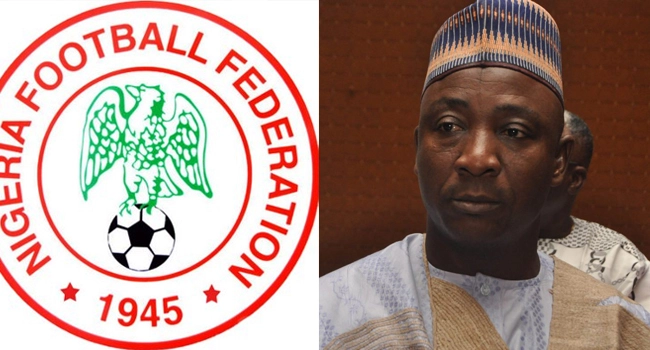
It was meant to be a new dawn. When Ibrahim Musa Gusau assumed the presidency of the Nigeria Football Federation (NFF) in September 2022, there was cautious optimism that Nigerian football—once the pride of the continent—would be restored to its former glory. Nearly four years later, that optimism has evaporated, replaced by a stench of financial scandal, unprecedented sporting humiliation and the mass resignation of the federation’s entire leadership. In this special report, SALIFU USMAN and AFFA ACHO examine how Nigerian football was driven to this precipice—and at what cost.
On Thursday, 27 August 2026, Gusau walked into a press conference at the NFF Secretariat in Abuja and dropped the bombshell: he announced his resignation and that of the General Secretary, Dr Mohammed Sanusi, with immediate effect, after three years and 11 months in office. Before then, seven members of the board had resigned from their positions. The Sunday Dankaro House had crumbled, but the resignations did little to quell the outrage.
The collapse of the Ibrahim Musa Gusau-led NFF administration exposed a football system weighed down by poor results, persistent welfare disputes, governance concerns and questions over financial accountability.
His departure came only 34 days before the end of his four-year tenure and after pressure intensified following Nigeria’s failure to qualify for the 2026 FIFA World Cup and, more dramatically, the Super Falcons’ failure to reach the 2027 Women’s World Cup.
The National Sports Commission (NSC) has since moved to reset the system, with the NFF electoral process for the September 27 Elective Congress suspended and the leadership of the country’s major domestic leagues ordered to hand over their responsibilities. A new electoral process is expected after a comprehensive reform programme involving the government, FIFA, CAF and other stakeholders.
For a country that regards football as its biggest sporting passion, the crisis is about much more than two failed World Cup qualifications. It is a story of an institution that struggled to translate its enormous football resources, talent and public investment into consistent international success and a properly functioning domestic football ecosystem.
The World Cup failures that broke the dam
The most visible evidence of the crisis is on the pitch. Nigeria’s failure to qualify for the 2026 FIFA World Cup was already a major blow. The expanded tournament featured 48 teams, yet the Super Eagles were unable to secure one of Africa’s places.
The final disappointment came in the African play-offs, where Nigeria lost to the Democratic Republic of Congo on penalties after failing to secure automatic qualification earlier in the campaign.
Then came an even more damaging blow. The Super Falcons, Africa’s most successful women’s national team, failed to qualify for the 2027 Women’s World Cup after losing 2-1 to South Africa in an intercontinental play-off. It ended Nigeria’s uninterrupted participation in every edition of the Women’s World Cup since the competition began in 1991.
The significance of that failure cannot be overstated. Nigeria has traditionally treated qualification for the Women’s World Cup as almost automatic. The Falcons’ record, alongside their dominance in African women’s football, made their absence from the global tournament particularly embarrassing.
The failures were not limited to the senior teams. Nigeria’s under-20 side also failed to qualify for the next Africa U-20 Cup of Nations, while the Golden Eaglets have struggled to regain their place among the continent’s leading youth sides. The pattern suggested something deeper than individual coaching failures.
When several national teams begin to miss major competitions, questions inevitably shift from the players and coaches to the structure responsible for identifying talent, preparing teams, funding camps, organising competitions, and creating a coherent technical pathway. That is where the Gusau administration became increasingly vulnerable to criticism.
A welfare crisis that refused to disappear
Perhaps nothing illustrated the NFF’s administrative weaknesses more vividly than the recurring disputes over unpaid allowances, bonuses and other entitlements.
In November 2025, the Super Eagles players and officials reportedly boycotted training in Morocco over unpaid bonuses and allowances ahead of their crucial World Cup play-off campaign. A national team preparing for a decisive international fixture should be discussing tactics, fitness and opposition analysis. Instead, Nigeria repeatedly found itself dealing with payment disputes.
The problem also extended to the youth teams. In April 2026, members of the 2023 and 2025 Flying Eagles squads reportedly complained about outstanding qualification bonuses and camp allowances covering several tournaments and extended periods in camp.
Players who represent the country are expected to give their all in the national shirt, but administrators must also demonstrate that agreements will be honoured. Repeated payment disputes undermine confidence in the system and create distractions at precisely the moments when teams need stability. The issue became even more serious when questions arose over the utilisation of a Federal Government intervention fund.
The N12bn question
At the heart of the NFF crisis lies a staggering question: what happened to billions of naira in public funds meant for the players? Anti-graft agencies—the Economic and Financial Crimes Commission (EFCC) and the Independent Corrupt Practices and Other Related Offences Commission (ICPC)—have opened investigations into the NFF’s handling of Federal Government intervention funds.
N12 billion approved by President Bola Tinubu in January 2024 was specifically disbursed to clear outstanding bonuses and allowances owed to players across various national teams—payments that had been withheld for more than 15 months.
The Economic and Financial Crimes Commission (EFCC) has confirmed that its investigation into the utilisation of a Federal Government intervention fund released to the NFF is ongoing. However, no individual should be declared culpable simply because his or her name is associated with an investigation. The proper authorities must establish the facts and determine whether any wrongdoing occurred.
But the very existence of the investigation has intensified the demand for transparency in an organisation that manages significant public and football-development resources.
EFCC spokesman Dele Oyewale confirmed to LEADERSHIP on Thursday that the investigation is “ongoing” and that some officials linked to the funds have already been invited for questioning. “Investigation is ongoing on the matter,” Oyewale stated, making it clear that the mass resignations will not derail the probe.
Allegations of deeper institutional problems
The concerns go beyond the intervention fund. A fact-finding committee established by the Gusau-led NFF to examine the failures of the national teams reportedly identified allegations that some board members, management staff and coaches could have received incentives to influence national-team invitations.
The committee did not name individuals or present the allegations as established facts. Instead, it recommended mechanisms to verify the claims before any action was taken.
The report also raised concerns about unequal payments to members of national-team delegations, including claims that players and officials could remain unpaid while other members of the delegations received their entitlements. Even as allegations, such claims strike at the heart of football administration.
Selection for a national team must be based on sporting merit. If players begin to believe that access to the national team can be influenced by money or connections, the credibility of the entire system is threatened.
More troublingly, former international Fanny Amun, who chaired the NFF fact-finding committee, said Gusau did not honour the committee’s invitation. That episode raised questions about the willingness of the federation’s leadership to confront difficult issues within its own structure.
Stakeholders react
The resignations have triggered a flood of reactions from football stakeholders—and the consensus is clear: resignation is not enough.
Tolu Ogundeji, a Lagos-based sports marketing consultant, who spoke to LEADERSHIP Sports by phone, said: “What Gusau and his team have done in just four years is nothing short of sabotage. We missed two World Cups—two!
“The old guards must go—all of them. We need fresh blood, young administrators who understand modern football economics, not these political jobbers who see the NFF as a retirement package. If we recycle these people, we will be having this same conversation in another four years.”
For his part, an Abuja-based football coach, Mohammed Bello, placed the blame squarely on financial recklessness.
“How do you expect a coach to succeed when players are owed 18 months of bonuses? The ₦12 billion under investigation is not just money; it is the dreams of our children.”
Bello demanded that the anti-graft agencies go beyond mere invitations.
“The EFCC must not just invite them for tea. We need arrests, prosecutions and jail time if the evidence is there. Let this serve as a deterrent for the next set of people who think Nigerian football is a cash cow.”
Mrs Florence Eze, a women’s football advocate, said the most painful casualty of the Gusau years is the women’s game.
“I am heartbroken. The Super Falcons missed the 2027 World Cup—our first absence since 1991. Do you understand what that means? A generation of young girls now has no Nigerian heroines to look up to on the global stage. The Falcons were the gold standard. Gusau’s board treated them like an afterthought.”
She called for a forensic audit of all funds earmarked for women’s football.
“Where is the FIFA Forward money meant for the women’s game? Where are the allowances for the Falconets? These are not rhetorical questions. Nigerians deserve receipts.”
Barrister Chidi Okoro, an Abuja-based lawyer, offered a sobering legal perspective on the mass resignation.
“Resigning does not confer immunity. Sections 98 and 315 of the EFCC Act are very clear—criminal liability survives resignation. If the EFCC finds evidence of embezzlement or diversion of public funds, they can still prosecute Gusau and his board members even if they are no longer in office. In fact, the resignation might work against them; it suggests a consciousness of guilt.”
Okoro urged the National Sports Commission not to rush the reform process.
“Do not appoint another caretaker committee of politicians. Appoint technocrats—accountants, sports economists and retired international players with integrity. Let them run the NFF for one year while we fix the statutes.”
Gusau’s ‘achievements’
A fair assessment of the Gusau era must acknowledge that the administration did not fail in every area.
Gusau has pointed to several achievements, including the expansion of coaching education, progress in refereeing, infrastructure development and improved domestic league administration.
The NFF also returned Nigeria to the CAF A-Licence coaching convention after years away, while CAF B and C coaching programmes were conducted during the administration.
The federation also embarked on the construction of a 68-room players’ hostel and new training pitches at the Moshood Abiola National Stadium in Abuja. The project includes two new pitches, reconstruction of an existing synthetic pitch, dressing rooms and spectator terraces. These are meaningful projects.
Gusau can also point to Nigeria’s silver and bronze medals at the 2023 and 2025 Africa Cup of Nations, respectively, and the Super Falcons’ WAFCON 2024 triumph in Morocco, as successes during his tenure.
The problem, however, is that infrastructure projects and isolated successes could not disguise the widening gap between Nigerian football’s potential and the quality of its administration.
A chance to rebuild
The collapse of the Gusau administration should not be treated merely as another change of leadership. It should be used to confront the structural weaknesses that have repeatedly dragged Nigerian football backwards.
Former chairman of the Gombe State Football Association and grassroots sports promoter, Ahmed Shuaibu Gara Gombe, said that unless Federal Government Decree 101 is abolished and gives way to private management of Nigerian football, no meaningful results will be achieved.
He insisted that the problem with football in Nigeria is institutional deficiencies, not leadership.
“The removal of Gusau will not solve the problem in Nigerian football. Until we abolish Government Decree 101, nothing will be achieved in our football. Why should the government run football? All the taxpayers’ money appropriated for football is unaccounted for. We are just joking, not ready to fix our football,” Gara declared.
Meanwhile, President Bola Tinubu has ordered a comprehensive reform of Nigerian football following Gusau’s resignation, saying the exercise should address longstanding weaknesses in governance, administration, stakeholder representation, development pathways, domestic competitions and accountability.
That directive reflects the scale of the problem. The answer cannot simply be to replace Gusau with another president and retain the same structures.
We’ve got the edge. Get real-time reports, breaking scoops, and exclusive angles delivered straight to your phone. Don’t settle for stale news. Join LEADERSHIP NEWS on WhatsApp for 24/7 updates →
Join Our WhatsApp Channel