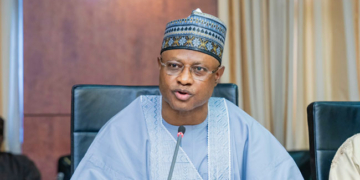
The chairman, Board of Trustees (BOT) of the Centre for Transparency Advocacy, Dr. Chima Amadi, yesterday said economic remedies from the International Monetary Fund (IMF) and the World Bank cannot revive the Nigerian economy.
He also said the policies of the two international financial institutions may not be able to raise 200 million Nigerians out of poverty.
He asked the nation to look beyond ideas being imposed by developed countries.
He said developing countries should have the autonomy to choose policies that best suit their conditions.
Amadi, who made the submissions at the 4th National Colloquium in Sokoto, said the nation’s high inflation rate was indefensible.
He said: “Compared with other African and Asian countries, especially Indonesia, which is comparable to Nigeria in most respects, economic development in Nigeria has been disappointing.
“With GDP of about $45 billion in 2001 and per capita income of about $300 a year, Nigeria has become one of the poorest countries in the world. As of 2000 it had earned about $300 billion from oil exports since the mid-1970s, but its per capita income was 20 percent lower than in 1975.
“Meanwhile, the country has become so heavily indebted – external and domestic debt amount to about 70 percent of GDP— that it has serious difficulty servicing debts. Regional and sectoral unevenness in growth performance is high.
“From the foregoing, it is simply clear that to raise 200 million Nigerians out of poverty as this current administration has resolved to do within the next decade, it would take more than just making it a campaign mantra but a radical departure from economic orthodoxy of the Global North evinced in the Washington Consensus model.”
Amadi, who is a doctoral fellow at the University of Warwick in the UK, said economic growth strategies recommended by developed countries for developing nations are unworkable.
He said the developed countries had been promoting strategies which they had never practiced.
He added:” Historical context of development shows that many of today’s developed countries such as the United Kingdom and the United States achieved economic growth through strategies like tariffs, subsidies and regulations to protect their nascent industries. This historical perspective contrasts sharply with the free-market liberalisation policies they now promote for developing countries.
“The neoliberal policies advocated by institutions like the World Bank and the International Monetary Fund (IMF) such as rapid liberalisation of trade and investment, privatization and deregulation are not consistent with the historical experiences of successful development.
“In fact, these policies might even hinder the growth of developing nations by exposing them prematurely to global competition,” he added.
He said the federal government should adopt subsidies and other forms of intervention to save the economy.
Amadi said: “The state must play a significant role in guiding economic development similar to the way it was utilised by now-developed countries during their own developmental stages.
“This includes the use of tariffs, subsidies and other forms of government intervention to support budding industries. Shall we forget hastily how former president Donald Trump used tariffs to effectively protect the American economy from the onslaught of the Chinese trade practices?
“Developing countries should have the autonomy to choose policies that best suit their unique economic conditions and developmental stages. This contrasts with the one-size-fits-all approach often prescribed by international economic organizations.
“By providing this historical and critical analysis, I dare Nigeria’s leaders and economic policymakers to not be afraid to challenge conventional economic wisdom and call for a more nuanced and historically informed approach to economic development policy, especially for developing countries.
“There is now an urgent need for policy diversity and experimentation, making it incumbent on policymakers to acknowledge that strategies successful in one country
may not be universally applicable.”
On the nation’s high inflation rate, Amadi blamed it on over-reliance on oil revenue.
He added; “Inflation in Nigeria has been a complex and challenging issue throughout its history. The nation’s heavy reliance on oil revenues, inadequate diversification of the economy, policy mismanagement, and global economic dynamics have all played significant roles in shaping inflation trends.
“Before Nigeria gained independence in 1960, the country’s inflation rate was relatively low, primarily due to its agrarian economy and limited industrialization.
“ The 1970s marked a period of rapid economic growth fueled by oil exports, which led to a significant increase in government revenue. However, this period also witnessed rising inflationary pressures as the influx of petrodollars and increased government spending drove consumer demand and importation.
“The 1970s oil boom brought immense wealth to Nigeria, but it also led to
economic imbalances. The nation became heavily reliant on oil exports, leading to a neglect of other sectors and creating vulnerabilities to oil price fluctuations.
“In the late 1970s and early 1980s,
Nigeria experienced double-digit inflation, soaring to a peak of over 23% in 1984. The
government’s mismanagement of fiscal policies and its inability to diversify the economy contributed to this inflation surge.”
We’ve got the edge. Get real-time reports, breaking scoops, and exclusive angles delivered straight to your phone. Don’t settle for stale news. Join LEADERSHIP NEWS on WhatsApp for 24/7 updates →
Join Our WhatsApp Channel