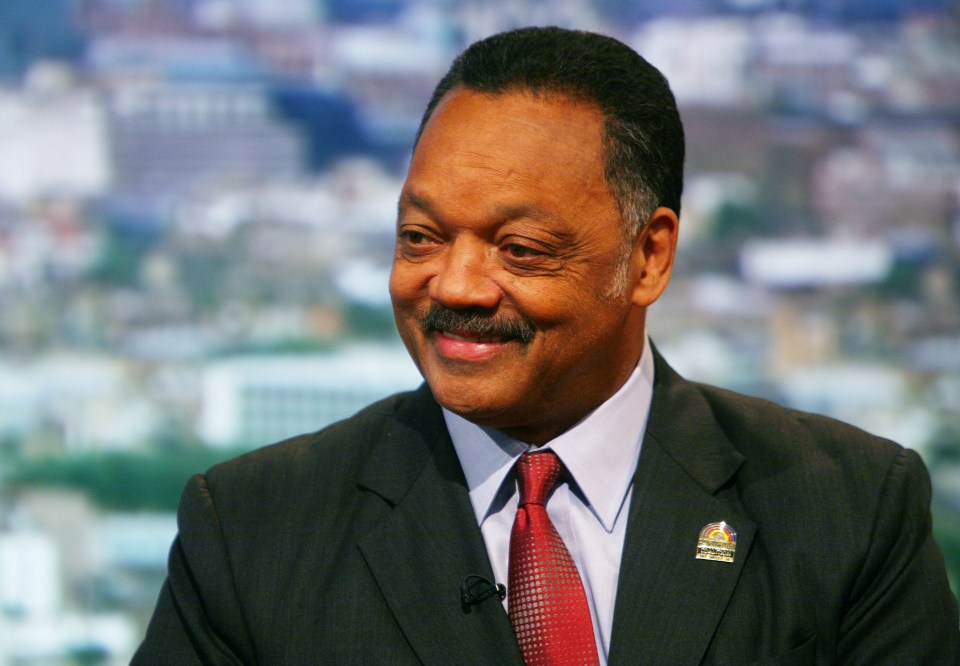
There is a photograph burned into the memory of anyone who watched Barack Obama win the presidency on that November night in 2008. Jesse Jackson, standing in the crowd at Grant Park in Chicago, tears streaming down his face not weeping from sadness, but from the weight of a lifetime of struggle finally, partially, redeemed.
That image said more about Jesse Jackson than any biography could. He had spent six decades fighting for a moment he was not certain he would live to see. And when it came, he wept like a man who had carried something unbearably heavy for a very long time and was only just allowed to put it down.
Jackson died on February 17, 2026, at 84, having battled Parkinson’s disease since 2017. He leaves behind a movement, a legacy and an America that is still, frankly, arguing about the very things he devoted his life to resolving.
The tributes have been appropriate to the scale of the man. Barack Obama said he stood “on his shoulders.” United States president, Donald Trump called him “a force of nature.” Kamala Harris described him as “one of America’s greatest patriots.”
President Bola Tinubu,who as a young man in Chicago watched Jackson battle discrimination in the very streets where he would later fight his own battles, described him as a moral force who “kept hope alive” for Black America and Africa alike. These are not the usual political courtesies that accompany death. They are acknowledgements that something rare has departed the earth.
Jackson’s greatness was not accidental. He was shaped in the furnace of the American civil rights movement, working alongside Martin Luther King Jr. and James Bevel when that work could get you killed. He absorbed the discipline, the theological grounding, the moral seriousness of that generation. But he also possessed something peculiarly his own, a gift of the garb, for language, for theatre, for converting outrage into political energy. “Keep hope alive” was not a slogan. It was a theology. And for millions of Black Americans navigating a society that seemed structurally committed to their diminishment, it was also a lifeline.
His two presidential campaigns in 1984 and 1988 are worth pausing on, because history has a tendency to flatten their significance. He ran first as a protest candidate, dismissed by the political establishment as unelectable theatre. He finished third in 1984. He finished second in 1988, winning primaries, amassing delegates, forcing the Democratic Party to reckon with a constituency it preferred to take for granted. He did not win. But he cracked something open. Twenty years before Obama walked into the White House, Jackson had already demonstrated that a Black man could mount a serious, sustained campaign for the American presidency and not be laughed out of the room. Obama himself acknowledged this directly. “He laid the foundation for my own campaign to the highest office of the land,” Obama said. That is not a small thing. That is history.
For Nigeria and Africa, Jackson’s significance carries a different but equally substantial weight. He visited Nigeria multiple times ;in 1986 condemning American policy toward apartheid South Africa, in 1994 during the turbulent years of military rule, in 1998 and 1999 as a Presidential Special Envoy working to consolidate the transition to civilian democratic governance. At a time when Nigeria’s democracy was fragile and the international community’s attention was inconsistent, Jackson kept the pressure on.
Tinubu’s tribute noted that Jackson “inflicted the cracks” in America’s racial glass ceiling before Obama shattered it. That phrase deserves to be remembered. Crack-inflicting is harder work than shattering. It requires sustained effort against a surface that does not yield, that pushes back, that injures the one striking it. Jackson bled against that ceiling for decades so that others could come along and finish the job.
What should his passing mean for us? Not just sorrow, though sorrow is warranted. Not just celebration of a life well-lived, though that too. But an honest reckoning with the fact that the work is unfinished in America, in Nigeria, across the African continent.
The racial hierarchies Jackson fought in the United States find their analogies in the class hierarchies, ethnic exclusions and governance failures that continue to blight Nigerian public life. The demand for dignity, for accountability, for a political system that serves the many rather than enriching the few these are not foreign importations. They are universal, and they were at the centre of everything Jackson stood for.
He wanted, as Tinubu rightly noted, for us to keep hope alive. Not naive hope, Jackson was too shrewd a political operator for sentimentality. But the disciplined, active, organised hope that shows up at polling stations, that challenges power when it becomes corrupt, that refuses to accept that things cannot be better than they are.
The dreamer has departed. The dream, unfinished, remains. And the question Jackson’s death puts before all of us in America, in Nigeria, everywhere is whether we have the stamina to carry it forward.
We’ve got the edge. Get real-time reports, breaking scoops, and exclusive angles delivered straight to your phone. Don’t settle for stale news. Join LEADERSHIP NEWS on WhatsApp for 24/7 updates →
Join Our WhatsApp Channel