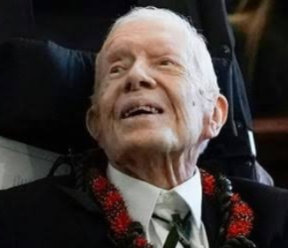
The passing of Jimmy Carter, America’s 39th president, at the remarkable age of 100, marks the end of an era that redefined what public service means in the modern world. His death on December 29, 2024, closes a chapter not just in American history, but in global humanitarian service, where a former president chose to leverage his post-presidency influence not for personal gain but for the betterment of humanity.
Carter’s journey from a peanut farmer in Plains, Georgia, to the White House, and subsequently to becoming one of the world’s most respected humanitarian figures, offers profound lessons about leadership, service, and the moral compass that should guide those in positions of power.
His life story challenges the conventional narrative that a president’s impact is measured solely by their years in the Oval Office.
While his single term as president (1977-1981) was often criticised and marked by challenges including the Iran hostage crisis and economic difficulties, it was his post-presidential life that truly distinguished him.
The Camp David Accords between Egypt and Israel stand as perhaps his greatest achievement in office, demonstrating his exceptional skills as a mediator and peacemaker – skills he would later employ globally through The Carter Center.
What sets Carter apart from other former presidents is his revolutionary approach to post-presidential life. Instead of following the traditional path of lucrative speaking engagements and corporate board positions, he chose a different route – one of active humanitarian service.
The establishment of The Carter Center in 1982 created a new model for how former leaders can contribute to society. Under his guidance, the Center became a powerful force in global health, democracy promotion, and conflict resolution.
His work in Africa, particularly in Nigeria, exemplifies this commitment. The Carter Center’s efforts to eradicate Guinea worm disease and river blindness have transformed countless lives. His historic visit to Nigeria in 1978, spending three days at the State House in Marina, Lagos, laid the foundation for a pragmatic U.S.-Africa relationship that transcended mere diplomatic niceties to address fundamental human needs.
The 2002 Nobel Peace Prize was more than just recognition of his humanitarian work; it was an acknowledgment that true leadership extends beyond the confines of political office. Carter demonstrated that the influence of a leader need not diminish upon leaving office – it can actually grow when directed toward humanitarian causes.
His involvement with Habitat for Humanity, building homes for the underprivileged, showed that no task was too humble for a former president if it served humanity.
Carter’s personal battle with cancer in 2015, which he faced with characteristic grace and transparency, further endeared him to the public. His recovery and continued service until his final years demonstrated the resilience that marked his entire life.
Becoming the longest-living former U.S. president was not just a testament to longevity but to a life lived with purpose and continuous engagement in meaningful causes.
His commitment to truth and morality in politics, particularly relevant in today’s era of political polarisation, sets a standard that current and future leaders would do well to emulate.
Carter showed that it’s possible to maintain moral integrity while navigating the complex world of international politics and humanitarian work.
As President Bola Tinubu noted in his tribute, Carter exemplified how to remain relevant and impactful after leaving high office. This is particularly significant in an age where former leaders often struggle to find meaningful roles that serve the greater good rather than personal interests.
His approach to post-presidential life has created a new paradigm for how former heads of state can contribute to society.
The world Carter has left behind faces many of the same challenges he worked to address – poverty, disease, conflict, and the need for stronger democratic institutions. His passing should serve as a call to action for current leaders to embrace his vision of servant leadership.
The measure of a leader, as Carter demonstrated, lies not in the power they wield while in office, but in how they use their influence to serve humanity throughout their lives.
As we bid farewell to this remarkable statesman, the best tribute we can pay is to continue his work. His legacy challenges us to view public service not as a stepping stone to personal advancement but as a lifelong commitment to improving the human condition.
In our view, the world needs more leaders who, like Carter, understand that true greatness lies not in the positions we hold but in the impact we have on others’ lives.
Jimmy Carter’s century-long journey from Plains, Georgia, to global humanitarian icon reminds us that the greatest legacy a leader can leave is not in the power they accumulated or the wealth they generated, but in the lives they touched and the positive change they brought to the world.
His life stands as a testament to the enduring impact one individual can have when guided by compassion, integrity, and an unwavering commitment to service.
We’ve got the edge. Get real-time reports, breaking scoops, and exclusive angles delivered straight to your phone. Don’t settle for stale news. Join LEADERSHIP NEWS on WhatsApp for 24/7 updates →
Join Our WhatsApp Channel