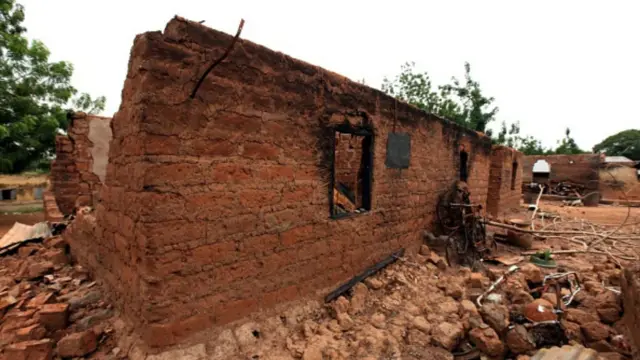
One hundred and sixty-two people are dead. Slaughtered in their own homes, in their own village, by extremists who had announced their intentions months in advance.
The massacre of residents of Woro and Nuku communities in Kaiama Local Government Area of Kwara State recently is a damning indictment of a security apparatus that, despite repeated warnings, failed to prevent a tragedy that was practically advertised.
Let us be clear about what happened. Jihadist militants, whether affiliated with Boko Haram or the Islamic State-linked Lakurawa faction, rode into these villages on motorbikes, armed with AK-47 rifles, explosives and pump-action weapons. They surrounded the communities, blocked exits, and for nearly 10 hours carried out a systematic execution of men, women and children whose only offence was refusing to submit to a perverted interpretation of their own faith. The attackers moved door to door.
They gathered young men, bound their hands, and shot them. They fired on motorists along a federal highway.
And when residents emerged after a brief lull caused by a military aircraft hovering overhead, the killers called people to a mosque under the pretence of prayers and murdered those who showed up. Soldiers arrived at 03:00, a full hour after the massacre ended. The attackers had already fled.
President Bola Tinubu has responded with what has become the standard Nigerian government playbook: condemnation of the attack in strong language, deployment of troops after the fact, and the establishment of a new military operation this time dubbed “Operation Savannah Shield.” The President described the gunmen as “heartless” and vowed they would “not go scot-free.”
Governor AbdulRahman AbdulRazaq, after briefing the President in Abuja, expressed confidence that the military would restore calm. These are appropriate responses, as far as they go. But they do not go nearly far enough, and Nigerians are right to ask why their government is perpetually in reactive mode when the evidence for proactive intervention was overwhelming.
Consider the timeline. Amnesty International reported that the attackers sent letters and pamphlets to Woro two weeks before the massacre. But that was not even the first warning. Five months earlier, the militants had written to the village head, informing him of their intention to preach in the community. The Ilorin council was notified. Soldiers were deployed to Woro. And then, inexplicably, they were withdrawn after a few weeks.
The final warning letter, delivered in January, was signed under Boko Haram’s formal name and referenced its leader in the Lake Chad Basin.
In our view, this was not a surprise attack. It was a scheduled atrocity, one that Nigeria’s security infrastructure watched approach with something between complacency and paralysis.
This pattern is not new. From the abduction of the Chibok schoolgirls in 2014 to the repeated massacres in Benue, Plateau, Niger, Katsina, Zamfara and Kaduna states over the past decade, the Nigerian state has demonstrated a consistent inability or unwillingness to act on intelligence before blood is spilled.
The country’s security agencies receive warnings, file reports, sometimes make initial deployments, and then move on to the next crisis, leaving communities exposed. The withdrawal of troops from Woro after a few weeks, despite credible and specific threats, captures this dysfunction with painful clarity.
The establishment of Operation Savannah Shield, while welcome, raises questions that the government must answer. Why does it take a massacre of over 160 people before a military battalion is deployed to an area where jihadist activity had been documented for months? The militants had been preaching in border villages across Niger State, openly encouraging residents to reject the Nigerian constitution. Their presence in the forests around the Borgu region was known to local officials. If this level of overt insurgent activity did not trigger a pre-emptive security response, then something is broken in the chain between intelligence gathering and operational decision-making.
The courage of the Woro and Nuku residents deserves recognition. These were Muslim communities that refused to be conscripted into an extremist ideology, choosing instead to practise their faith peacefully. They paid for that refusal with their lives.
The President was right to commend their stand. But commendation rings hollow when the state failed to protect them despite having every reason to know they were in danger.
Nigeria cannot continue to fight terrorism with post-massacre military deployments and strongly worded presidential statements. The country needs a security architecture that treats credible threats with the urgency they demand, one where a five-month warning from a terrorist group results in sustained military presence, not a temporary deployment that melts away when attention shifts.
Until that happens, Operation Savannah Shield and whatever operations follow it will amount to locking the stable door long after the horses have bolted.The 162 souls lost in Kaiama did not have to die. That is the most painful truth of all.
We’ve got the edge. Get real-time reports, breaking scoops, and exclusive angles delivered straight to your phone. Don’t settle for stale news. Join LEADERSHIP NEWS on WhatsApp for 24/7 updates →
Join Our WhatsApp Channel